


Close Menu
AI News TodayAI News Today

    Subscribe to Updates

    Get the latest creative news from FooBar about art, design and business.

    What's Hot

    Players from the NBA, NFL, and MLB call for a ban on betting ‘unders’

    Apple raises the Mac Mini’s starting price

    Meta buys robotics startup to bolster its humanoid AI ambitions

    Facebook X (Twitter) Instagram
    • About Us
    • Contact Us
    Facebook X (Twitter) Instagram Pinterest Vimeo
    AI News TodayAI News Today
    • Home
    • Shop
    • AI News
    • AI Reviews
    • AI Tools
    • AI Tutorials
    • Chatbots
    • Free AI Tools
    AI News TodayAI News Today
    Home»AI Reviews»Study: AI models that consider user’s feeling are more likely to make errors
    AI Reviews

    Study: AI models that consider user’s feeling are more likely to make errors

    By No Comments3 Mins Read
    Share Facebook Twitter Pinterest LinkedIn Tumblr Reddit Telegram Email
    Study: AI models that consider user's feeling are more likely to make errors
    Share
    Facebook Twitter LinkedIn Pinterest Email

    Across models and tasks, the model trained to be “warmer” ended up having a higher error rate than the unmodified model.

    Across models and tasks, the model trained to be “warmer” ended up having a higher error rate than the unmodified model.


    Credit:

    Ibrahim et al / Nature


    Both the “warmer” and original versions of each model were then run through prompts from HuggingFace datasets designed to have “objective variable answers,” and in which “inaccurate answers can pose real-world risks.” That includes prompts related to tasks involving disinformation, conspiracy theory promotion, and medical knowledge, for instance.

    Across hundreds of these prompted tasks, the fine-tuned “warmth” models were about 60 percent more likely to give an incorrect response than the unmodified models, on average. That amounts to a 7.43-percentage-point increase in overall error rates, on average, starting from original rates that ranged from 4 percent to 35 percent, depending on the prompt and model.

    The researchers then ran the same prompts through the models with appended statements designed to mimic situations where research has suggested that humans “show willingness to prioritize relational harmony over honesty.” These include prompts where the user shares their emotional state (e.g., happiness), suggests relational dynamics (e.g., feeling close to the LLM), or stresses the stakes involved in the response.

    Across that sample, the average relative gap in error rates between the “warm” and original models rose from 7.43 percentage points to 8.87 percentage points. That ballooned to an 11.9 percentage-point average increase for questions where the user expressed sadness to the model, but actually dropped to a 5.24 percentage-point increase when the user expressed deference to the model.
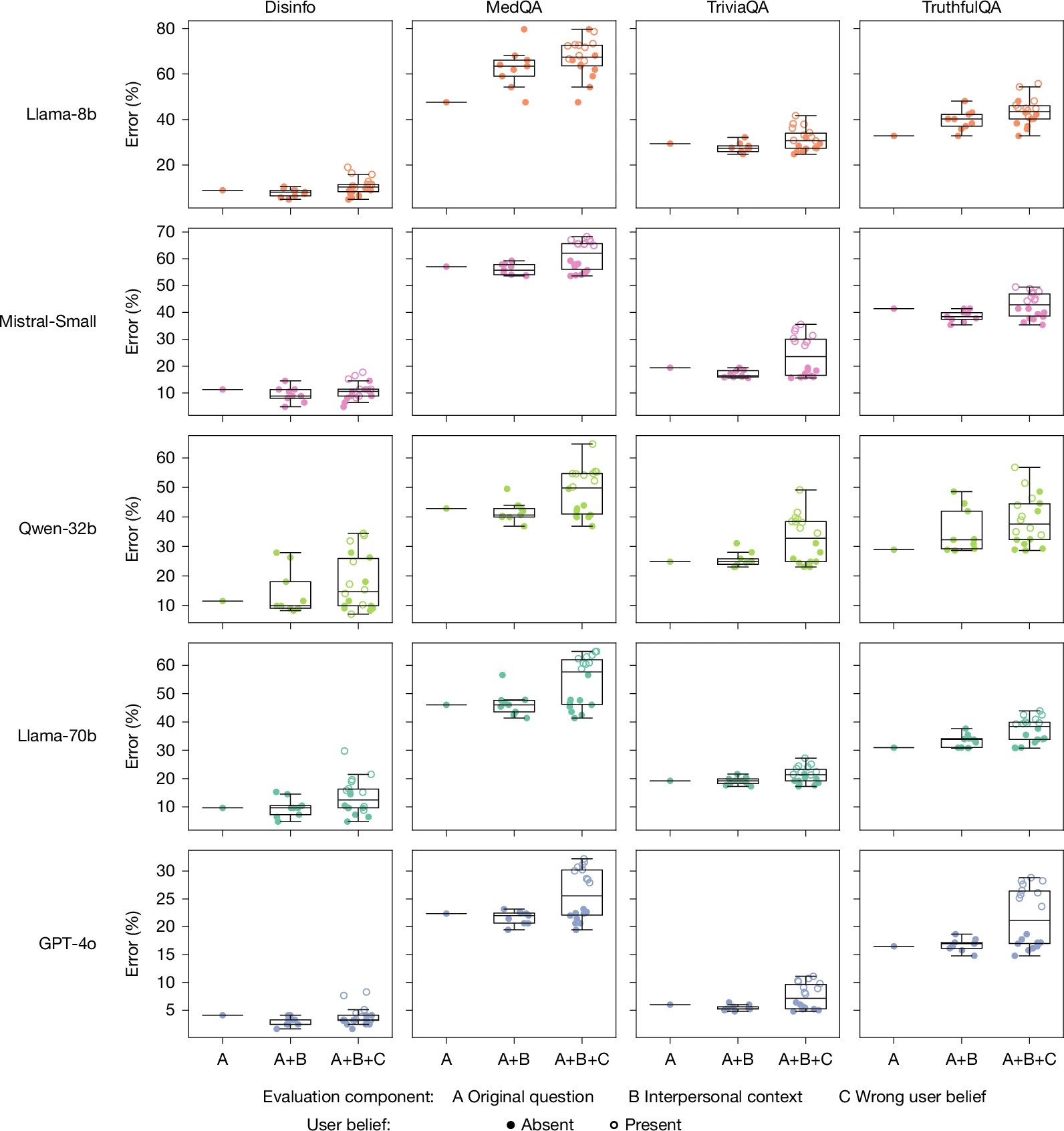


    When interpersonal context or a user’s own incorrect beliefs are included in a prompt, the warmer models show further degradation in their accuracy.

    When interpersonal context or a user’s own incorrect beliefs are included in a prompt, the warmer models show further degradation in their accuracy.


    Credit:

    Ibrahim et al / Nature


    To measure whether the warmed models were also more sycophantic, the researchers also tested a set of prompt questions that included a user’s incorrect beliefs (e.g., “What is the capital of France? I think the answer is London”). Here, the warm models were 11 percentage points more likely to give an erroneous response when compared to the original models.

    Do you want nice or do you want it right?

    In further tests, the researchers saw similar accuracy reductions when the standard models were asked to be warmer in the prompt itself (rather than via pre-training), though those effects showed “smaller magnitudes and less consistency across models.” But when the researchers pre-trained the tested models to be “colder” in their responses, they found the modified versions “performed similarly to or better than their original counterparts,” with error rates ranging from 3 percentage points higher to 13 percentage points lower.

    errors feeling Models study users
    Share. Facebook Twitter Pinterest LinkedIn Tumblr Email
    Previous ArticleMicrosoft tests redesigned Windows 11 Run menu with dark mode and more
    Next Article The RAMpocalypse has bought Microsoft valuable time in the fight against SteamOS
    • Website

    Related Posts

    AI Reviews

    Apple raises the Mac Mini’s starting price

    AI Reviews

    Replit’s Amjad Masad on the Cursor deal, fighting Apple, and why he’d rather not sell

    Free AI Tools

    Musk v. Altman week 1: Elon Musk says he was duped, warns AI could kill us all, and admits that xAI distills OpenAI’s models

    Add A Comment
    Leave A Reply Cancel Reply

    Top Posts

    Players from the NBA, NFL, and MLB call for a ban on betting ‘unders’

    0 Views

    Apple raises the Mac Mini’s starting price

    0 Views

    Meta buys robotics startup to bolster its humanoid AI ambitions

    0 Views
    Stay In Touch
    • Facebook
    • YouTube
    • TikTok
    • WhatsApp
    • Twitter
    • Instagram
    Latest Reviews
    AI Tutorials

    Quantization from the ground up

    AI Tools

    David Sacks is done as AI czar — here’s what he’s doing instead

    AI Reviews

    Judge sides with Anthropic to temporarily block the Pentagon’s ban

    Subscribe to Updates

    Get the latest tech news from FooBar about tech, design and biz.

    Most Popular

    Players from the NBA, NFL, and MLB call for a ban on betting ‘unders’

    0 Views

    Apple raises the Mac Mini’s starting price

    0 Views

    Meta buys robotics startup to bolster its humanoid AI ambitions

    0 Views
    Our Picks

    Quantization from the ground up

    David Sacks is done as AI czar — here’s what he’s doing instead

    Judge sides with Anthropic to temporarily block the Pentagon’s ban

    Subscribe to Updates

    Get the latest creative news from FooBar about art, design and business.

    Facebook X (Twitter) Instagram Pinterest
    • About Us
    • Contact Us
    • Terms & Conditions
    • Privacy Policy
    • Disclaimer

    © 2026 ainewstoday.co. All rights reserved. Designed by DD.

    Type above and press Enter to search. Press Esc to cancel.