

Close Menu
AI News TodayAI News Today

    Subscribe to Updates

    Get the latest creative news from FooBar about art, design and business.

    What's Hot

    These are the first Nvidia RTX Spark laptops

    Escaping the Valley of Choice in BI

    Strava declares war on scrapers ahead of IPO

    Facebook X (Twitter) Instagram
    • About Us
    • Contact Us
    Facebook X (Twitter) Instagram Pinterest Vimeo
    AI News TodayAI News Today
    • Home
    • Shop
    • AI News
    • AI Reviews
    • AI Tools
    • AI Tutorials
    • Chatbots
    • Free AI Tools
    AI News TodayAI News Today
    Home»Chatbots»Gravitational lens shows a galaxy just 800 million years post-Big Bang
    Chatbots

    Gravitational lens shows a galaxy just 800 million years post-Big Bang

    By No Comments2 Mins Read
    Share Facebook Twitter Pinterest LinkedIn Tumblr Reddit Telegram Email
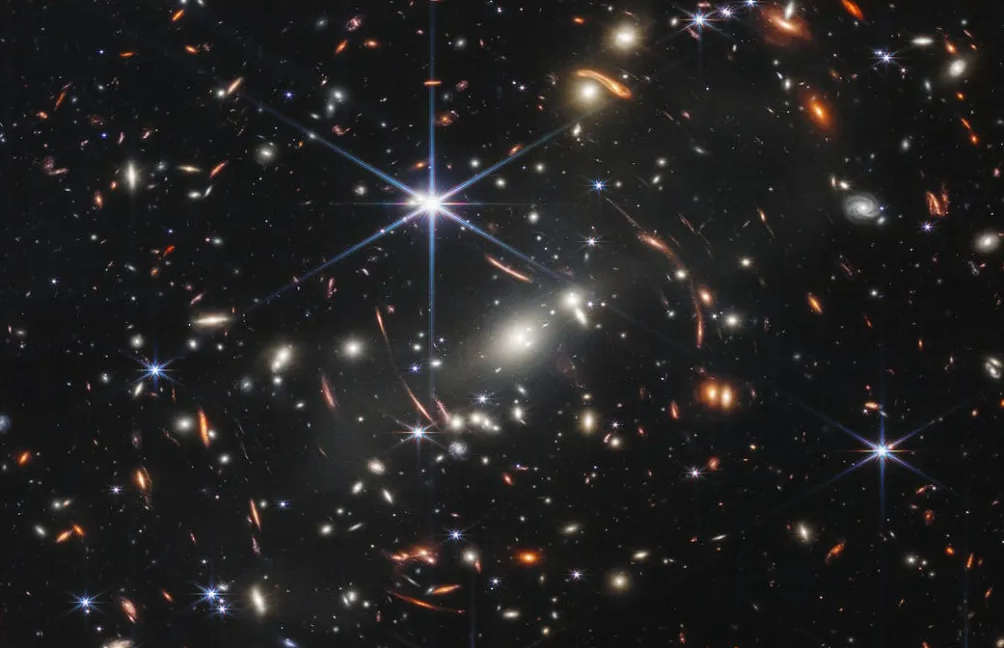
    Image of a field of stars and galaxies, with most of them distorted by a gravitational lens.
    Share
    Facebook Twitter LinkedIn Pinterest Email

    Despite being incredibly poor in heavy elements, LAP1-B has an unusually high amount of carbon; its carbon-to-oxygen ratio is higher than our Sun’s. The researchers think the answer might lie in how these massive first-generation stars died.

    According to our models, when a massive, Population III star reaches the end of its life, its core collapses into a black hole, but the resulting supernova explosion isn’t energetic enough to blow the entire star apart. “Their bounding energy of gravity is stronger that in the usual massive stars,” Nakajima said.

    Instead, the collapse results in a faint supernova with significant fallback, in which the heavier elements from the star’s core, such as oxygen, are sucked back past the event horizon and trapped in the black hole beneath. At the same time, the lighter outer layers, which are rich in carbon, escape and are expelled into the surrounding gas. LAP1-B’s chemical makeup, with low oxygen but elevated carbon, looks like a fingerprint of a gas cloud produced by Population III stars supernovae.

    But there was one other clue hidden in the gas in LAP1-B, and it was all about its speed.

    The dark matter

    By looking at how the emission lines in the spectrum were broadened by the Doppler effect, Nakajima and his colleagues measured that the gas is swirling around inside the galaxy at roughly 58 kilometers per second, a rather typical value for dwarf galaxies.

    Using the laws of gravity, the team calculated how much mass must be present to keep gas moving at that speed from flying off into intergalactic space. “We estimated the amount of material at 10 million solar masses,” Nakajima said.

    Because the stars account for less than 3,300 solar masses and the gas adds just a tiny bit more, the team concluded that the rest of the galaxy must be made up of dark matter.

    Bang Galaxy Gravitational lens million postBig shows years
    Share. Facebook Twitter Pinterest LinkedIn Tumblr Email
    Previous ArticleBlue Origin may need external funding to hit ambitious launch targets
    Next Article Anthropic courts a new kind of customer: small business owners
    • Website

    Related Posts

    Chatbots

    Strava declares war on scrapers ahead of IPO

    Chatbots

    An OpenAI model solved a famous math problem that stumped humans for 80 years

    Chatbots

    Unastella, a South Korean rocket startup that launched from home, raises $24M

    Add A Comment
    Leave A Reply Cancel Reply

    Top Posts

    These are the first Nvidia RTX Spark laptops

    1 Views

    Escaping the Valley of Choice in BI

    0 Views

    Strava declares war on scrapers ahead of IPO

    0 Views
    Stay In Touch
    • Facebook
    • YouTube
    • TikTok
    • WhatsApp
    • Twitter
    • Instagram
    Latest Reviews
    AI Tutorials

    Quantization from the ground up

    AI Tools

    David Sacks is done as AI czar — here’s what he’s doing instead

    AI Reviews

    Judge sides with Anthropic to temporarily block the Pentagon’s ban

    Subscribe to Updates

    Get the latest tech news from FooBar about tech, design and biz.

    Most Popular

    These are the first Nvidia RTX Spark laptops

    1 Views

    Escaping the Valley of Choice in BI

    0 Views

    Strava declares war on scrapers ahead of IPO

    0 Views
    Our Picks

    Quantization from the ground up

    David Sacks is done as AI czar — here’s what he’s doing instead

    Judge sides with Anthropic to temporarily block the Pentagon’s ban

    Subscribe to Updates

    Get the latest creative news from FooBar about art, design and business.

    Facebook X (Twitter) Instagram Pinterest
    • About Us
    • Contact Us
    • Terms & Conditions
    • Privacy Policy
    • Disclaimer

    © 2026 ainewstoday.co. All rights reserved. Designed by DD.

    Type above and press Enter to search. Press Esc to cancel.