

Craig Campbell walked away from the river of investor money flowing into AI to create, of all things, a website.
Sure, Campbell probably could have started an AI company. He’s a former engineer at Meta and an experienced tech founder who in 2022 sold his last venture — an e-commerce tool for businesses that use Shopify — right as the AI boom was booming. “I had my prior VC investors breathing down my neck, going ‘start something else. We’ll write you a blank check.’” He had other ideas.
People generally aren’t rushing to get into the website business, what with the Google Zero event horizon approaching. Campbell was undeterred and has grown his service — Past Maps — into a sustainable business. And he’s managed it in an increasingly unlikely way: via organic search.
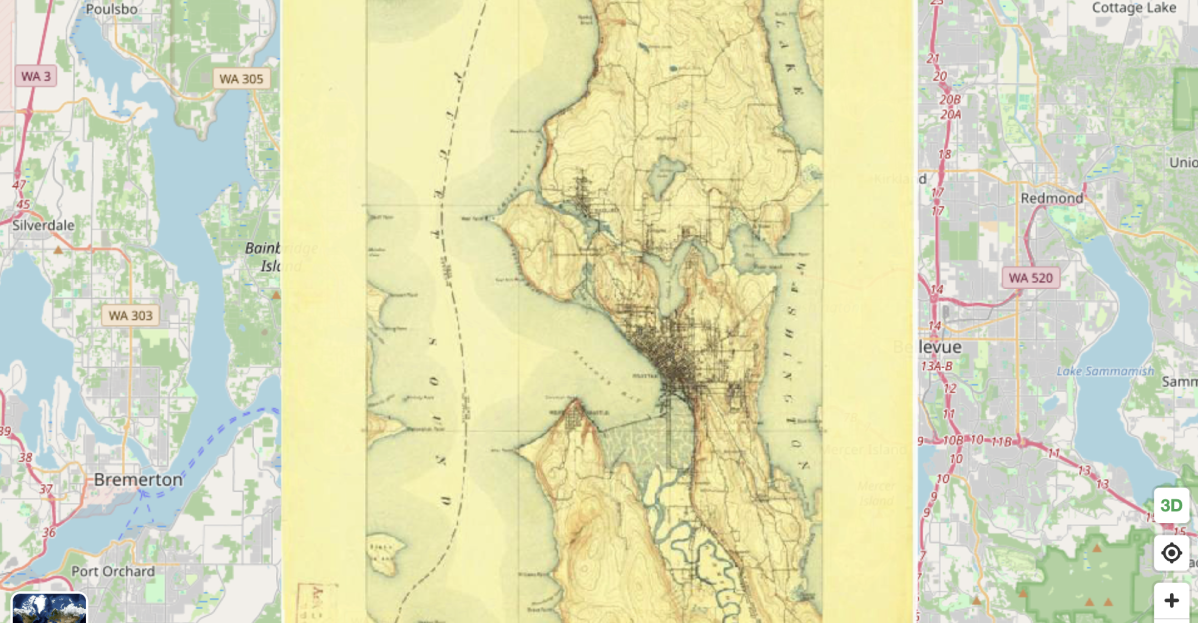
Past Maps is true to its name. The site lets you view historical maps of a particular region with a modern-day map overlaid. You can adjust the opacity to fade between the two views. The maps come from publicly available sources like the US Geological Survey, but the tools to allow people to explore them in this way were developed by Campbell. He built them to help inform his metal detection hobby — by pinpointing the modern-day locations of old structures and trails, he’d identify new places to go looking for artifacts. He started sharing his map tooling on Reddit with other metal detection enthusiasts and found that other people wanted to get their hands on what he’d created. With that, his newest tech venture was charted.
You don’t have to be looking for literal gold to enjoy Past Maps. For someone who’s just curious about what’s around them, it’s its own kind of treasure trove. I’ve used it to help grasp things like the shape of the Duwamish River before it was straightened out to help ships move through the waterway. Campbell’s customers use it for a wide range of reasons — from genealogy research to a daily user who maps old oil wells. It’s a research tool, but it’s also just plain fun.
The growth trajectory has been steady. Campbell says traffic has grown from an average of 20,000 active users a month to now over 300,000 a month in year three. The income is good enough to sustain Campbell and his wife, who also helps with the business. But he can’t help but think about what the money might have been like if he had taken those VC investments to work on AI. “I’m making the same as when I was like, an E4 at Facebook, which is like a mid-level engineer.”
“This is how the web is supposed to work. This is actually the old school web.”
Past Maps’ biggest source of traffic is Google Search results. Campbell found early on that Past Maps was rising through the ranks of search when people went looking for historical information about locations of interest to them — a church their grandmother attended, or abandoned mine sites in a particular county.
By tagging his maps and webpages in a way that Google understands, he saw a cycle start to pick up. “As I started exploding out this data and making it finally available to Google and giving it a place on the web, traffic just started to build.”
“This is how the web is supposed to work. This is actually the old school web,” he says. “It is alive and well, but only in these really, really small niches.”
An old school web publisher of 10 or 15 years ago likely would have relied on display advertising for the bulk of their revenue. You can dabble with a free Past Maps account, but going deeper requires a $9 weekly pass or $52 per year for an annual subscription. Subscriptions protect Campbell from the whims of fluctuating marketing budgets and an ad tech industry largely controlled by Google — which the DOJ ruled as an illegal monopoly in 2025.
While AI may be eating the open web alive, Campbell has fully embraced AI tools to help run the business. Campbell says that he used to spend one or two hours a day handling every service request himself, writing lengthy emails rather than sending a form response and an FAQ. Now, he lets a local agent model on his desktop to handle the front-line triage. Its prescheduled task runs once an hour — assuming his laptop is powered on — and has access to his Gmail. It weeds out spam and marketing messages, identifies the things that need his attention, and drafts a response. He says this has cut down his customer service time to about 10 minutes a day.
“I do sometimes have angry customers,” Campbell says. “If they ask me for a refund, it cues up the refund and subscription cancellation request with Stripe. It does the whole thing, then it pings me.” At that point, he looks over the request, approves or denies it, and checks the message before hitting send.
Campbell is also using AI to help build an OCR tool — Optical Character Recognition — that will work with old maps. “Cartographers are assholes,” Campbell jokes. Historical maps are a particular challenge for existing OCR systems. Labels will curve along features like rivers, use inconsistent spacing, and are sometimes crowded in on top of each other. Campbell found that off-the-shelf tools would fail to parse these maps. He found more success with modern LLMs using reasoning, but it’s not a simple matter of prompting an agent to “OCR these maps,” he says.
“You have to still bring that human spark into the mix.”
Instead, he’s found success in combining a human sensibility for experimentation with the LLM’s capabilities, rather than relying solely on the tool. “It still doesn’t bring like that human-level reasoning spark, and creativity, and being able to stitch together decades of using tools like this,” he says. “You have to still bring that human spark into the mix.”
Campbell may have walked away from a supposed AI gold rush, but in doing so it seems he created a recipe for a successful business online in the age of Claude Code and AI summaries. When you start with something you’re passionate about, make something that’s useful, and share it with other people like you, that turns out to be a pretty good foundation. Campbell’s day-to-day looks awfully different from the way you’d build and run a website 10 years ago, but the things that have made the business a success today are thoroughly human.