

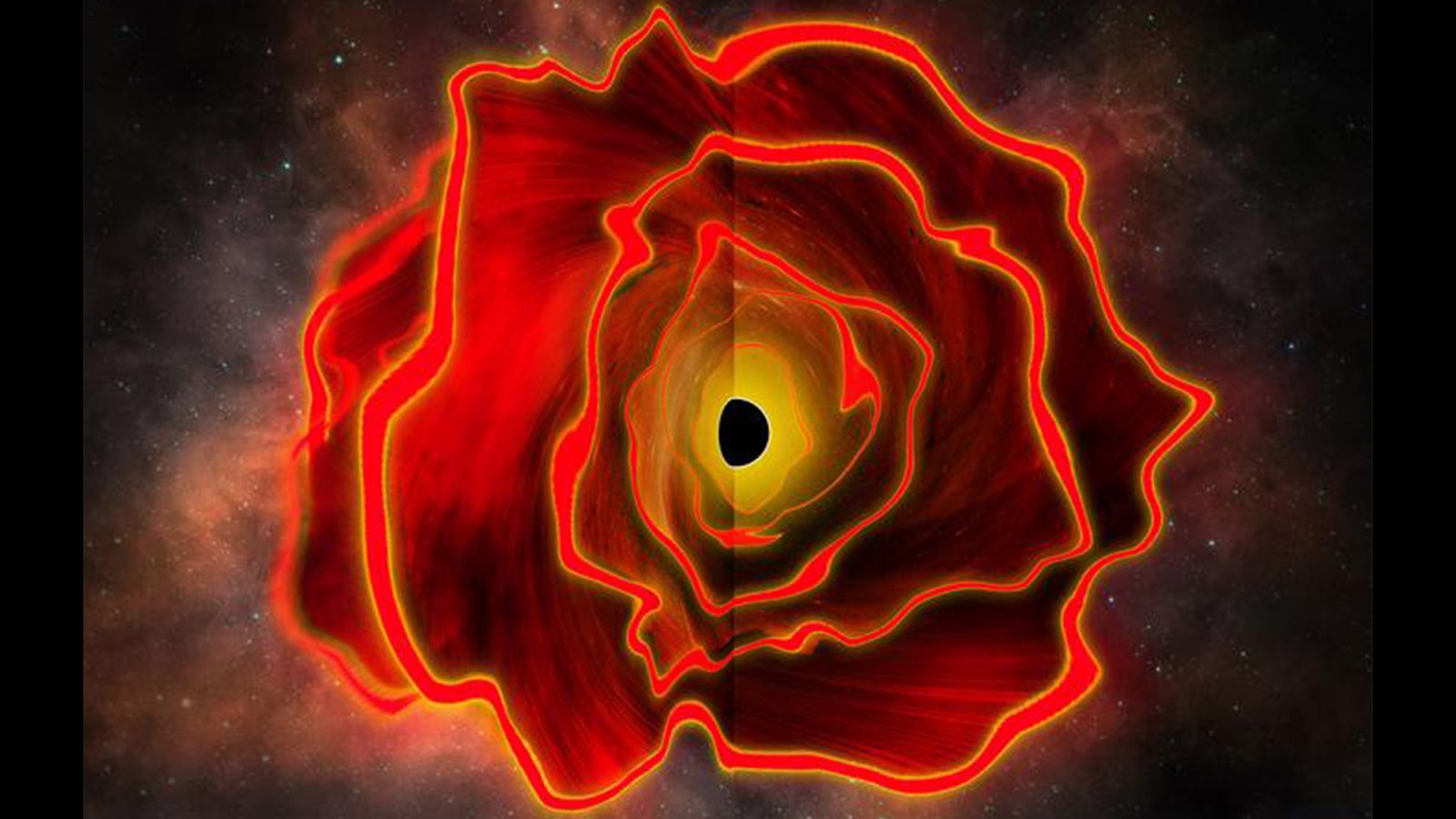
It’s time to cue up some Chris Cornell and get in the mood, because astronomers may have found a real black hole sun. While the Soundgarden frontman wrote the 1994 song after mishearing a news broadcast, the black hole star we’re talking about today is likely very real.
Astronomers have been studying the half-black hole, half-star object, known formally as MoM-BH*-1, and this week published the results of their analysis in the journal Nature. The object bears a striking resemblance to a star, thanks to its outer shell of very hot and dense gas. It exhibits other star-like behaviors as well, especially when viewed with the NIRSpec instrument on NASA’s James Webb Space Telescope.
But there are some notable differences when compared to other stars. MoM-BH*-1 has a black hole at the center instead of a molten core like a traditional star. It’s also the size of our entire solar system and puts out over 100 billion times the amount of energy of any known star. The energy output is more in line with what astronomers have measured from black holes. It also exhibited some traits unlike anything else ever observed.
“The way its light is almost entirely red, and abruptly disappears below a certain wavelength, is so dramatic that there is no comparison among any known class of objects,” Rohan Naidu, the study’s lead author and a University of Hawaii associate professor and MIT Kavli Institute fellow, told The Guardian.
This got Naidu and the other researchers thinking that the object might be something completely new. They weren’t even looking for a black hole star. They were using the James Webb Space Telescope to search for the oldest galaxies in the known universe and learn more about how they formed. Naidu believes they may have uncovered two pieces of the puzzle at once, as these black hole stars could have played a role in the formation of early galaxies.
A potential answer to the little red dot mystery
The James Webb Space Telescope launched in 2021 and began observing the universe in July 2022. It almost immediately began finding a series of mysterious objects that researchers call little red dots, since that’s how they appear in scans. Research has turned up 341 little red dots as of this writing, and due to limitations of the telescope’s instruments, researchers haven’t been able to figure out what they are.
“These little red dots seem to be everywhere in the early universe, but essentially disappear by the present day,” Naidu said in a statement issued by MIT. “What exactly these objects are has been one of the most debated topics of the JWST era.”
There are plenty of guesses, and black hole stars are one of them. Another study conducted by a team of astronomers led by Vasily Kokorev at the University of Texas at Austin posited that these little red dots were all black hole stars. The study, published this June, suggests that the little red dots were supermassive black holes shrouded in a dense, outer layer of gas rather than the standard accretion disc.

Naidu’s research appears to back up this claim, since MoM-BH*-1 exhibits many of the same characteristics of other little red dots, with the only notable difference being that it’s much brighter than the others, outshining its host galaxy and making it bright enough to measure and study. The hallmark red color helped the team conclude that what they were looking at was likely a black hole star.
“When we see something very red in the universe, we often assume that it’s surrounded by dust, like soot or ash,” Robert Simcoe, director of MIT’s Kavli Institute for Astrophysics and Space Research, who co-authored the study with Naidu, said in another MIT statement. “The same way that the wildfire smoke from Canada recently made the sky in Boston look bright red, astronomical objects can also appear redder than their intrinsic color when you see them through a veil of dust.”
The research team found that the red light from MoM-BH*-1 was unique because it didn’t appear to come from dust and had no metal signatures, unlike other stars, which functionally ruled out nuclear fusion as a source for the light as one would find in a normal star. The team ran simulations that showed how to achieve that same red light.
“We started to ask: Could you make something that red using just hydrogen, without any dust?” Simcoe said. “To our surprise, it turns out you can, if you have an extremely dense screen of hydrogen, so dense that it looks more like the surface of an enormous star than a wispy interstellar nebula.”
Naidu noted that all known little red dots are consistent with findings on MoM-BH*-1, suggesting researchers may be close to solving the mystery of these enigmatic objects.