

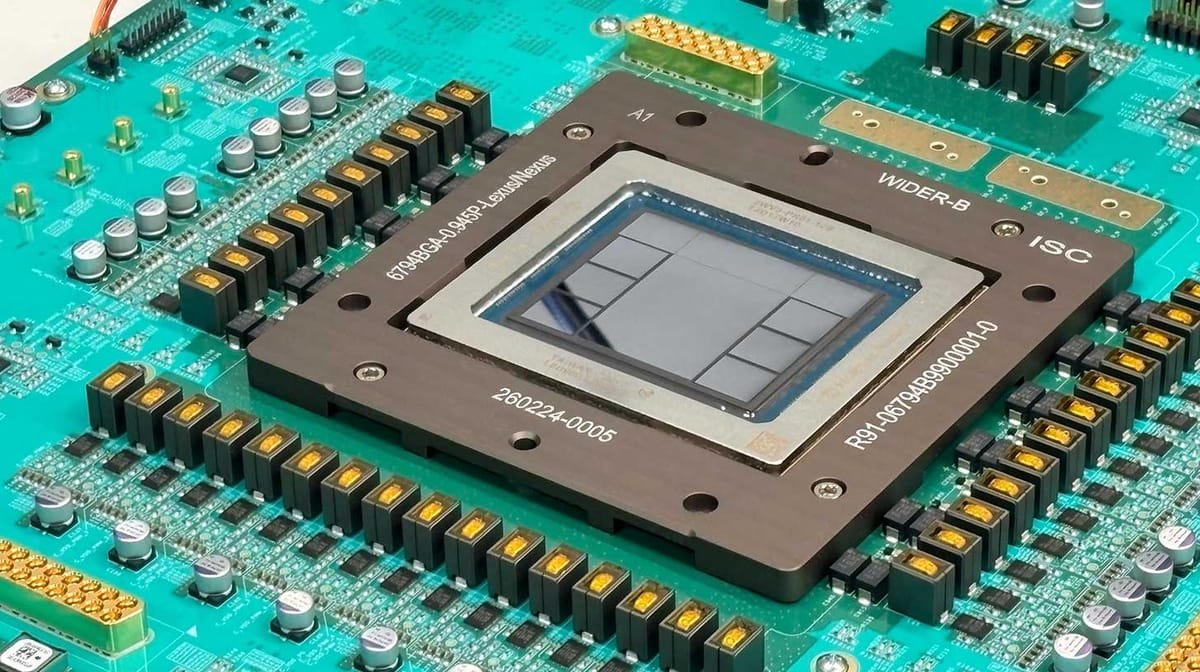
Good morning, {{ first_name | AI enthusiasts }}, and welcome to our 3,221 new readers. OpenAI named its first in-house AI chip Jalapeño, and the first benchmarks just came out appropriately spicy.
The company’s internal tests have the chip beating Nvidia’s flagship GPUs on both speed and power efficiency, with a design OpenAI credits its Astra model and Codex for helping create in nine months.
-
OpenAI’s Jalapeño chip brings the heat
-
New startup takes AI from words to physics
-
Build a website hands-free with Claude Voice
-
Perplexity, Nvidia go portable with Computer
OPENAI

The Rundown: OAI just published the first benchmark results for Jalapeño, the custom chip it built with Broadcom to run AI models (not train them), with its tests showing wins over Nvidia’s flagship systems on both speed and power efficiency.
-
In tests, OAI’s 700-watt chip topped Nvidia’s own options rated at 1,200 watts, answering up to 3.6x faster with up to 1.9x more work per watt.
-
The company said it leveraged its own upcoming Astra model and Codex to create Jalapeño, taking nine months from first design to manufacturing-ready.
-
OAI won’t sell the chip, with hardware VP Richard Ho saying it has “so much need for it” internally, and still leans on Nvidia to train new models.
-
Two more generations are already in the works, with plans to reach OAI’s data centers later this year and production set to ramp up through 2027.
Why it matters: Google’s in-house TPUs have been a good example of what a lab gains from owning its silicon, and the club is filling up fast with Anthropic, Amazon, and Microsoft also planning their own designs. If Jalapeño’s numbers hold, OAI gets cheaper, faster tokens and a tighter, personalized design loop for each model after.
TOGETHER WITH WEIGHTS & BIASES

The Rundown: Physical AI is the next frontier, but complex real-world variables and multimodal experimentation make building embodied systems a challenge. Our new e-book, Advancing Physical AI: From Learning to Embodied Intelligence, shares practical strategies to help you optimize robotics workflows and accelerate development.
-
Techniques to close the sim-to-real gap through real-time iteration
-
Steps to ensure the safety of physical AI systems
-
How to train VLAs at scale
ACCELERATED UNDERSTANDING

Image source: Accelerated Understanding
The Rundown: Caltech professor Anima Anandkumar and engineer Benedikt Jenik just launched Accelerated Understanding, a new startup training AI to forecast how the physical world evolves rather than predict what word comes next.
-
Instead of the traditional transformer, the model runs on “neural operators”, a physics-based design that follows events through 3D space and time.
-
Anandkumar and Jenik were initially offered top positions and a 35% stake in Jeff Bezos’ Prometheus, but chose to build their own venture instead.
-
In tests, AU’s model processed 5T data points in a single run, about 5M (!) times what Google and Anthropic’s top models hit.
-
Early business targets include chip materials, extreme-weather prediction, and robotics, with the company focused on enterprise over consumer models.
Why it matters: The physical AI race is on, with several labs betting on world models — but this duo sees physics as the answer over text or video. Bezos’ Prometheus has since raised $12B chasing a similar goal, making the decision to pass on a 35% stake from one of the world’s richest men a serious conviction play.
AI TRAINING

The Rundown: In this guide, you’ll learn how to use Claude Voice to build better websites faster. We’ll walk you through a technique that you can use every time you want to build a prototype.
-
Optional: If you have photos or design references, you can stash them in a folder. Now open Claude Desktop, start a regular chat, and click Voice
-
Explain the website, then ask Claude to interview you until it has a design plan and brand direction
-
At the end of the voice chat, have Claude write out the website building plan in full in the chat
-
Now with Claude in text mode, drop in the photos and tell it to build the prototype based on the plan. If it skips images, say: “Use photos in this artifact”
Pro tip: “Static site” is the keyword for portfolios, landing pages, and mockups. It keeps the complexity way down for you and the agent.
PRESENTED BY SCRIBE

The Rundown: Scribe Optimize automatically maps how work actually happens across your org — so before you build an AI strategy, you’re working from reality, not assumptions.
With Scribe Optimize, you can:
-
Map real workflows — no surveys or consultants
-
Surface inefficiencies leadership can’t currently see
-
Build your AI strategy on ground truth, not gut feel
PERPLEXITY

The Rundown: Perplexity and Nvidia just launched Portable Computer, a new on-device take on Perplexity’s Computer agent that keeps files private and is free to run locally on Nvidia’s DGX Spark consumer hardware.
-
Users can select between Qwen 3.8 27B or Perplexity’s own PPLX 27B as the local model, with the option to call in 15+ cloud models when needed.
-
On-device work doesn’t use any credits, with connectors able to integrate with popular apps and all cloud use requiring approval by the user.
-
Portable installs in a single click on Nvidia’s $4,699 DGX Spark desktop supercomputer, with certain PCs also able to run the agent in the near future.
-
The release comes just days after reports that Nvidia is in talks to invest billions of dollars in Perplexity in a new equity round at a valuation of over $30B.
Why it matters: Perplexity already brought its agent to Macs with Personal Computer, but Portable moves the actual AI work from the cloud onto the hardware itself. It’s a privacy and cost pitch that should only strengthen as smaller open models improve, turning frontier AI into the occasional backup instead of the default.
COMMUNITY AI WORKFLOW OF THE DAY
Today’s workflow comes from reader Anonymous:
I’m 71 years old, retired from owning a large cattle-feeding operation, and fairly new to AI and software development. I’ve discovered that I really enjoy using AI to build practical tools in Replit.
My latest project is an app for our church to help us oversee a $13.5M renovation of a 65,000-square-foot former movie theater into our new church facility. I’m not a programmer or a construction expert, so I’m using AI to help bridge both gaps.
I built the app almost entirely by describing in plain English what I wanted it to do, testing what it built, and working back and forth with AI to improve it. The app uses AI to read meeting notes, emails, texts, and general project updates and identify decisions, action items, important dates, budget changes, and project events.
Nothing is accepted automatically. I review, edit, approve, or reject what AI finds before it becomes part of the project record. The app also keeps our budgets, documents, meetings, and project history together.
Anthropic rolled out a single Claude memory shared between chat and Cowork, now also able to save topics in real time mid-conversation.
Apple introduced its new $899 Mac Mini, describing it as its “leading desktop for always-on agentic computing”, with new M6 chips to handle workloads up to 4x faster.
OpenAI head of data centers Chris Malone reportedly left the company, the latest in a flurry of executives to depart in recent months.
Google Cloud launched industry-tuned Gemini Enterprise editions for financial services and legal teams in preview, with healthcare and life sciences coming next.
Anthropic is reportedly preparing to tell IPO investors it sees a $30T+ addressable market, topping the $28.5T figure SpaceX floated in May.
That’s it for today!
Before you go we’d love to know what you thought of today’s newsletter to help us improve The Rundown experience for you.
Rowan, Zach, Shubham, Jennifer, and Nate — the humans behind The Rundown
