

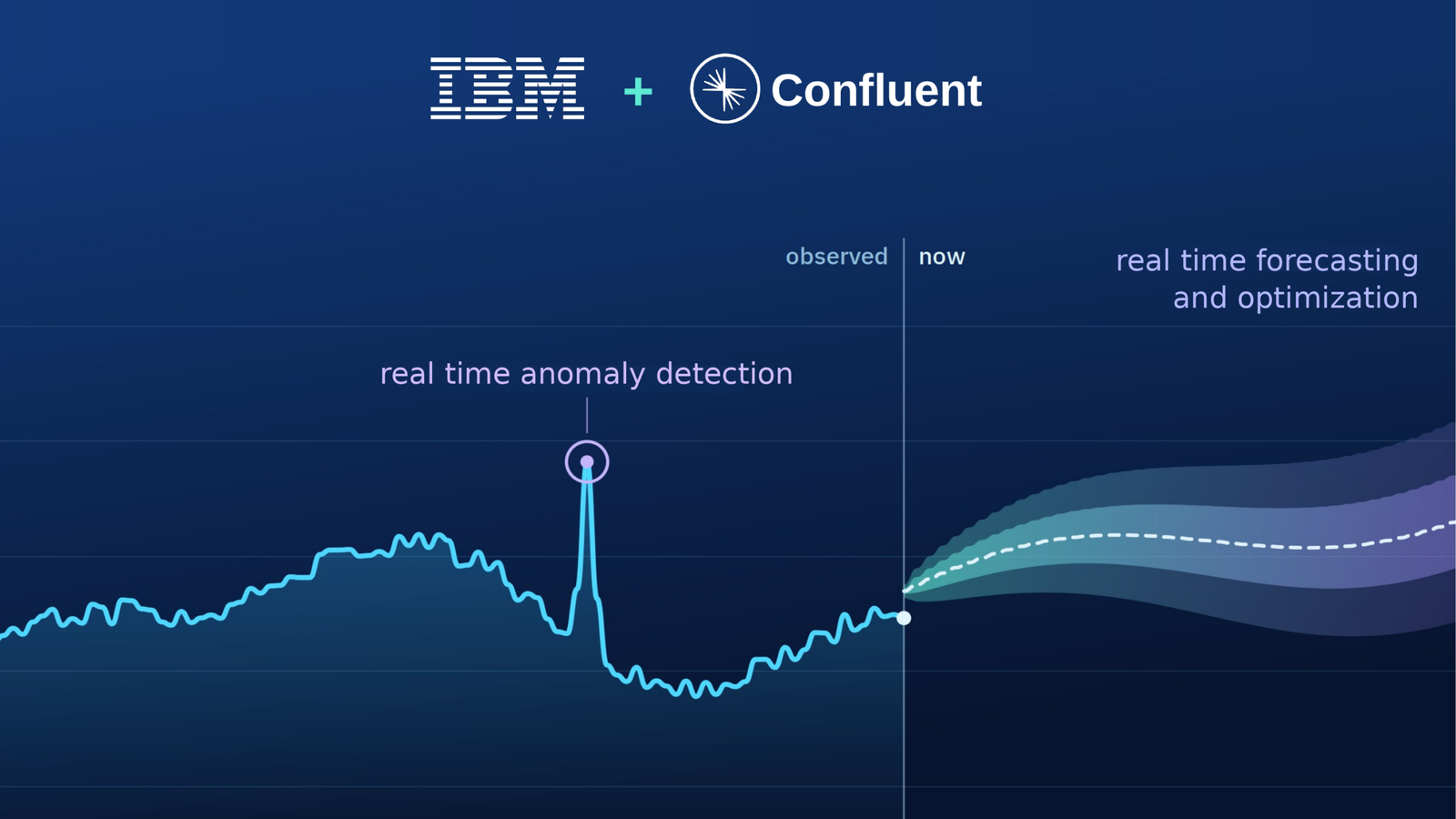
Foundation models transformed how enterprises unlock value from unstructured data. The bigger prize is streaming data, where the mission-critical decisions live: how much to order, which payment to stop, when the pump will fail, how hard to run the line, what happened the last time it looked like this. IBM and Confluent are now bringing that unlock stream-native, and the models are live in Early Access on Confluent Cloud, running where the data already moves, with Confluent Platform next.
Until now, those decisions have run on outdated economics: one bespoke model at a time and months of expert work on each. So teams model the few hundred series where the money is and cover the rest with safety margins, extra inventory, extra headroom, extra tolerance, acted on after the window has closed. That margin is the cost of a decision nobody could forecast, paid every cycle.
A time series foundation model (TSFM) changes that. Trained once across vast, varied signals, it generalizes to a series it has never seen: give it a window of measurements and it tells you what comes next, how far behaviour sits from normal, which history looks like this one, and which settings best serve a target. Using one does not take an army of data scientists either: a demand planner, a fraud analyst or a process engineer can put these models to work on their own streams. Around the models, IBM is building functions that shift the work left, so forecasting, anomaly detection, optimization and semantic intelligence arrive as capabilities you call rather than projects you build.
Picture one tempering line in a chocolate factory, its temperature, speed and throughput sampled every few seconds and watched against fixed thresholds. Drop a foundation model into that stream and it forecasts the line’s output through the evening shift, so the planner sees a shortfall while there is still time to act. It scores today’s run against how the line normally behaves on dark chocolate, so a slow drift surfaces before a bar blooms. It finds the closest match in plant history, so the engineer knows how the last runs like it turned out. It conditions on the settings the crew controls, and fine-tunes when the last points of accuracy are worth it. No data science team required, and the same model rolls to every line in every factory.

IBM ran these models before offering them, in its own products and operations first, then with design partners in cement, steel, pulp and paper, food and telecommunications. The numbers make the case: every point of accuracy is worth millions, productivity gains run 5 to 10×, and work that waited for specialists now sits with the domain experts who own the decision.
Now that proof meets real-time context: IBM brings frontier models that understand how signals behave, 44M+ downloads behind them, and Confluent brings the live state of the business and reach to every system that acts. Together they run stream-native, hosted in Confluent Cloud and called from Flink. Access opens on Confluent Cloud on AWS. Confluent Platform follows, bringing the same models and capabilities to on-premises and hybrid environments.
Time series intelligence meets real-time context with zero configuration, built-in governance and efficiency
The months usually spent wiring a model into production are months you keep: Granite reads the signal, Confluent supplies the context, the governance and the delivery to everything downstream.
A signal’s value decays with time: a pump caught drifting today is a work order, the same pump next week is an outage.

Forecasting and detection are stateful: the next value only means something against recent history, and an anomaly only exists against a running sense of normal. Flink manages that state, keyed per series and fault tolerant, so each model gets the history it needs without a separate data store or a database hit per call.

This is where the value compounds. Confluent’s data streaming platform puts business data in motion and makes it usable for ML. The platform continuously streams, connects, governs, and processes real-time data, capturing live business signals that IBM Granite Time Series models use for forecasting, anomaly detection, similarity search, classification, gap-filling and optimization. Confluent provides what you need to implement streaming use cases quickly, reliably, and securely, so you can focus on developing real-time ML applications rather than managing data infrastructure.
Confluent Cloud, the cloud deployment of Confluent’s data streaming platform, provides native inference, which allows you to run IBM Granite Time Series models directly within Apache Flink® on Confluent, providing greater flexibility, security, and cost efficiency for real-time data processing while unifying data and ML workflows. The benefits include:
- Real-time intelligence where the data lives: Run forecasting and anomaly detection directly on streaming data, at the very moment business conditions change, without extracting time-series data into a separate ML platform or data warehouse.
- Zero configuration: Confluent manages model serving, infrastructure, scaling, and runtime operations, so there is no provider credential to manage or glue between data pipelines and the model. Call IBM Granite Time Series models directly from Flink SQL for real-time anomaly detection and forecasting.
- Fresh, enriched context: Confluent continuously captures and processes data into an up-to-date view of the current state of the business, from sensor telemetry and payment activity to application metrics, so models can act on what’s happening now rather than stale batch data to make more reliable, accurate predictions. Inference results are written to Kafka topics and shared with fanout, consumable by alerting systems, dashboards, lakehouses and AI agents.
- Built-in governance and traceability: Inference pipelines adhere to the same schemas, lineage and access controls as everything else on the platform. Kafka topics are durable and replayable, which supports auditing, troubleshooting, model evaluation, and rerunning inference against historical data.
- Cost efficiency: Native inference eliminates the need to provision and manage dedicated model-serving infrastructure or GPUs, with zero cloud ingress or egress fees.
- Enhanced security: Data stays within Confluent Cloud for inference and adheres to RBAC and privacy policies throughout the platform.
- Faster time to value: Teams can move from streaming data to a working forecast and anomaly-detection pipeline in minutes using familiar SQL syntax, rather than building a separate ML stack or point-to-point data pipelines.
By bridging operational and analytical estates, Confluent helps teams turn live business events into actionable intelligence, bringing IBM Granite Time Series models into the stream. And because no single model serves a shampoo line, a card network and a retail catalogue alike, IBM and Confluent offer a portfolio rather than a model.
A complementary portfolio of time series foundation models, matched to the decision you are making
Every decision asks the future a different question. A planning cycle needs a range of outcomes, a trading desk the most accurate number from data at every rate, a fleet of a hundred thousand series a cost that stays rational, and a security team the moment a stream stops behaving like itself and what happened last time it did. The portfolio is four complementary time series foundation models, all in Early Access and called through Confluent’s existing AI_FORECAST and AI_DETECT_ANOMALIES Flink SQL functions. Switch models with one SQL parameter, no pipeline redesign.
The whole project is one call:
SELECT
  AI_FORECAST(
    load_kw,
    event_time,
    JSON_OBJECT('model' VALUE 'ttm', 'horizon' VALUE 12)
  ) OVER (
    ORDER BY event_time
    RANGE BETWEEN UNBOUNDED PRECEDING AND CURRENT ROW
  ) AS forecast
FROM meter_readings;
Change the model value and the same call runs any of the four, with no separate ML stack to build or operate.

There is no single best model, so a few questions steer the choice. One series or thousands? One variable or many? Time to train, or out of the box? How far ahead? Forecasting, or anomalies? PatchTST-FM reads a series the way a language model reads text, patch by patch, each variable in its own channel so one noisy signal can’t drag the rest down, and returns a full distribution, so a planner can set reorder points off the 90th percentile. FlowState keeps a running summary updated with every point, and because its dynamics are continuous in time it reads seconds-level SCADA and hourly market data alike. TTM drops attention for tiny mixing networks along time and across variables, so a million-parameter model covers a hundred thousand series nightly on CPU. And TSPulse pairs time and frequency views in one small multi-task model for anomaly detection, classification, gap-filling and the question every operator asks: have we seen this before.
Small was a decision, not a compromise: inference runs natively inside Confluent Cloud, or on your own CPUs with the open weights from the Hugging Face Hub, and no cloud ingress or egress keeps architecture simple and cost down. IBM Granite also brings IBM’s enterprise AI governance framework, with model provenance and licensing transparency, and a growing set of functions on the models that make each use case more useful out of the box. This is where portfolio and platform come together, where a model stops being a librarian of the past and becomes an optimizer of decisions still in flight.
Where the value lands: forecasting, anomaly detection, optimization and semantic intelligence
All four compress the time between an event and knowing about it. In the stream, that gap shrinks from days to seconds, and the signal becomes a trigger for other AI systems, agents and workflows that investigate, triage what matters, and loop in a human, context already gathered, when a decision needs a person. Each of the four is also being packaged as a function, so more of the work lives in the platform and less with the team using it.

Forecasting and planning
Most forecasting is still a statistical model and gut feel dressed up as a decision. Bespoke ML has not closed the gap, one model per series, refit by hand and drifting with the horizon, so planning covers the handful of series worth the effort and the rest runs on safety stock.
Follow a demand planner at a grocery retailer, where planning reaches the head of the catalogue and never the tail, which sits on a shelf as working capital. She points one shared model at the whole catalogue: it works on an unseen series immediately, takes drivers like weather and promotions, and hands back a distribution rather than a single line. Nothing is built per SKU, so one model is a model factory: a two-year SKU and a three-month one in the same job, a launch with no history starting from the SKUs it resembles, 100,000 SKUs nightly on CPU, the same play across categories and regions.
The distribution turns service level into a policy she can state out loud. And because each forecast lands on a topic, it is a trigger rather than a report: replenishment fires from it, allocation and pricing read the same numbers, a markdown lands before stock ages and a reorder before the shelf empties. The results land where the business keeps score: fewer stockouts and markdowns, customers who find what they came for, revenue protected on the shelf, and freed working capital, usually the largest line in the business case.
Anomaly detection
Anomaly detection is the broadest lane, and one missed anomaly is rarely small: in fraud it is a customer’s money, in security a breach, in IT operations an outage customers meet first, and each lands on the brand as hard as the balance sheet. In financial services, rule-based detection is enumerable, so adversaries enumerate it, and tightening a rule declines more honest customers, revenue gone and a customer half out the door. Bespoke ML wants labels that are scarce and stale, and false alarms cost more than the crime.
Picture the fraud lead at a retail bank: the model keeps a sense of normal per card and scores every payment through the same AI_DETECT_ANOMALIES call while it is still in flight. Because it also forecasts, it flags the drift toward trouble before the event. A card that bought groceries in the same three postcodes for two years funds a wallet abroad at 3am and the alarm fires before the money moves, while the same customer on an honest holiday sails through.
Protection starts on day one, because what the model learned elsewhere transfers to new products, corridors and asset types with no labelled case. It also has to keep moving, because the adversary does: fraud patterns and attack signatures change monthly, so the model is customized on the bank’s own stream, refit as cases are confirmed, improved continuously rather than rebuilt yearly. And as banking and commerce turn agentic, with agents initiating payments at machine speed, the rhythm of normal shifts and volumes climb, so live context and in-flight scoring matter even more. Every score enables the next move: block the payment, escalate to an analyst with the closest past cases attached, hand it to an agent.
The same technique reapplies wherever an entity has a rhythm: IT latency, cell-site KPIs, the tempering line from the opening.
Production optimization
Every plant runs on a model of itself, and keeping it honest is hard: statistical models drift, rule-based control holds a setpoint but never improves it, and bespoke ML explains nothing, so optimization stays in pilots and the plant runs on margins.
Andrés runs process at a shampoo plant whose mixing line streams temperature, agitator speed, dosing rate and viscosity into Confluent. He puts a foundation model on the stream and it works out of the box: months of bespoke modelling become days, productivity gains of up to 10×, and he customizes only where the line demands it. Conditioned on what he controls, the forecast becomes a simulator: energy at this mixing speed, throughput at this temperature and dosing rate, viscosity in spec or not. An optimizer searches that space against a KPI he names, respects his constraints, and explains what it recommends, because a recommendation he cannot interrogate he will not act on. Andrés is a process engineer, not a modeller, and the person who knows the line steers it.
Optimization does not freeze at go-live, it re-optimizes as inputs change: a surfactant supplier switches, a fragrance batch behaves differently, demand shifts from the 400ml bottle to the travel size, and this quarter the objective is throughput rather than energy. Restate the objective and constraints, and the line runs on the next best setpoint rather than last year’s, starting from the closest past runs and their fixes. The gains land in the currency his CFO tracks: one point on an operation turning over hundreds of millions is a seven-figure line, and one food manufacturer starts with one process and 400 factories behind it.
Production optimization anchors something larger: quality prediction and equipment condition come next, and as AI moves into manufacturing, robotics and physical systems, it is the first of many in a large, disruptive market.
Semantic intelligence
Every lane above ends on the same question: have we seen this before? The models answer it with embeddings, compact vectors that capture the shape of a window in time and frequency, so two episodes that look alike land close together whatever their scale or offset. In the stream, each window is embedded as it arrives and matched against past episodes and their outcomes, so what comes back is a precedent, not a score: the runs that drifted this way and what fixed them, the demand curves a new SKU most resembles, the confirmed fraud cases this session rhymes with. The same embeddings drive classification and gap-filling, and index the context an agent retrieves before it acts.
This is only the beginning for time series. As with language models, the pace is accelerating: new architectures, new data sources, agentic and user experiences built on the models, and more of it ready to use on day one. IBM and Confluent will keep innovating the way they started, with design partners and clients on real enterprise use cases, for productivity, accuracy and responsiveness across every lane.
Become an innovation partner and get started with time series models on Confluent
Available now in Early Access on Confluent Cloud: forecasting and anomaly detection directly on your data streams, with no model training, feature engineering or AI/ML expertise required. Confluent Cloud is the starting point, and Confluent Platform is next, so the same models and capabilities reach on-premises and hybrid estates. The feedback loop is the point: what you find on your own streams teaches the models what to become next.