

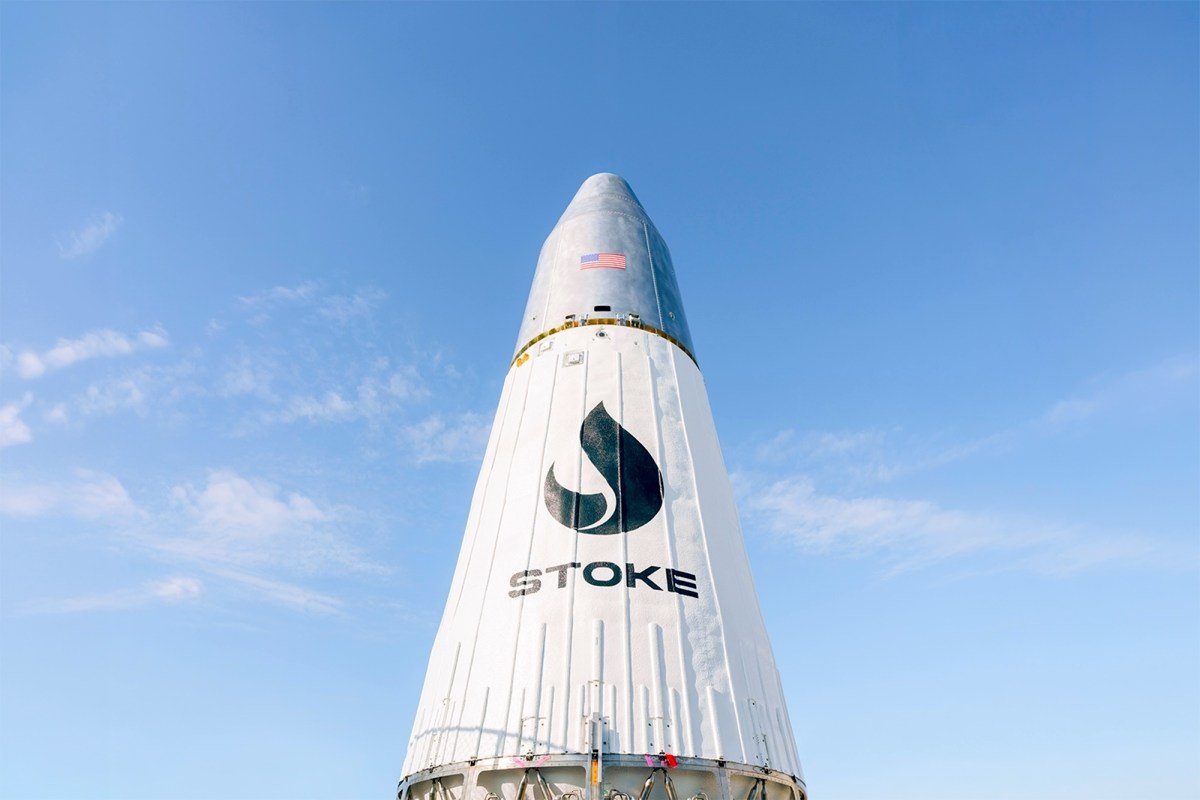
The fuel for a fully reusable rocket that can unlock truly low-cost access to space isn’t methane or liquid oxygen. It’s cash, and Stoke Space Technologies is tanking up. The company has now “completed the initial closing” of a $1 billion Series E round intended to help it reach orbit and prepare a new, larger rocket for operations.
“This round is really to scale,” CEO Andy Lapsa told TechCrunch. “To lay the infrastructure, to scale in production and flight frequency, and importantly to fund the development of the second generation vehicle.”
The round was led by Point72 Ventures (hedge fund billionaire Steve Cohen’s tech investment vehicle), and Spark Capital, and included investment from General Innovation, Glade Brook Capital, US Innovation Technology, Washington Harbour Partners, Woven Capital and Y Combinator, among others.
Stoke is one of a handful of startups attempting to compete with Elon Musk’s SpaceX in the low-cost rocket launch space. SpaceX was built around the Falcon 9, which has a reusable booster stage, and now Musk and company are trying to field a huge, fully-reusable rocket, Starship.
But unlike its rivals Rocket Lab, Relativity Space or Firefly Aerospace, Lapsa’s company is aiming straight at that holy grail: A rocket where both the booster stage and the payload-carrying second stage come back to Earth so they can be reused cheaply. It’s never been done before.
Such ambition and technical feats require capital. SpaceX has spent well over $10 billion on Starship over the last decade, and the vehicle still hasn’t yet reached orbit, although that may change on its next flight. Now, Stoke has raised $2.3 billion in total.
In particular, SpaceX has struggled to identify the right materials and configuration for the components that shield the second stage of the rocket from the extreme heat caused when it is reentering the atmosphere. Stoke instead flows super-cooled liquid hydrogen through its thermal shielding, a unique active cooling solution that Lapsa says has been tested exhaustively on the ground and will be deployed on the first flight.
“We can flow excess coolant — more than we think we need in order to overcool the surface of the vehicle — and take a conservative stance from that perspective in early flights,” he said.
Lapsa said that he expects Stoke’s first vehicle, the Nova Pathfinder, to take flight in early 2027. In a business known for delays, he’s confident sharing that target following a series of structural and operational tests on the rocket’s first stage at the company’s Moses Lake facility. Next up is test-firing each stage of the rocket on the ground to ensure they are ready for flight.
“The ground system is checked out to the extent that we can do it without the rocket, and the rocket’s checked out to the extent that we can do it without the launch pad,” Lapsa said. “So the next step is to do them together.”
The startup has already sold launch contracts on the vehicle, which can carry three metric tons to low-Earth orbit — that will be, Lapsa believes, the largest debut vehicle of any U.S. rocket maker. That said, few rockets get off the ground on time or with total success, and simply getting to orbit would be an achievement.
“We have multiple Pathfinder vehicles in production, and we have confidence that we will bring Pathfinder to market and into orbit regardless of this round,” Lapsa said.
Stoke also revealed plans for an even bigger rocket, the Nova Block 2, that has been under development for the past few years. Based on the same technologies as the Pathfinder, including the engines and the company’s novel heat shield, that vehicle will be able to bring 15 metric tons to low-Earth orbit, slightly more than the Falcon 9.
The goal is to deploy it in 2029, right when, according to Musk, the Falcon 9 will be phased out. Is Lapsa drooling at the possibility of picking up increasingly desperate launch customers just as SpaceX pulls back?
“It amplifies the mismatch between launch supply and demand for launch, there’s no question about that,” he admits. “Regardless of Falcon 9 retiring or not retiring, the space industry and the space economy scales exactly as fast as rockets get off the ground, particularly rockets that serve third-party customers.”
That last remark is a dog whistle that satellite operators will surely hear: When SpaceX’s Starship takes flight, companies and government agencies looking to buy tickets will be competing with the space company’s internal projects, and might have to pay a premium to use the big rocket. Stoke, on the other hand, has not revealed plans to operate its own space assets.
“Now is the time to get moving […] so that we can finally start deploying a lot of the constellations and applications that we aspire to as an industry but have been stuck on the ground,” Lapsa said.
When you purchase through links in our articles, we may earn a small commission. This doesn’t affect our editorial independence.