


Authors: Amir Hossein Karami and Hamed Tahmooresi
At national-operator scale, the most expensive operational failure is not an outage. It is treating every symptom of an outage as a separate problem.
Consider a fiber cut. It can produce a flood of downstream alarms across routers, transport links, base stations, probes, service KPIs, and customer-care channels. A conventional NOC sees hundreds of red tiles. An effective operations system sees one evolving incident, estimates its customer and SLA impact, identifies the most plausible upstream cause, and either executes a proven low-risk repair or gets the right human on the case immediately.
That is the practical shift behind modern telecom AIOps: from alarm-centric operations to incident-centric service assurance. It is especially consequential for operators serving tens of millions of subscribers, where alert fatigue quickly becomes a quality-of-service and leadership problem.
The benchmark is a direction, not a vendor shopping list
Public evidence from large operators points in a consistent direction, while also showing why claims need careful handling.
China Mobile has publicly described moving packet-transport operations toward incident-centric management. A TM Forum case study reports a program that compressed approximately 600,000 daily alarms into about 600 incidents in a stated scenario. China Mobile’s more recent autonomous-NOC work emphasizes intelligent agents and closed loops. TM Forum TM Forum
Airtel has published work on AI-based predictive maintenance, while its TM Forum transformation case study describes a data-driven shift toward service outcomes, RCA-enriched work orders, and automation. The transferable point is not a headline percentage; it is joining operations data with a workflow that can act before a service issue becomes customer-visible. Airtel TM Forum
Jio markets its ATOM platform around ML-enabled network analytics, RAN analysis, and anomaly detection. This is useful confirmation that anomaly detection belongs inside an operational platform, rather than as an isolated dashboard experiment. Jio ATOM
AT&T is a valuable customer-impact benchmark: its public AI work spans analytics and automation for network operations. The durable design lesson is to prioritize a technical event by the service and customer harm it can cause—not by device severity alone. AT&T Labs
Turkcell publicly demonstrates AI-oriented 5G and network-automation work, but detailed, independently verifiable descriptions of its internal alarm-correlation and RCA process are limited. Treat it as a strategic peer, not as evidence for unverified compression or MTTR figures. Turkcell
This pattern is also aligned with the 2025 ITU-T M.3390, which defines requirements for AI-enhanced telecom operations spanning network-resource assurance, network-service quality, end-to-end service-quality analysis, and service-assurance strategy generation.
Build an incident factory, not a louder dashboard
A useful architecture transforms raw signals through a sequence of increasingly meaningful objects:
The ordering matters. An LLM is not a replacement for deterministic event processing. It is much more reliable when it receives a compact incident record, topology context, prior resolved incidents, change history, and runbook evidence—rather than millions of unfiltered alarms.
1. Normalize before you model
Start with a canonical event and incident schema. Every incoming signal needs a stable identity, timestamp, source, object type, alarm family, severity, location, and correlation identifiers. Enrich it with live topology, inventory/CMDB ownership, service dependencies, maintenance windows, active changes, and business-service mappings.
This layer is not glamorous, but it determines whether later machine learning is trustworthy. A model cannot infer a correct root cause from an outdated topology graph or an event stream that cannot distinguish a child alarm from its parent.
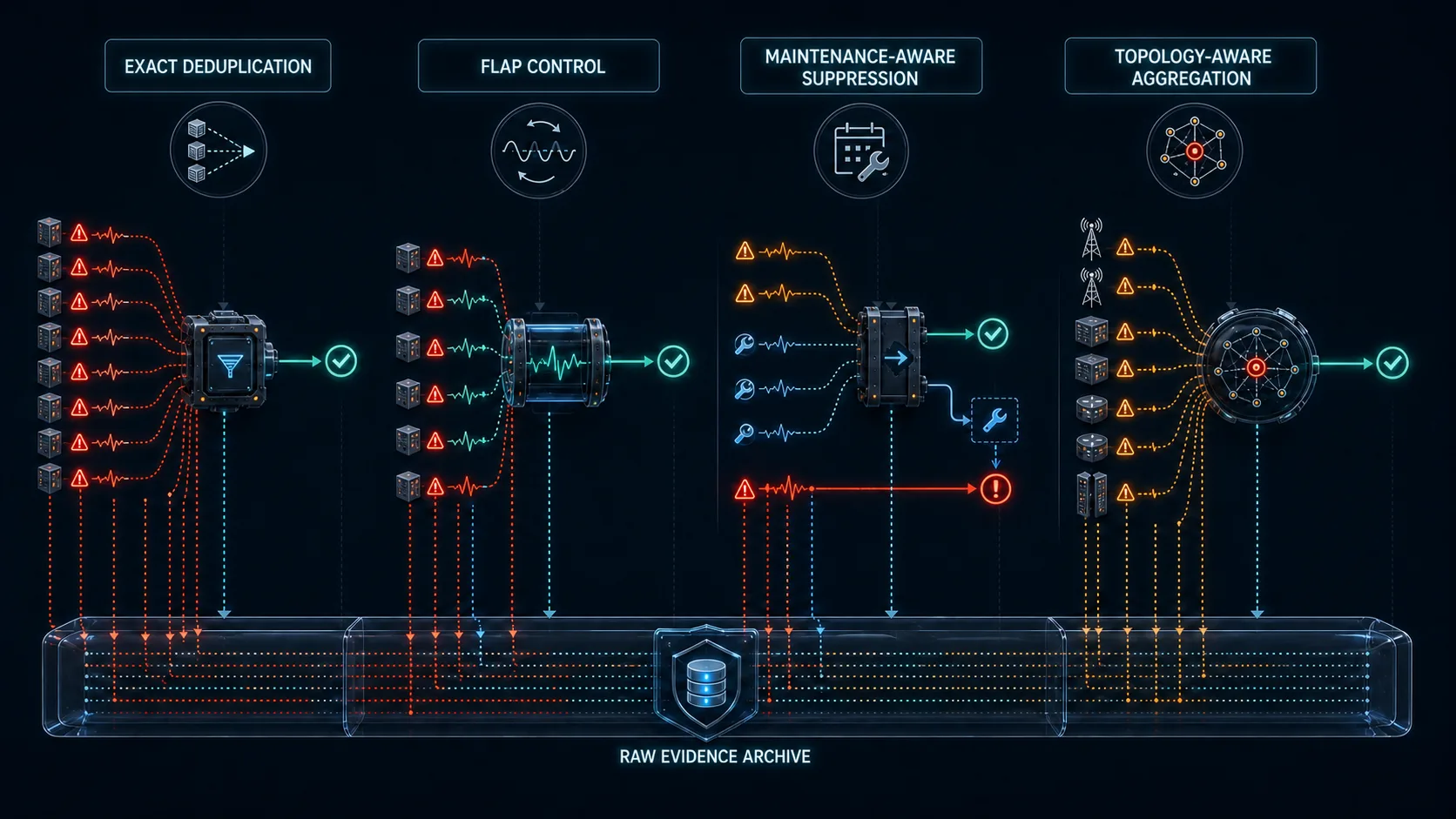
2. Reduce noise with four explicit controls
Noise reduction should be explainable and measurable:
Exact deduplication: collapse repeated copies of the same alarm within a source-appropriate time window.
Flap control: group open/clear oscillations and notify only when persistence exceeds policy.
Maintenance-aware suppression: silence expected symptoms during approved work, while retaining an audit trail and guarding against an unexpected impact spike.
Topology-aware aggregation: identify a likely upstream dependency and represent downstream symptoms as evidence within a single incident.
Never discard raw evidence. Suppression is a presentation and workflow decision; original signals must remain queryable for RCA, audit, and model training.
3. Rank incidents by impact, confidence, and urgency
Device severity is only one input. A practical score is a policy-controlled combination of service criticality, affected subscribers, SLA exposure, geographic blast radius, duration, revenue or risk, technical severity, recurrence, and RCA confidence:
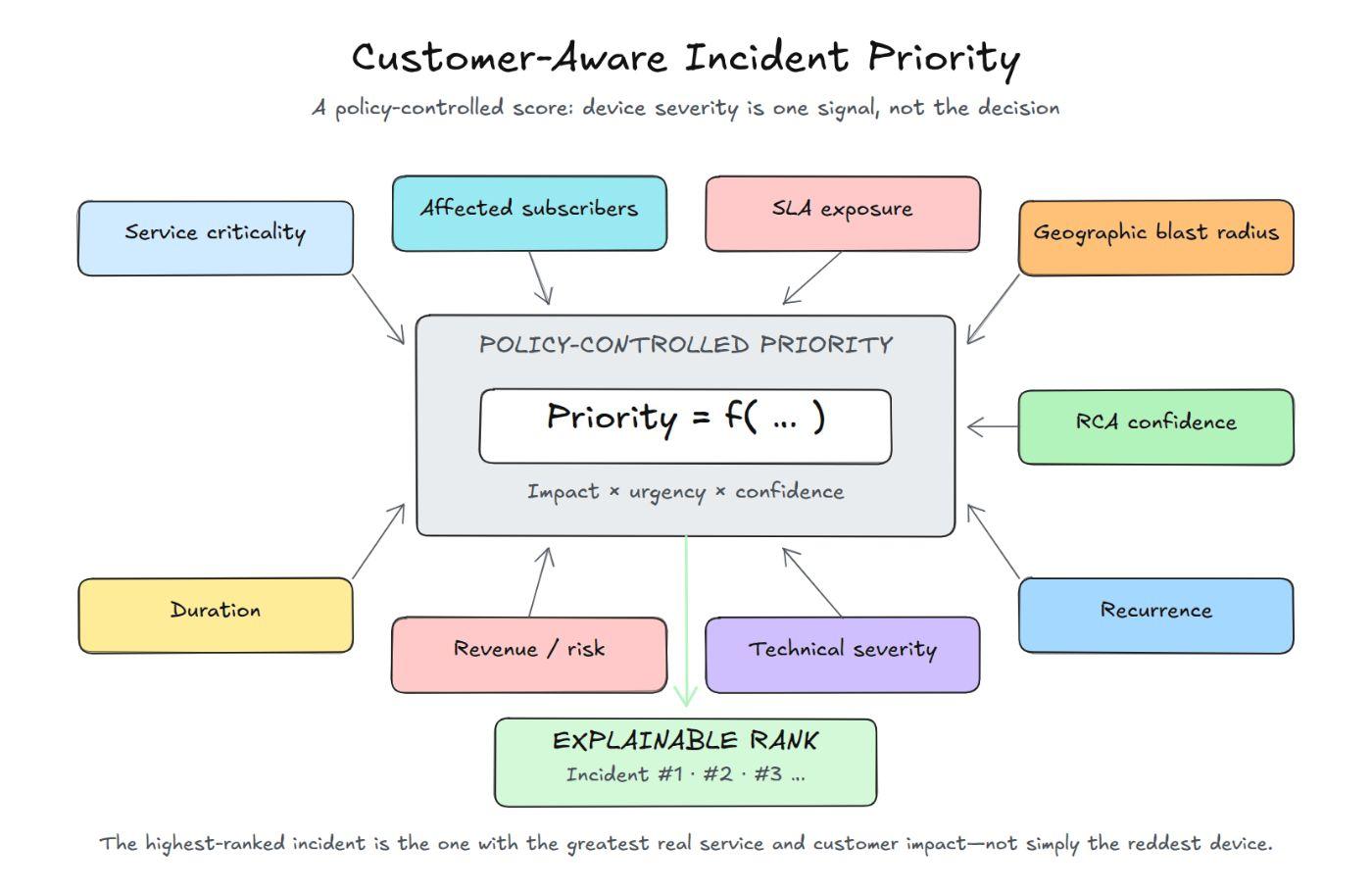
The result should include an explanation: which service is affected, how many subscribers may be exposed, which dependency is implicated, what changed recently, and why this incident outranks the next one. Operators need the explanation to trust automation and to improve it.
4. Treat RCA as ranked hypotheses, not false certainty
Real-time RCA works best as evidence fusion. Combine temporal order, dependency direction in the topology graph, KPI anomalies, alarms, logs, configuration changes, historical incident patterns, and customer complaints. Output the top hypotheses with confidence and supporting evidence.
For example, a fiber-path failure hypothesis becomes stronger when it precedes simultaneous loss-of-signal alarms in dependent sites, transport KPIs degrade along the same path, and there is no scheduled change. A dashboard that says “root cause: fiber cut” without that evidence is not RCA; it is an assertion.
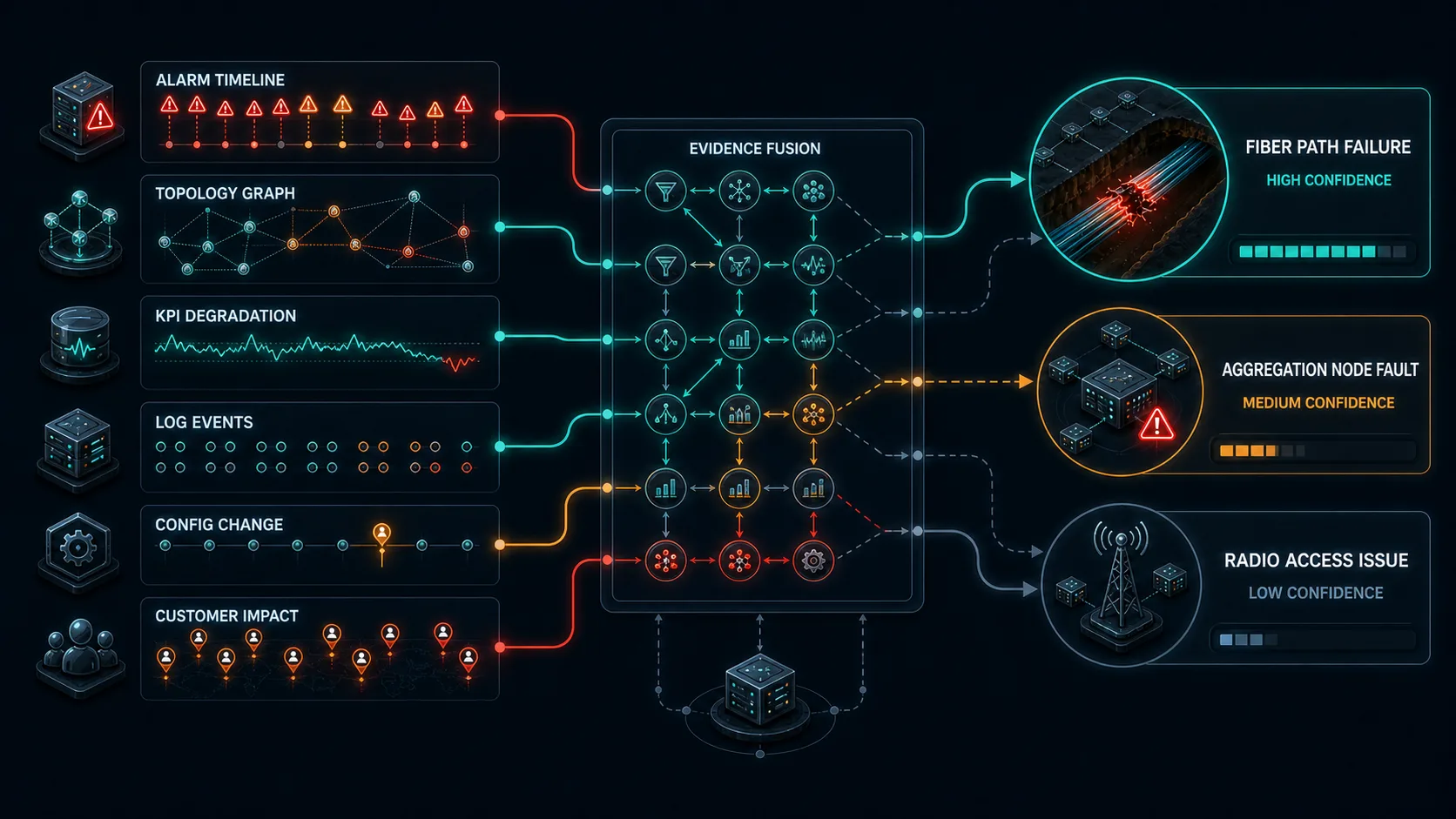
Graph methods, rules, statistical anomaly detection, and causal reasoning each have a role. Use supervised learning only where labeled historical outcomes are sufficiently reliable. Use generative AI for retrieval, explanation, incident summaries, and runbook guidance; keep policy decisions and high-risk actions under deterministic controls.
Escalation should be a decision system
The best escalation is not “page everyone for anything red.” It is a set of explicit lanes:
|
Lane |
Condition |
Response |
|---|---|---|
|
Observe |
Low impact or low confidence |
Group, enrich, and watch for persistence or escalation triggers. |
|
Automate |
High confidence, reversible, approved runbook |
Execute a bounded action, validate service recovery, and record the evidence. |
|
Assisted response |
Material impact or incomplete confidence |
Create one enriched incident and route it to the owning NOC/domain team with recommendations. |
|
Major incident |
High customer/SLA impact or safety/security risk |
Trigger a clear incident command path, executive communication thresholds, and frequent impact updates. |
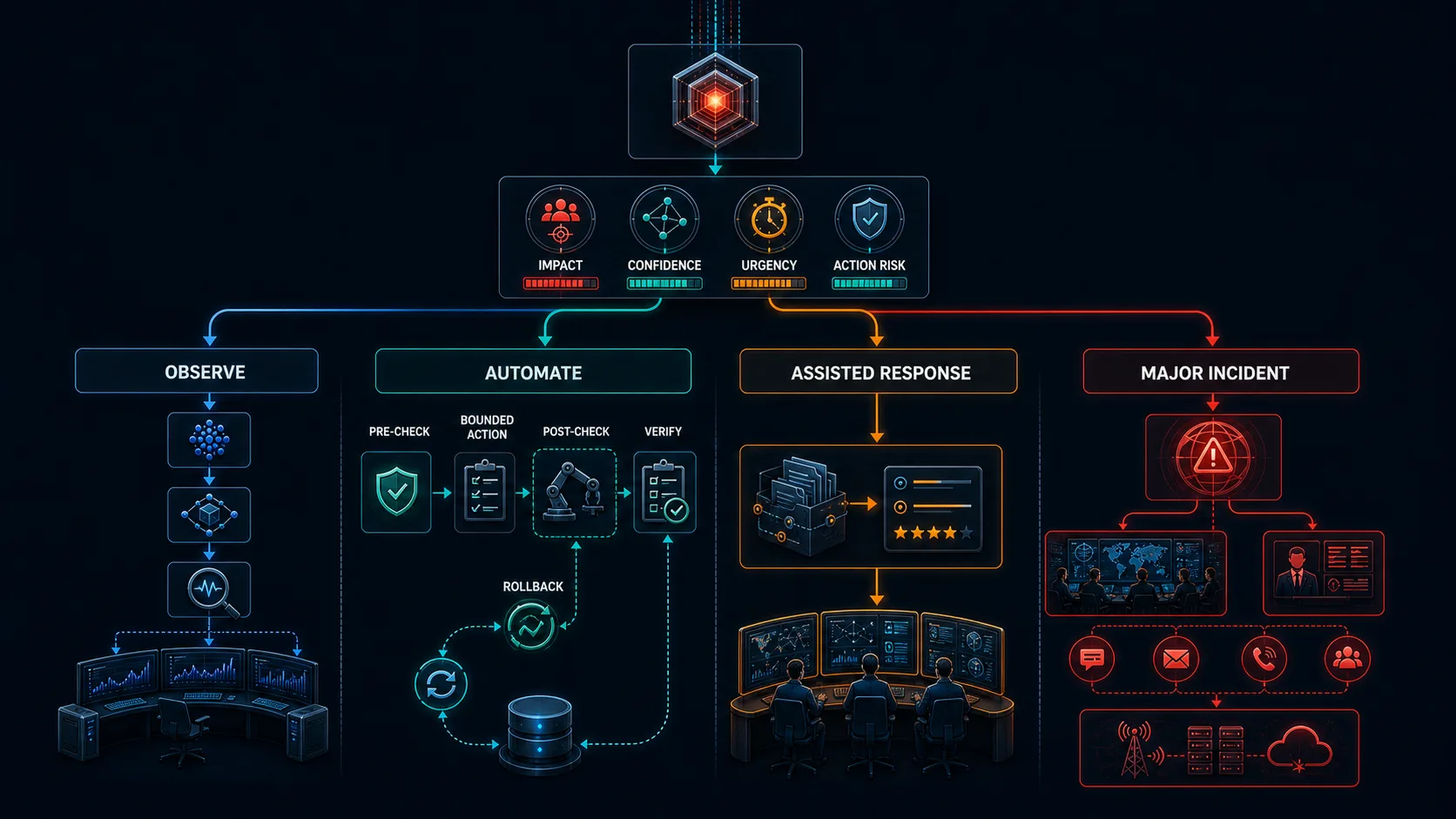
Automation needs guardrails: action allowlists, blast-radius limits, approval thresholds, rollback, pre/post checks, immutable audit records, and automatic handoff when verification fails. Closed-loop operation is a maturity journey, not a switch to flip.
Design the control room around decisions
An executive dashboard should answer questions, not display more telemetry:
Which business services are at risk now, where, and for whom?
How many raw alarms became actionable incidents—and how much was suppressed with later validation?
What are the top recurring root-cause classes and the most fragile dependencies?
Are we detecting degradation before customer complaints?
Which automations recovered service, failed verification, or were rolled back?
At the operational level, track alert-to-incident compression, actionable-alert precision, incident correlation accuracy, RCA top-1/top-3 accuracy, mean time to detect, acknowledge, mitigate, and resolve, customer-impact minutes, SLA breaches, recurrence, and automation success/rollback rates. Baseline these metrics before changing policy. A falling alert count is not success if missed incidents increase.
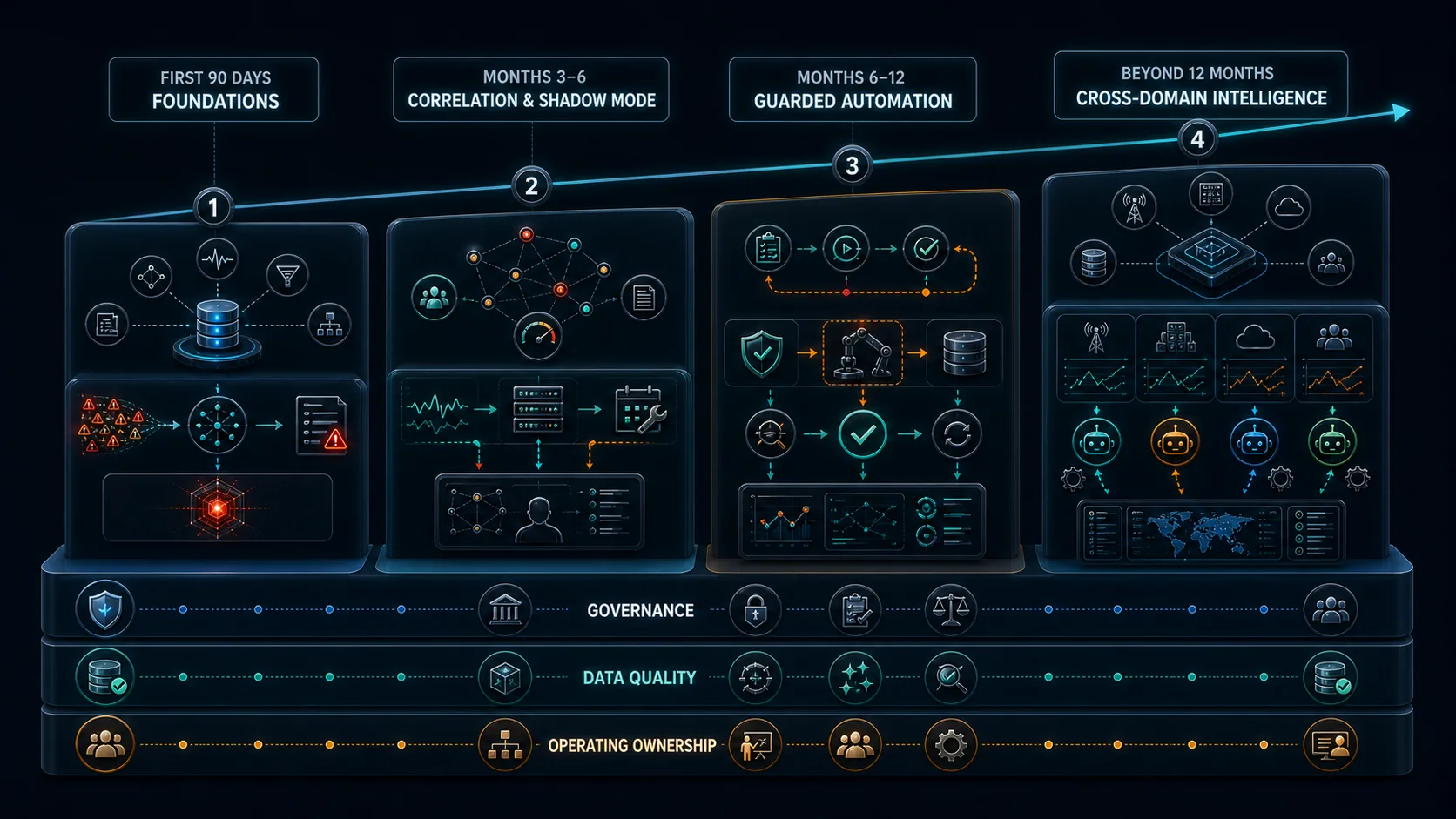
A staged path to production
First 90 days: select one bounded, high-volume domain such as transport or RAN. Establish data contracts and topology ownership; measure baseline alert volume, incident volume, MTTR, and complaint correlation. Implement deterministic deduplication, maintenance suppression, and one incident record.
Months 3–6: add topology-aware correlation, impact scoring, change correlation, and a human-reviewed RCA hypothesis view. Validate results against resolved incident records and shadow-mode decisions.
Months 6–12: automate only a small number of proven, reversible runbooks. Add verification, rollback, model monitoring, and a feedback mechanism in the incident workflow.
Beyond 12 months: extend cross-domain service models, predictive maintenance, and domain-specific agents. Governance, data quality, and operating-model ownership remain first-class work throughout.
The leadership takeaway
The winning objective is not fewer alerts by itself. It is fewer unexplained, unowned, customer-impacting incidents. Large operators show that the route is a shared data foundation, topology-aware correlation, customer-aware prioritization, evidence-based RCA, and carefully governed automation.
If a team begins with that outcome, its dashboards become calmer, engineers get better incident context, and automation becomes safer precisely because it is introduced gradually.
References and note on evidence
This article synthesizes public operator and industry materials current as accessed on August 24, 2026. Reported operator metrics are context-specific case-study results, not universal performance guarantees. Public material for Turkcell contains less operational detail than the China Mobile, Airtel, and Jio examples; no unverified internal implementation claims are made here.
ITU-T, Requirements for AI-enhanced telecom operation and management (M.3390) (2025), International Telecommunication Union.
TM Forum, Joint innovation drives China’s big three toward autonomous networking, TM Forum case study.
TM Forum, China Mobile achieves Level 4 AN in network operation center with intelligent agents, TM Forum case study.
TM Forum, Airtel’s data-driven transformation journey, TM Forum case study.
Airtel, Airtel deploys Avanseus AI-based predictive maintenance solution (2021), Airtel press release.
Jio Platforms, Adaptive Troubleshooting, Operations and Management (ATOM), product overview.
AT&T Labs, Analytics, AI and Automation, research overview.
Turkcell, 6GEN LAB, research and innovation overview.