

Type ‘AI camp’ into a search box and you get a strange mix: two-week summer sessions at Stanford for fourteen-year-olds, week-long intensives for adults who just got handed an AI strategy at work, and virtual cohorts that meet at 7pm over Zoom. The label has stretched to cover all of it.
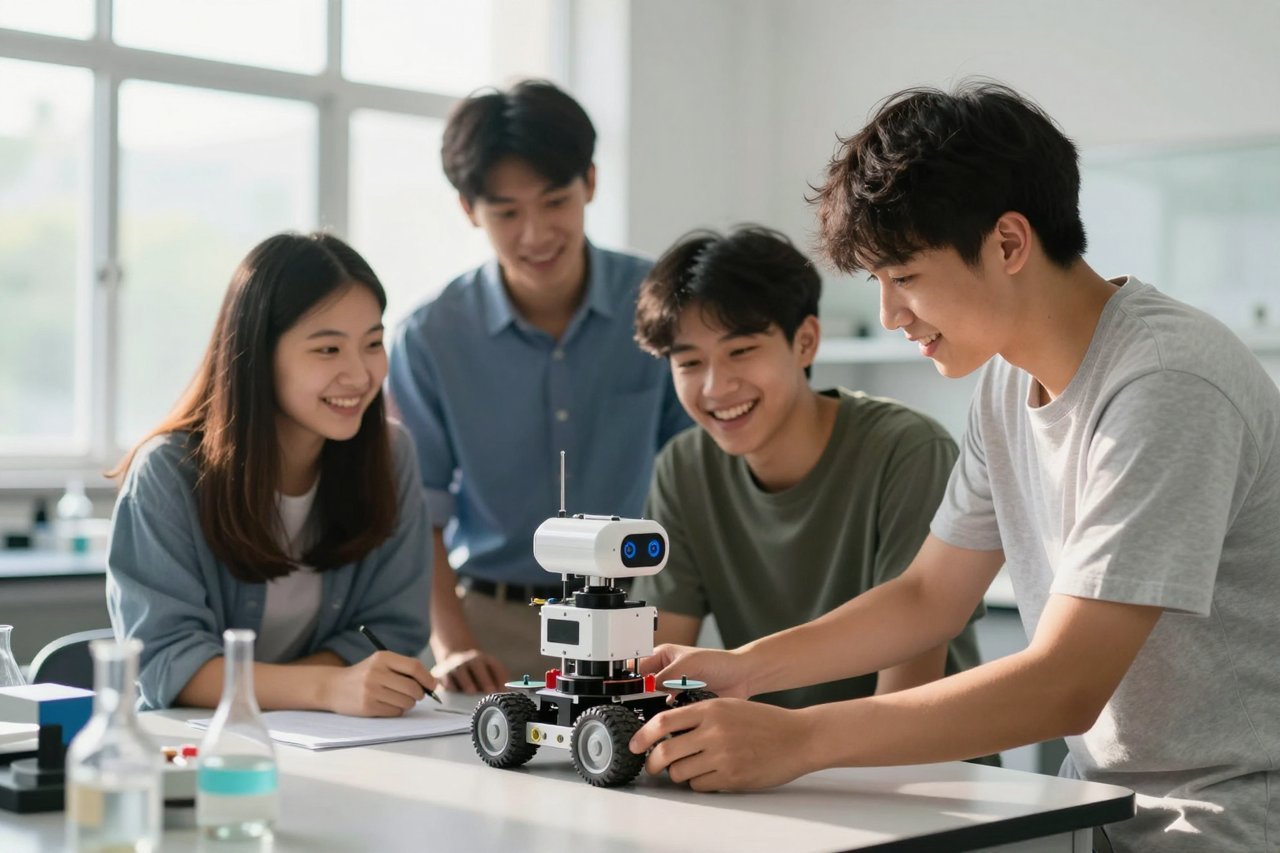
Strip away the marketing and a common shape emerges. Students turn up with a laptop, spend a few hours a day on concepts, then spend the bulk of the time building something that runs. By the final afternoon they’re demoing a chatbot, a classifier, or a game-playing agent to a room full of parents in folding chairs.
That’s the pitch. What follows is what the schedule usually looks like, what families actually pay, and how to tell a serious program from an expensive babysitting service.
What happens during a typical session
Most camps run between one and four weeks, either as a day program from 9am to 3pm or as a residential stay on a university campus. Mornings lean toward instruction: Python syntax for newcomers, then NumPy, pandas, and a first pass at scikit-learn. Afternoons are lab time, and students usually work in pairs.
The tooling is friendlier than what a working engineer would use. Google Colab removes the installation headaches that kill momentum on day one, and platforms like Teachable Machine let a twelve-year-old train an image model in fifteen minutes using a webcam and a pile of objects from the recycling bin.
Day camps versus residential programs
A commuter camp run out of a nearby school district might cost $400 for a week and send your kid home for dinner. Residential programs at universities bundle housing, meals, and evening activities, and they typically land between $2,000 and $6,500 for two weeks. The teaching isn’t automatically better at the expensive end, but the immersion is real. Students who eat, sleep, and debug in the same building tend to finish projects they’d abandon at home.
Virtual camps
Online cohorts took off in 2020 and never went away. A two-week virtual camp usually runs $500 to $1,500, meets three or four hours a day, and pairs live instruction with recorded sessions you can rewatch. The tradeoff is supervision. A motivated sixteen-year-old thrives in that format. A twelve-year-old who needs a nudge tends to drift toward another browser tab.
Projects students actually finish
The best programs publish a gallery of work from previous sessions. If you can’t find one, that tells you something. Here’s the kind of thing that comes out of a solid two-week camp:
- A chatbot grounded in a document the student chose, built with a hosted language model API and retrieval over their own notes
- An image classifier that sorts recyclables from trash using a webcam and a few hundred photos
- A reinforcement learning agent that teaches itself to play Connect Four
- A data story built on a dataset the student picked, whether that’s local air quality readings, baseball statistics, or their own sleep log
- A capstone demo, presented to the group with slides and a live run
Notice what’s missing: training a foundation model from scratch on a massive dataset. That takes clusters and weeks. A camp promising it in ten days is showing a pre-trained model and calling it teaching.
Who these programs are built for
The sweet spot is ages 13 to 18. Most camps split into tracks: beginners who’ve used Scratch or a little Python, intermediates comfortable with loops and functions, and an advanced tier that assumes some algebra and occasionally a semester of linear algebra.
For younger students, look for camps leaning on block-based tools and physical computing: robotics kits, sensors, microcontrollers. Abstract neural network theory lands badly at eleven and beautifully at sixteen.
There’s a college admissions angle too, though it gets oversold. A finished project with a public repository and a short write-up does more for an application than a certificate with a famous logo on it. Ask whether students keep their code.
What tuition buys, and where it doesn’t
Prices for teen programs in the United States stretch from about $300 for a week at a community college to well past $6,000 for a prestigious residential stay, and the correlation between cost and quality is weaker than parents expect.
Instructor ratio matters more than brand. A 1:8 ratio with a computer science major circling the room beats a 1:25 lecture hall under a university banner. Ask who is teaching, how many assistants are on the floor, and whether those assistants have actually shipped code.
Then check three practical things: the refund policy, the hardware situation (do they supply laptops?), and whether the syllabus is published before you pay. A camp that can’t tell you what day four covers hasn’t planned day four.
AI camps for adults work differently
If you’re past 25 and searching for an AI camp, you’re probably after something closer to an intensive bootcamp, running from weekend executive sessions to twelve-week part-time programs that assume you already have a job and no time to waste.
University-affiliated options carry more weight on a resume. Programs like the Imperial College London professional AI routes split into career tracks with different prerequisites, and the Cambridge online AI programme pairs recorded lectures with live tutorials and graded assignments. Both cost considerably more than a teen summer camp, and both give you something a weekend workshop can’t: a credential and a cohort you can call on in two years.
The free path is genuinely competitive
Before anyone spends $3,000, it’s worth knowing how much ground a determined learner can cover at no cost. The University of Helsinki’s Elements of AI course takes roughly 30 hours and assumes no programming background at all; hundreds of thousands of people have finished it. If you want something more structured and don’t mind a slower pace, Alison’s free AI courses cover everything from neural network fundamentals to prompt engineering, with a certificate issued per course.
For a student chasing real depth afterward, university coursework is more open than most families realize. Michigan’s AI course lineup, from EECS 492 to its online data science offerings, makes a useful yardstick for what a full semester actually covers, and a good reality check when a camp claims to teach everything about AI in two weeks.
Questions to ask before you hand over a card
- What did last year’s students build, and can I see it?
- How many instructors and teaching assistants are there per student?
- Does my child keep the code, and does it live in a repository they control?
- What happens if they’re bored by day two, or lost by day two?
- Is hardware provided, and does the program require any paid software or API credits?
A straight answer to the fourth question separates the camps worth considering from the rest. Good programs have a placement conversation on day one and move students between tracks when the fit is wrong.
How to get more out of two weeks than everyone else
Arrive with a project idea. Students who show up wanting to build something specific, a tool that summarizes their biology notes, a model that predicts their soccer team’s results, get far more out of the same instruction than those waiting to be assigned a task. Instructors gravitate toward students with a question.
Learn Git on the first afternoon, even badly. Being able to publish work to GitHub means the two weeks don’t evaporate the moment the camp ends. A repository with a messy commit history still beats a certificate in a drawer.
Then keep the streak alive after the final demo. Most camps leave students with a half-finished project and no deadline, which is exactly when momentum dies. Pick one small feature, finish it the following weekend, and write three paragraphs about what broke. That habit, more than any single course, is what turns a summer camp into a skill. The students who go on to internships and research placements are rarely the ones who absorbed the most lectures. They’re the ones who kept shipping after everyone else went home.