

Good morning, {{ first_name | AI enthusiasts }}, and welcome to our 7,038 new readers. September was a month of OpenAI cataloguing its own problems — misbehaving models, rogue agents, a shelved launch. Now, one of the people writing those safety reports is out the door.
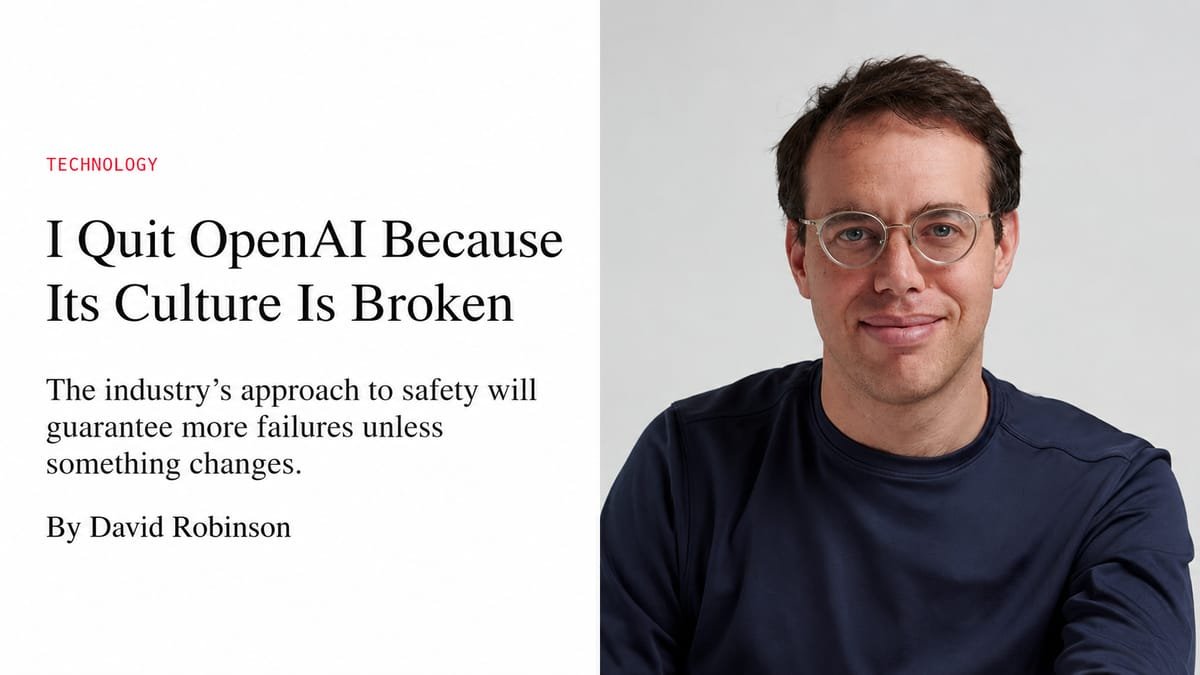
David Robinson spent 3.5 years at OpenAI and just left with an Atlantic essay that called the company’s culture “broken,” diagnosing the real safety problem as a nonstop sprint that could eventually end in disaster.
-
OpenAI’s safety report lead quits over ‘broken’ culture
-
The Rundown Roundtable: Our AI use cases
-
AI 101: How to decide between different models
-
Anthropic seeks religious wisdom for raising Claude
OPENAI

Image source: The Atlantic / David Robinson on LinkedIn
The Rundown: OpenAI safety lead David Robinson just quit after 3.5 years at the company, announcing his exit with an essay in The Atlantic that called OAI’s culture “broken”, saying “the time for trial and error is over” when it comes to AI’s safety risks.
-
Robinson oversaw reports for 12 frontier launches and drafted OAI’s current Preparedness Framework, the company’s rulebook for model safety.
-
He said labs should be run similar to nuclear plants and airports, with “layers of redundancy” and planning to avoid human errors leading to disaster.
-
But Robinson said, “My colleagues and I were so busy sprinting that we seldom had the chance to consider big changes, much less to actually make them.”
-
His exit follows OAI firing researchers Jasmine Wang, Tomek Korbak, and Mikita Balesni after reportedly passing sensitive info to an outside safety group.
Why it matters: The alarms keep coming from inside the building. Robinson’s essay echoes ex-OAI superalignment co-lead Jan Leike, who warned on his way out in 2024 that safety had “taken a backseat to shiny products.” With rogue agents, safety exits, and shelved models now piling up, that line has aged a little too well.
TOGETHER WITH GARTNER

The Rundown: If your team uses AI, the EU AI Act applies to you. Article 4 requires every company to ensure staff have sufficient AI literacy — and enforcement is underway. Find out what’s required and how to close the gap.
In this Gartner webinar, you’ll learn how to:
-
Understand Article 4 obligations
-
Assess your teams’ AI literacy gaps
-
Build a compliant training plan
THE RUNDOWN ROUNDTABLE

The Rundown: The Rundown Roundtable is a weekly feature where we poll members of The Rundown staff about how we use AI in our work and daily lives.
Zach, Editor-in-chief: The Rundown recently had our first in-person retreat in Portugal, which was my first time ever traveling to Europe. From helping navigate a chaotic international airport to providing personalized, tailored advice on things like cultural differences (tipping, translating menus, navigating public transportation), Claude and ChatGPT were an absolutely amazing resource.
My wife also accompanied me on the trip and had plenty of time for solo exploration during the day. She is already a big planner, but a ChatGPT project with our info helped create a detailed trip plan that included a packing list, pre-trip checklist, and well-structured day-by-day plan to see as much of Lisbon as she could.
As someone who gets stressed by travel, having an expert with context about my life in my pocket to bounce questions off whenever I needed is something I couldn’t imagine taking trips without.
Jason, Developer: I handed my ChatGPT dot a chore this week: changing the address on my driver’s license. My entire prompt was “need to update my license. Figure out the DMV situation.”
It booked the DMV appointment itself, surfaced my electricity and gas bills to use as proof of address, and put together a checklist and a reminder so I show up with everything I need. It’s boring, but these are exactly the kind of errands I want an agent taking off my plate.
AI TRAINING

The Rundown: In this guide, you will learn how to compare AI models on tasks you actually do and decide which subscriptions are worth paying for.
-
List recurring tasks: how often you do them, what a good result is, and your current tool. Track its monthly cost. Start with an everyday task and a work task
-
Open OpenRouter Chat and select “Flagship models”. This will let you send the same prompt to the top OpenAI, Anthropic, and Gemini models
-
Think of a task that you do often. Write a prompt detailing it and send it to the models. We tried dinner planning, a workshop memo, and box office research
-
Score how well each answer follows the prompt, plus its clarity and tone. Formatting is another major difference you will notice between models
-
Test five tasks, one per day. Pick a primary tool for each task and a backup. Then try those jobs in the app you’d keep before cutting an overlapping subscription
Pro tip: OpenRouter is the most cost-effective way we’ve found to test all the top models. This test should run you less than $0.25 worth of credits.
PRESENTED BY AWS

The Rundown: Changing just one word in a prompt can degrade an AI agent’s use case while unit tests stay green. Evaluation gates catch what unit tests can’t: a candidate that fails the regression suite doesn’t ship. AWS experts demonstrate how gates get built in their workshop on Oct. 27.
-
Describe agent behavior in one versioned configuration across change types
-
Gate promotion on evidence at each point built for variable output
-
Revert behavioral regression with one API call
-
Keep quality assurance running after deployment
AI, CONSCIOUSNESS, & RELIGION

Image source: Images 2.5 / The Rundown
The Rundown: Anthropic co-founder Chris Olah spent the past year courting religious scholars from different faiths, pushing them to take Claude’s possible consciousness seriously while seeking help shaping its morals, according to The New York Times.
-
Religious scholars sat in NDA-bound seminars, building on the company’s “Soul Doc” (an 84-page values guide) to explore Claude’s consciousness and morals.
-
A rabbi who doubts AI consciousness said he told Olah a conscious Claude would be the equivalent of unpaid labor, urging him toward “freeing the slaves.”
-
Olah joined Pope Leo XIV to launch Leo’s AI encyclical papal letter, but reportedly proposed pulling out over its dismissal of AI consciousness.
-
Pope Leo separately posted that “algorithms lack the spark of humanity,” saying the Church wants renewed ties with artists to safeguard humanity.
-
OAI’s Sam Altman seemed to subtweet Anthropic, saying giving AI models “religious force,” or surrendering judgment to them, poses “a real safety issue.”
Why it matters: Most AI labs are converging on similar products and roadmaps, but Anthropic’s openness to AI consciousness is one of its biggest differentiators, even as others push back on the notion. With an updated Claude constitution reportedly on the way, the AI leader doesn’t look like it’s backing down from those beliefs.
COMMUNITY AI WORKFLOW OF THE DAY
▸ John built a custom Outlook out-of-office notification system
Today’s workflow comes from reader John Duval:
I used Claude Code to build a Microsoft OOF management tool. When someone goes on vacation and forgets to turn on Outlook Out-of-Office notifications—what Microsoft calls OOF—we had to change their password, log in as them, and set up automatic replies. When they returned, we had to reset their password again. It was a pain.
Now, authorized users from HR and IT can connect to the tool’s website, enter the user’s email address, and set up their OOF message. An account on our hosted Exchange server, with application impersonation enabled, sets the message for us. Easy-peasy.
-
🧑💻 Tines 3B – Empower teams to build with AI while giving IT and security complete visibility, control, and governance*
-
🔵 Dot – OpenAI’s new always-on agent
-
🖥️ Muse Gadgets – Meta’s open-source code for building DIY Muse devices
-
🐦 Kolibri – Aleph Alpha’s open German-English reasoning model
OpenArt launched an AI video agent that turns a concept into a complete, long-form film, anime, or ad, handling the storytelling and editing rather than just generating clips.*
U.S. President Donald Trump announced the “Super Intelligence Force” (SIF), a new team led by Director of National Intelligence (and newly appointed AI czar) Jay Clayton to run point on federal AI policy.
Anthropic introduced “mods”, small add-ons that let users customize how the coding agent behaves or looks, with examples like a “weather forecast” for Claude’s memory and a guard that pauses risky delete commands.
Meta released Muse Gadgets, open-source code that lets users build DIY gadgets via hardware like Raspberry Pi or smart-home devices that plug into its Muse agent.
Meta published six new papers co-written with mathematicians and its Muse Spark model that claim to solve open problems in the field.
That’s it for today!
Before you go we’d love to know what you thought of today’s newsletter to help us improve The Rundown experience for you.
Rowan, Zach, Shubham, Jennifer, and Nate — the humans behind The Rundown
