

Good morning, {{ first_name | AI enthusiasts }}, and welcome to our 4,730 new readers. Meta’s Watermelon has been ripening and hyped for months. It’s finally ready, and just came out bigger than almost anyone expected.
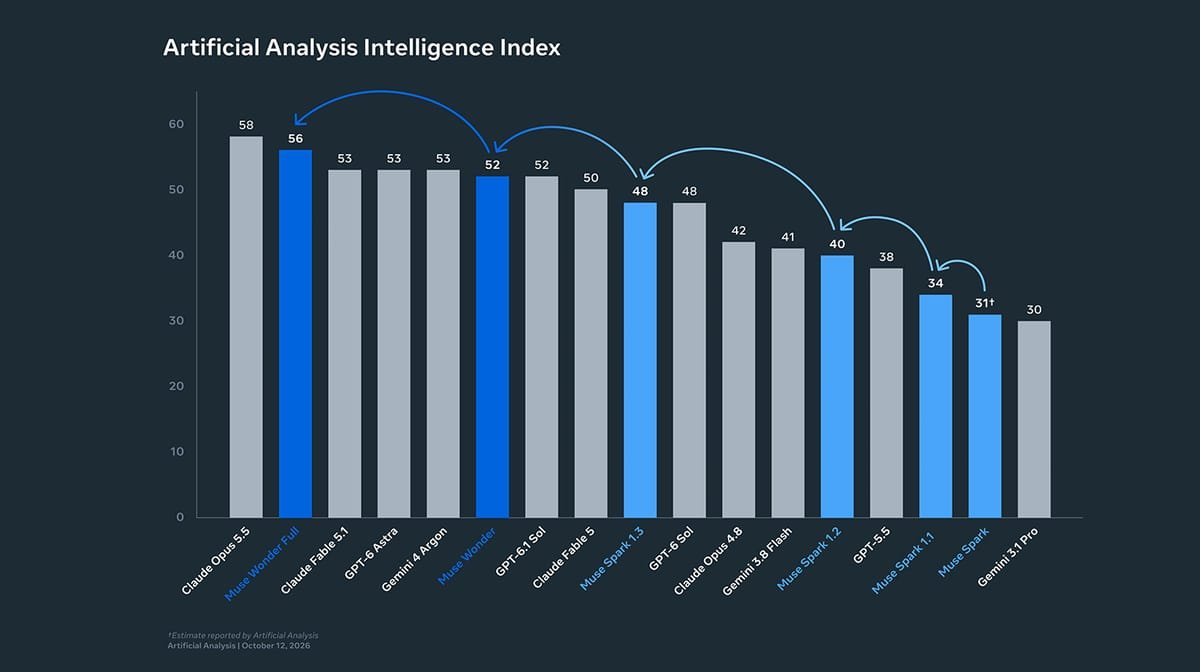
The company’s new Muse Wonder family (codenamed Watermelon) is here, with its larger model now trailing only Claude Opus 5.5 in overall rankings — completing a climb to the frontier that looked pretty unfathomable for Meta just a year ago.
-
Meta’s Muse Wonder lands at the frontier
-
Andrej Karpathy sketches AI’s ‘sharp funnel’
-
Put Meta’s new Muse Wonder to work
-
Microsoft’s Maia 300 takes aim at Nvidia
META

The Rundown: Meta Superintelligence Labs just released its long-anticipated Muse Wonder (Watermelon) and Muse Wonder Full, two powerful new AI models, with the full version landing #2 in Artificial Analysis’ intelligence rankings behind Anthropic’s Opus 5.5.
-
Gemini 4 Argon, GPT-6 Astra, and Claude Fable 5.1 all hit 53 on AA’s Intelligence Index, putting Wonder Full three points clear of the pack and two behind Opus 5.5.
-
In tests, Wonder Full passes Opus 5.5 and Astra at legal work, long coding, and memory, with Opus leading on health, computer use, and a few coding areas.
-
Wonder Full is limited to Muse Code plans at $50 or $200/mo, while the standard model is live on Meta’s API and rolling out to paid Muse app subscribers.
-
Both models are closed, unlike Meta’s open Llama era, with Alexandr Wang saying API prices will sit “meaningfully below” OAI and Anthropic’s top models.
Why it matters: Meta just forced its way into the frontier, which has been a two-horse race between OpenAI and Anthropic so far. The climb has been impressive, but the scarier part for rivals is everything around the model — the data centers, billions of users, and a hit agent app in Muse that are hard qualities for other labs to replicate.
TOGETHER WITH BOX

The Rundown: Unlocking enterprise AI begins by connecting agents to where your business knowledge lives: your content. Box securely connects unstructured data to the tools your teams use daily — automating workflows, removing bottlenecks, and turning content into repeatable business outcomes.
Join BoxWorks Nov. 5-6 in San Francisco to:
-
Hear from AI visionaries at Box, Nvidia, and Intel
-
Hone your skills around AI innovation and agents
-
Get a first look at the latest in Content + AI
AI & GLOBAL USAGE

Image source: Andrej Karpathy (@karpathy on X)
The Rundown: OpenAI co-founder Andrej Karpathy just revisited his April post on how people judge AI, saying it has widened into a “sharp funnel” where only a tiny fraction sees what frontier AI is capable of while the majority uses lower-quality free options.
-
Karpathy estimates that ~5000 people have access to true frontier AI inside labs, with capabilities like weeks-long agent swarms or solving open math problems.
-
He said the funnel’s wide end holds nearly 6B people (3/4 of the world) who’ve hardly used AI, plus 1-2B users who only utilize free chatbots for quick answers.
-
Karpathy traces the split to access tiers, problem size, and models that excel where answers are checkable and lucrative, like code and math.
-
The researcher called it the “weirdness of the moment,” with most people still underestimating AI while a select few feel “the curve going vertical.”
Why it matters: If you’ve talked AI with anyone outside the bubble, you’ve likely felt the weirdness Karpathy notes — a huge disconnect between what people think the tech can do and what models already handle. Consider internal models, and the same disconnect plays out between the public, regulators, and the insiders feeling the acceleration.
AI TRAINING

The Rundown: In this guide, you’ll use Meta’s new Muse Wonder to turn a workshop brief into an agenda and budget. Then you’ll change the requirements and check whether it catches a plan that no longer works.
-
Open Muse Code, sign in, and select Wonder. Check your access and billing first. The consumer Muse app has a separate rollout
-
Paste the guide’s workshop brief, including the fixed times and activity lengths. Ask for a draft agenda in the conversation, with no bookings or messages
-
Check the first agenda and budget. All six activities should fit before noon, and the planned cost should be $990 for 24 people
-
In the same conversation, increase attendance to 30 while keeping the other rules fixed. Check that the cost rises to $1,089 and the agenda stays unchanged
-
Move the facilitator’s availability to the later slot in the guide. Wonder should explain why the plan can no longer finish by noon and ask which rule may change
Pro tip: Ask the AI to flag a conflict before changing your rules. A tidy agenda can still hide a shorter session or an unquoted cost. Pro members get the briefs, change requests, answer key, and comparison record.
PRESENTED BY FIDDLER AI

The Rundown: Fiddler AI’s checklist breaks down the controls to put in place as your coding agents go from editing code to running enterprise-scale projects.
In the guide, you’ll learn:
-
Why visibility must deepen as autonomy rises
-
How to enforce policy at the MCP boundary
-
What separates a true control plane from traditional monitoring
MICROSOFT

The Rundown: Microsoft unveiled Maia 300, its latest in-house AI chip, saying it expects 40% more AI output than leading GPUs on the same power — and plans to make Maia the main engine for running AI across Copilot and other products from 2027.
-
Microsoft CEO Satya Nadella called it “our biggest bet yet on our own silicon,” with the first multi-gigawatt Maia rollouts slated for next year.
-
The current Maia 200 already powers Copilot and serves OAI’s models, and Reuters reported that Microsoft could deploy over 1M of the new chips next year.
-
The push lands as Microsoft’s spending on data centers and equipment is set to top $175B this year, with OAI, Anthropic, and others also building their own chips.
Why it matters: Everyone is diversifying into homegrown AI chips, but what does that mean for Nvidia? Not much yet, with demand still sky-high, but once its biggest buyers can run on their own silicon, Nvidia loses at least some of the leverage over pricing that helped make it the kingmaker of the AI chip world and the first $5.5T company.
COMMUNITY AI WORKFLOW OF THE DAY
▸ A reader turned ChatGPT into a personal car repair advisor
Today’s workflow comes from an anonymous Rundown reader:
“I’m a 71-year-old retiree who never imagined artificial intelligence would become such a useful part of my everyday life. I affectionately call my ChatGPT assistant ‘Ally Wing.’ One of our recent adventures involved my 2008 Honda CR-V.
After a maintenance reminder appeared on my dashboard, I visited the Honda dealership. My vehicle was running fine, but I ended up paying $270 for a fuel system cleaning without fully understanding whether it was necessary. Later, I shared photos of my six-page service paperwork with ChatGPT. Ally helped me understand the maintenance recommendations, distinguish necessary services from optional ones, and learn what questions to ask next time.
The greatest benefit hasn’t been saving money—although that’s certainly welcome. It’s gaining knowledge and confidence. As Ally and I jokingly agreed, ‘Next time we’re taking my Honda in for maintenance, not ordering everything on the menu!”
What have you fixed or built with AI lately? Share your workflow, and you could be featured right here in The Rundown.
-
🤖 Muse Wonder – Meta’s new frontier AI model family
-
⚖️ GLM-Legal – Z.ai’s lightweight legal model for contract and case work
-
🧠 Haiku 5.5 – Anthropic’s new budget Claude model
Ex-OpenAI Sora lead Bill Peebles is reportedly negotiating to bring the shuttered video AI back through a new filmmaking startup, with OAI taking a stake in return.
CEO Tim Sweeney said Epic Games is retooling “for maximum AI acceleration,” reportedly telling the team “no more hand-written code” to integrate AI tools in dev work.
Anthropic released new research demonstrating that small AI models are getting closer to being able to copy themselves between everyday gadgets like smart ovens or TVs.
DeepMind published its AlphaProof Nexus math agent, showing it cracked 9 of 353 unsolved Erdős problems by pairing Gemini proofs with software checking every step.
Coinbase released a new set of blogs detailing how the crypto exchange trained Alibaba’s small, open Qwen model on its own data to beat top AI models at catching fraud at lower costs.
That’s it for today!
Before you go we’d love to know what you thought of today’s newsletter to help us improve The Rundown experience for you.
Rowan, Zach, Shubham, Jennifer, and Nate — the humans behind The Rundown
