

As manufacturers across industries strive to reduce their reliance on Chinese suppliers, Indian startup Scimplify has raised $25 million to expand its AI-powered approach to producing specialty chemicals and critical materials, with semiconductors, defense and energy emerging as key growth markets.
The all-equity strategic round was led by Hitachi Ventures, with customers Henkel and Teknor Apex joining as new investors. Existing backers Accel India, Bertelsmann India Investments, Omnivore, and 3one4 Capital also participated. The round values the Bengaluru-based startup at $250 million after the investment, according to a person familiar with the transaction, up from $150 million after a $40 million Series B round in March 2025. The latest investment brings Scimplify’s total equity funding to $80 million, the startup said, though it declined to disclose its valuation.
The growing adoption of AI and advanced computational tools has accelerated materials discovery and research. However, turning promising chemistry into commercially available products at scale remains a slow and complex process. Manufacturers need to develop production processes, qualify facilities, and meet stringent quality standards, all while navigating supply chains limited to a handful of countries. Scimplify is seeking to shorten that process.
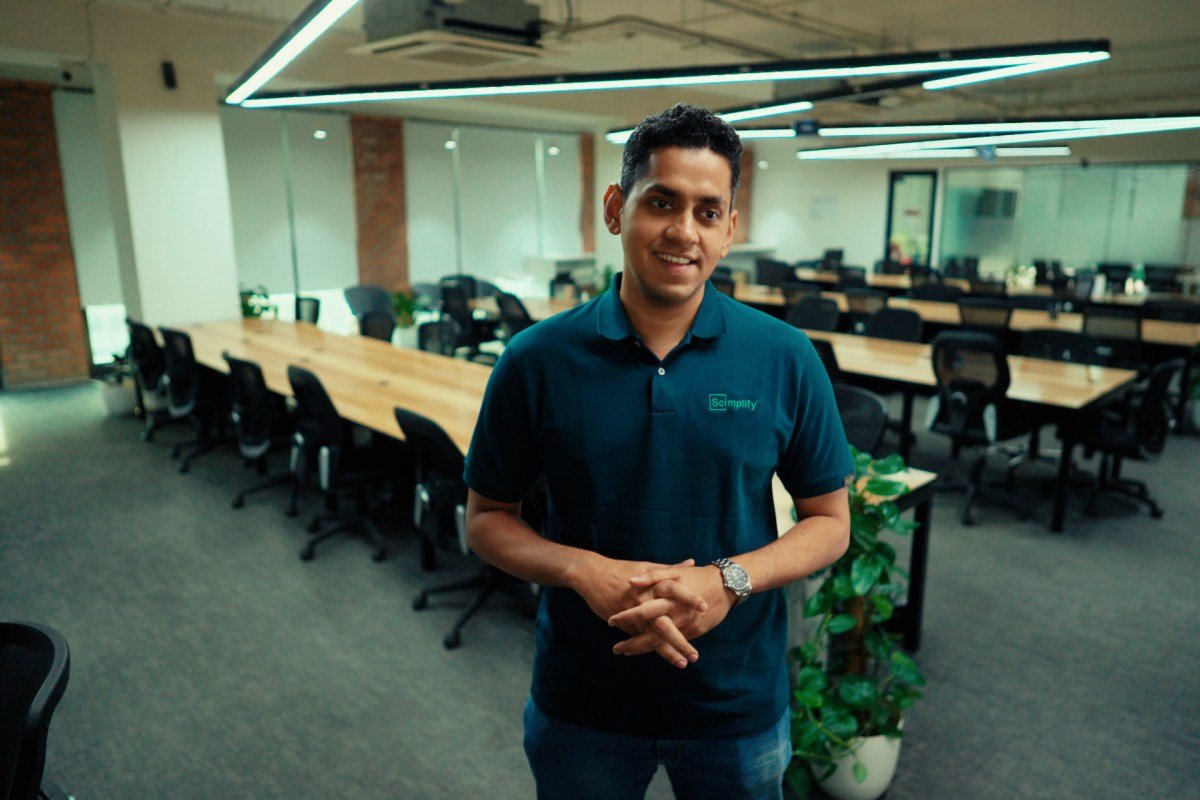
In some cases, the startup, founded in 2023, has gone from receiving a customer’s requirements to delivering the finished material in just two months, compared with the 12 to 18 months such work would typically take, co-founder Sachin Santhosh (pictured above) said in an interview.
Once it receives an order, Scimplify develops chemical manufacturing processes at its research facilities in Bengaluru and Hyderabad and then transfers them to partner factories for commercial production. Its proprietary AI platform, Scinode, helps coordinate the work by identifying suitable production routes and manufacturing facilities, while tracking quality and regulatory requirements. The platform uses specialized AI agents for different functions, including research, manufacturing and quality control, Santhosh told TechCrunch.
“Each of these agents is basically solving for what [a customer] would want, working backward from the customer’s requirement,” Santhosh said. “This helps us move a lot faster and remember customer context even for future references.”
Scimplify’s in-house team of scientists and engineers oversees production across a network of more than 500 manufacturing facilities. It helps customers establish alternative sources for materials whose supply is concentrated in China and a few other countries.
About 90% of Scimplify’s manufacturing currently takes place in India. The startup, however, plans to expand its production network to the U.S. and Japan over the next year as it seeks to attract more customers in both markets, Santhosh said.
The U.S. has emerged as a key growth market, with Simplify’s annualized revenue run rate in the country rising sixfold to about $60 million from $10 million a year ago, according to Santhosh. The market now accounts for roughly 30% of its business, while customers outside India collectively contribute more than half of its revenue, compared with less than 5% about 18 months ago.
Overall, Scimplify, which serves more than 1,000 customers and has delivered products to more than 40 countries, has reached an annualized revenue run rate of about $200 million, tripling from a year earlier, Santhosh told TechCrunch. The startup is targeting a $400 million annualized revenue run rate over the next year. Scimplify has also been EBITDA-positive for the past two months and expects to turn profitable after tax this month, he said.
Energy, electronics and defense now account for about 45% to 50% of Scimplify’s revenue, up from less than 15% a year ago, Santhosh stated. The growth comes as AI fuels demand for materials used in electronics and energy infrastructure, while ongoing wars drive demand from the defense industry.
Scimplify is working on producing tungsten derivatives from scrap, offering customers an alternative source of materials whose supply is heavily concentrated in China. The startup is also working on rare earth materials, another category where global supply chains remain heavily dependent on China.
The startup works with customers including Japanese electronics manufacturer TDK, German chemicals group BASF, and Hitachi. Santhosh cited a project involving TDK as an example of how the startup can shorten the time needed to develop and deliver specialty materials. Timelines, he said, vary depending on the project.
With its latest funding, Scimplify plans to deploy around $7.5 million for its U.S. expansion, including building out its manufacturing network, Santhosh said. It also earmarked another $2 million for further development of Scinode.
The startup employs about 340 people, including roughly 70 scientists. Most of its workforce is based in India, though it also has local teams in the U.S., Japan, Indonesia, and the UAE.
When you purchase through links in our articles, we may earn a small commission. This doesn’t affect our editorial independence.