

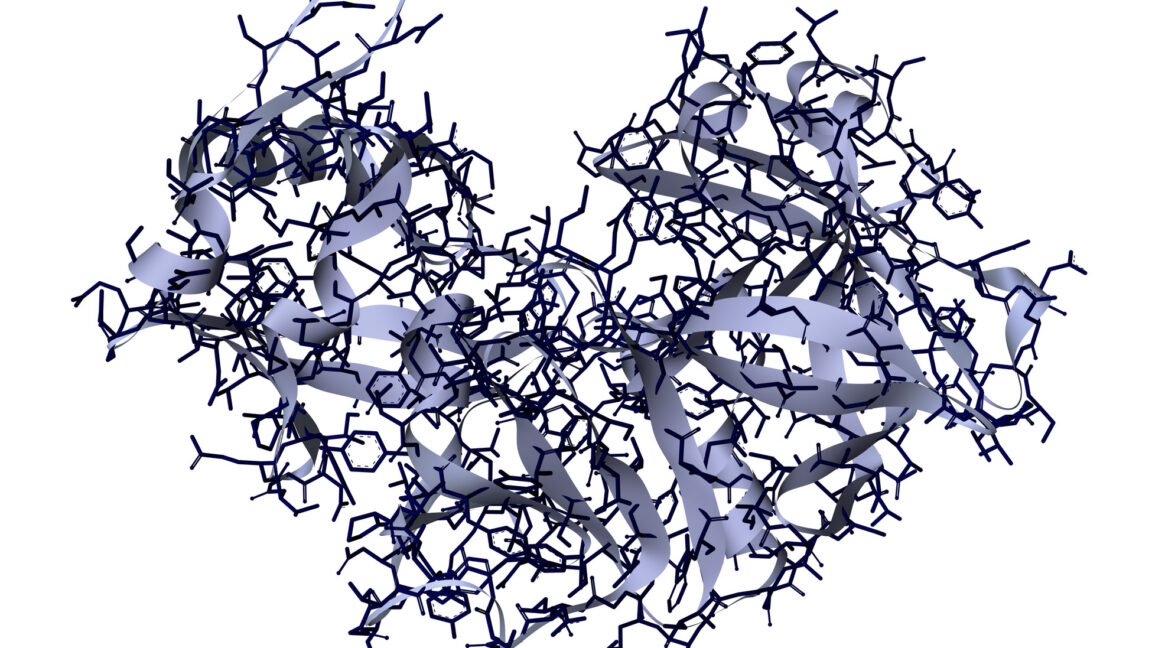
A protein is a chain of amino acids held together by what are called peptide bonds. On their own, those bonds are extremely stable; they’re estimated to have a half-life of several hundred years. But in Earth’s environment, most proteins don’t last nearly that long. That’s because organisms have evolved a handful of ways to catalyze the break-up of peptide bonds, which have diversified into countless specialized protein-digesting enzymes. Proteases are everywhere and generally make short work of any proteins that find their way into the environment.
Now, researchers have basically short-circuited the diversification process, using AI-based protein design tools to take the catalytic core of two types of protease and replace the entire rest of the protein. The resulting enzymes could be tuned to cut specific proteins in half, and the researchers demonstrated their effectiveness by using them to cut proteins associated with neurological diseases.
Cutting proteins
The basic peptide bond isn’t especially interesting-looking—it’s what you get when you link an amino group to an acid, releasing a water molecule in the process. As their name implies, amino acids have both an amino and an acid group, allowing them to form peptide bonds on two sides of the amino acid. This is critical for building up the long chains found in proteins. (The amino acids also have side chains with distinctive chemistry, which gives a backbone specific properties.)
Peptide bonds are formed by the removal of a water molecule from parts of an amino group and an acidic group.
Credit:
Wikimedia Commons
Breaking these bonds apart simply reverses the process by breaking apart the peptide bond and a water molecule, and linking their parts. Because both components are chemically stable, the reaction requires an enzyme to occur with any frequency. Without an enzyme, a typical peptide bond would be stable for hundreds of years in water.
Life has evolved a handful of enzyme mechanisms that manage this catalysis. The research at issue here relied on two different ones. One is a zinc protease, where the positive charge of the zinc atom coordinates the peptide bond that’s being broken, key parts of the protease, and a water molecule. The protease partially pulls a proton off the water molecule, activating it to attack and break up the peptide bond.