

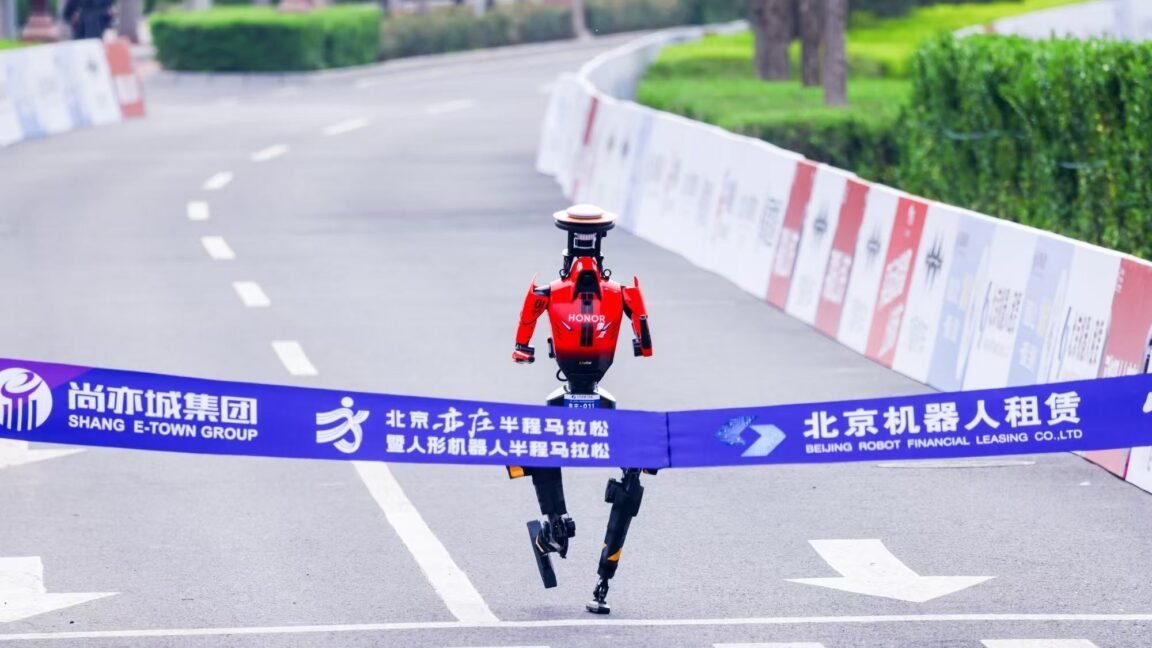
Humanoid robots outran the fastest human competitors while surpassing the human world record during a half-marathon event held in Beijing on April 19. The demonstration of fast-improving robotic speed and autonomy comes as China’s tech industry is rapidly scaling up mass production of humanoid robots to explore possible uses in the real world.
The fastest robot from Chinese smartphone-maker Honor notched a winning time of 50 minutes and 26 seconds while autonomously navigating the 13-mile (21-kilometer) route, according to the Global Times. That beat the human world record of 57 minutes and 20 seconds recently set by Ugandan long-distance runner Jacob Kiplimo during the Lisbon Half Marathon.
The winning robot design took inspiration from top human athletes by incorporating long legs measuring approximately 37 inches (95 centimeters) in length, said Du Xiaodi, a test development engineer for Honor, who spoke as a member of the winning team to The Associated Press and other news publications. Xiaodi also described the robot as incorporating a custom liquid-cooling system—derived from similar cooling technology for consumer electronics—that could potentially be adapted for industrial applications.
All three top-ranked robot contestants incorporated Honor’s “Lightning” model to operate autonomously and beat the 12,000 human competitors who ran along a parallel track during the half-marathon event, according to Reuters. Last year’s inaugural half-marathon for robotic competitors saw the fastest robot record a race time of 2 hours and 40 minutes—still significantly slower than the human winner of the 2025 event. So a year’s difference has seen notable improvements for autonomous robot runners.
But overall, humanoid robots still have a long way to go in terms of demonstrating their capability to operate in complex and sometimes chaotic environments. Autonomously navigating a half-marathon race course does not necessarily lead to an immediate robotic application or spell assured success in other domains.
The bigger race for humanoid robots
The Beijing half-marathon event—which featured 300 robotic contestants fielded by about 100 primarily Chinese teams—coincides with the billions of dollars invested by Chinese and US tech industries to develop humanoid robots. Until now, industrial and domestic robot deployments have involved highly specialized robots designed to perform particular tasks. Companies are betting that humanoid robots powered by the latest AI models can eventually prove capable of stepping directly into workplaces designed for humans while flexibly tackling a wider range of tasks.