

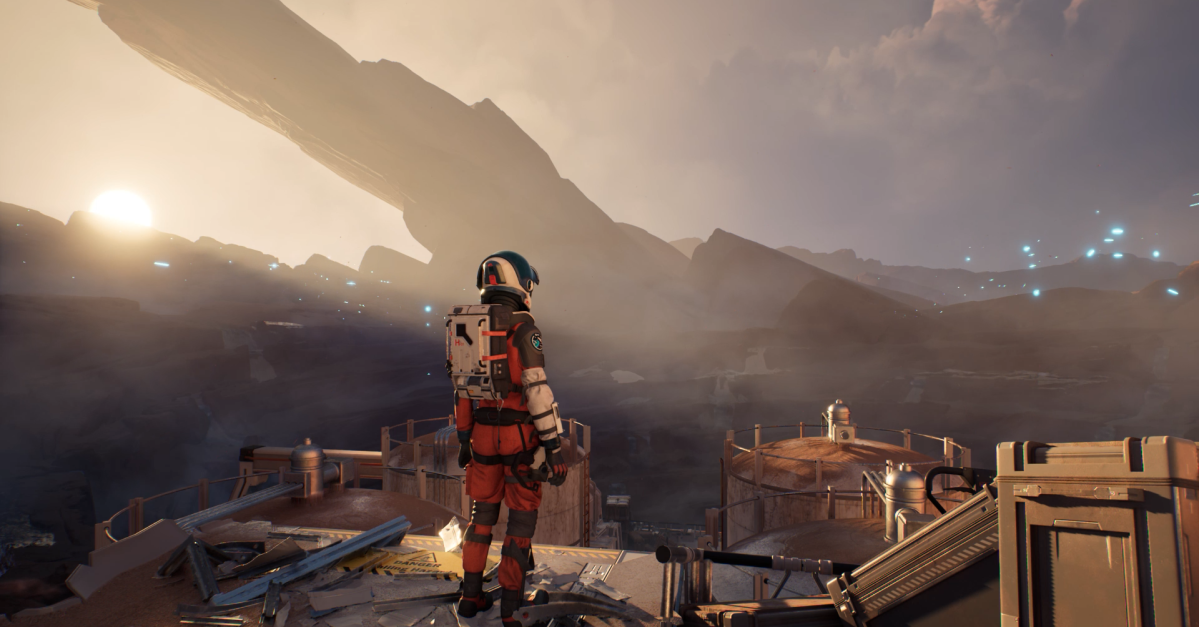
The last few weeks have bordered on overwhelming for science fiction fans. While Project Hail Mary is dominating the box office, For All Mankind is currently in the midst of its penultimate season, with a spinoff streaming next month. When it comes to games, Capcom kicked off a new sci-fi franchise with Pragmata, and Housemarque is about to launch the haunting shooter Saros. With all of that going on, it’d be easy to miss Aphelion. It’s a comparatively small and quiet adventure game, one focused more on storytelling than gameplay. But that also makes it a perfect complement to all of the current blockbusters, offering something much more intimate and approachable.
Aphelion is developed by Don’t Nod, a studio best known for the original Life is Strange and more recently the climbing game Jusant. The new game is sort of a mashup of Life is Strange’s storytelling and Jusant’s gameplay. In Aphelion’s near-future, the Earth is very close to becoming uninhabitable, but a recently discovered planet called Persephone has the potential to be humanity’s next home. Two astronauts, Ariane and Thomas, are sent to investigate just how viable the planet is. Naturally, things go wrong almost immediately. The two crash-land on Persephone and are separated. So in addition to trying to complete the mission for the good of humanity, the pair are also desperately trying to find each other on a cold, seemingly barren wasteland.
Aphelion plays like a third-person action game crossed with a walking sim. Much of the time you’re simply making your way through the environment as the story unfolds around you, but there’s also some puzzle-solving and platforming. Eventually, there’s even some stealth when you encounter a terrifying creature reminiscent of the smoke monster from Lost. But Ariane and Thomas find themselves in very different situations, and thus they control very differently. Ariane is mostly healthy and intact, and so her quest involves much of the climbing and exploration. Thomas, meanwhile, was injured and his suit was damaged, so he struggles to navigate the world while dealing with a faulty oxygen tank. There are no weapons, so you deal with everything either by climbing or using tools like a scanning device and a grappling hook.
If you’re comparing it to the other recent sci-fi games, there’s basically a progression: Aphelion is slower-paced and more accessible, Pragmata is a little faster and much more action-oriented, and then Saros is a pure, thumb-wrecking action game.
The story alternates between the pair’s storylines, as they work asynchronously. It’s kind of like a classic sci-fi novel told from multiple viewpoints. Ariane’s sections tend to be more tense and action-focused, with some really great set pieces that lend the game a cinematic vibe, like when you’re making your way through a terrible snowstorm filled with deadly lightning bolts. The Thomas chapters, meanwhile, are slower and more focused, as you uncover all kinds of new information about the mystery of the planet and the company that sent you to explore it.
Much like Pragmata, Aphelion pulls from all kinds of sci-fi influences — everything from Alien to Cat’s Cradle — so that it feels familiar in many ways, particularly when it comes to the core mystery. But what really drives it forward is the seemingly tragic story of its lead astronauts. I wanted to see them reunite much more than I cared about whatever was going on with Persephone, though eventually that mystery grabbed me as well. (Aphelion’s story is perhaps best described as a less trippy version of “The Very Pulse of the Machine.”)
The dual-perspective story is paced nearly perfectly, and at 11 chapters Aphelion is long enough to tell it without overstaying its welcome. The only real issue I had with the game is how rigid it can be. This isn’t anything approaching an open world where problems have multiple solutions. Instead, progress means following the exact route the designers intended.
Usually this works well enough, but there were a few times where I found myself confused about where to go next or how to proceed, all because I missed a small prompt. This happens most often during the climbing sections, where sometimes it looks like you can go somewhere, but making the leap ends with you falling to your death. These moments can be frustrating and mess with the pacing, but Aphelion does at least have very forgiving checkpoints, so when you die you can pick up right where you left off.
Perhaps the game Aphelion reminds me most of is The Invincible. Both are essentially the video game equivalent of a short sci-fi story, something tightly paced and incredibly focused. Aphelion uses the visuals and gameplay of blockbuster action games to tell a more intimate story, and that’s what makes it stand out during this very busy moment for the genre.
Aphelion launches on April 28th on the PS5, Xbox, and PC.