

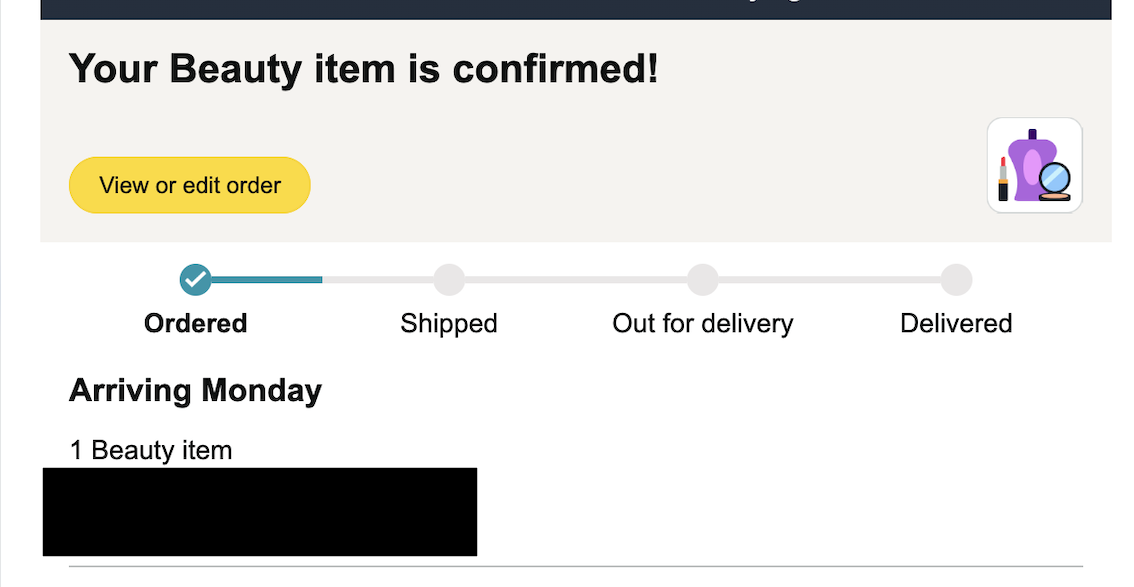
Earlier this summer, Amazon customers began noticing that emails related to their online orders looked sparse: Order confirmation emails didn’t name specific items anymore, and instead listed only item categories.
Complaints about the vague emails appear to have started in July; orders placed as recently as June contain thumbnails and names of the exact item purchased. Some shoppers are complaining to Amazon about the new system, saying the emails with no details make it harder to keep track of purchases (and kind of look like spam or a phishing attempt). Amazon has a long history of tweaking how order emails look — there are complaints going back years about what’s included and what isn’t — but in the last month and a half, more and more shoppers are noticing the vague order update notifications.
AI is likely partially to blame.
Over the last year or so, tech companies have asked consumers to imagine a world where an AI “agent” is doing their bidding for them, including spending their money. Google, with a catalog of billions of products in Shopping, is perhaps best situated to make that vision a reality, and indeed has already introduced a slew of shopping features powered by AI. Gemini Spark can mine a user’s email for crumbs of information to, for example, build custom vacation itineraries, pulling in data like concert ticket confirmations and biographical details about family. In May Google unveiled a shopping cart that works across various merchants that would eventually be integrated into Gmail as well, meaning shoppers could add things to their cart while reading their inbox or watching YouTube. How helpful an AI agent can be depends on how much personal information a user is willing to fork over.
As users hand over more and more data and agency to AI tools, service providers are caught in a bind: If agents are truly as efficient as tech companies say they are, customers and audiences in theory have no reason to visit a website themselves — the agent can just do it for them. (The Verge has been calling this “the DoorDash problem.”) Still, many big retailers, like Walmart, Target, and Wayfair, have signed on to commerce features built into Google’s AI surfaces, hoping that consumers will research, compare, and ultimately purchase their products via chatbots. Notably not on the list of merchants: Amazon.
Amazon has been more protective of its direct relationship with shoppers. Last year the company sued Perplexity for allowing users to shop on Amazon on their behalf; a judge sided with Perplexity earlier this month. Amazon has also been plugging away at AI-powered shopping features of its own, like price tracking and automatic purchasing. Alexa for Shopping is built into the Amazon app, and shoppers can query the chatbot for product recommendations and comparisons without going outside to Gemini or ChatGPT, for example. The Verge asked Amazon directly if the change in email format was to shield purchase information from companies like Google that are building AI-powered shopping tools.
”As customers shop with us more frequently, including on their phones, and use the ‘Your Orders’ page in the Amazon app to get real-time, consolidated order details and delivery status, we’ve simplified several order-related emails to direct customers to our app and website for the latest information on their orders,” spokesperson Maxine Tagay said in an email. “This also reduces customer information shared outside the Amazon app and website to further improve customer privacy.”
In other words: It’s a way to hedge against the DoorDash problem by hiding the meaty information on Amazon’s properties, and to keep customers visiting the retailer directly. The upshot for shoppers is that it’s ever so slightly more annoying to access our own information, too.