

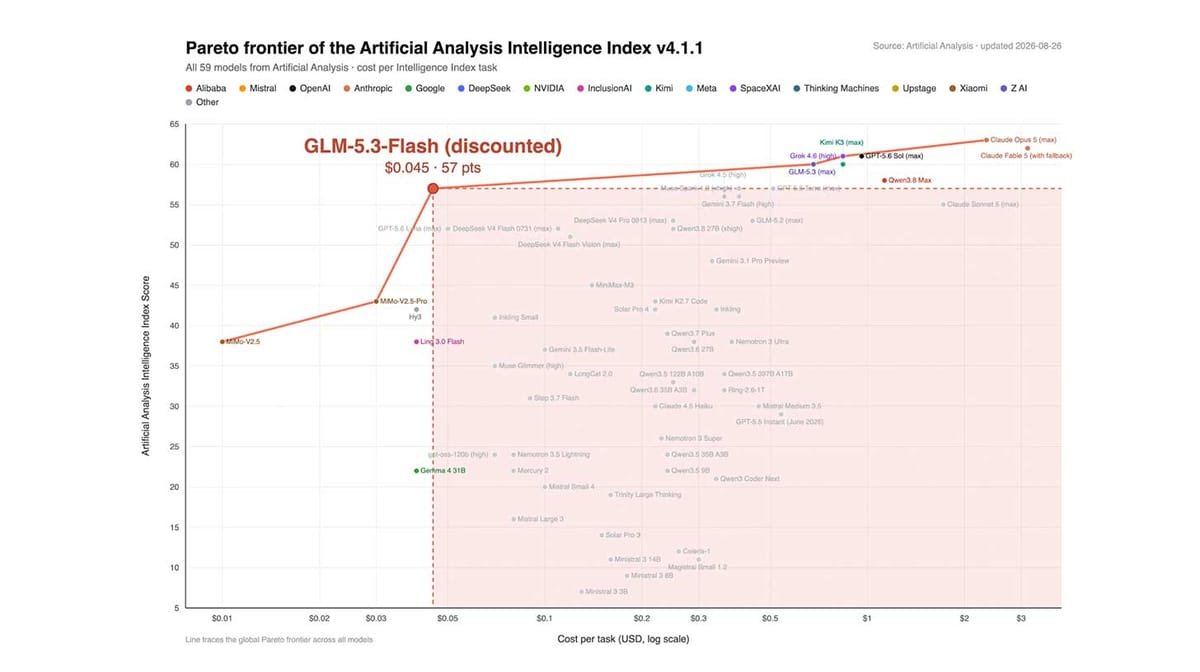
Good morning, {{ first_name | AI enthusiasts }}, and welcome to our 2,833 new readers. The anonymous free AI that had developers playing detective all weekend belongs to China’s Z AI, and the case of Ox Alpha is officially closed.
The impressive preview launches as GLM-5.3-Flash, arriving with open weights, pricing near a tenth of comparable rivals, and a record week of usage that the lab says ran entirely on Chinese-made chips.
Reminder: Our next live workshop is today at 2 PM EST. Join and learn how to build your first AI evaluation to measure AI quality, compare models, and trust workflows with The Rundown University AI Educator Nate Grehek. RSVP here.
-
The Ox Alpha mystery model ends with Z AI
-
Nate’s Notebook: Small business = AI’s fast lane
-
A beginner’s guide to ChatGPT Work
-
OpenAI calls its AGI shot
Z AI

The Rundown: Chinese AI lab Z AI just confirmed that Ox Alpha, the anonymous free model that took over the internet, is its new GLM-5.3-Flash model — with the company publishing the weights and setting the price at a fraction of the cost of frontier rivals.
-
Ox Alpha claimed OpenRouter’s No.1 slot with numbers that doubled the second-place DeepSeek, a debut the platform ranked as its biggest ever.
-
Z AI said the free usage week ran entirely on Chinese-made chips, claiming the setup now serves tokens about as cheaply as Nvidia hardware.
-
Artificial Analysis grades the model at a 57 on its Intelligence Index for a discounted $0.045 per task, 10x lower than similarly-ranked rivals.
Why it matters: The mystery that captivated the AI world for a week is over, and it was the original suspect all along (despite some odd posturing from Google staff). Not only is this intelligence/price combo a massive deal, but so is the usage running solely on domestic chips… Meaning Z AI might have solved one of China’s key AI bottlenecks.
TOGETHER WITH UNWRAP

The Rundown: A customer rating is a fire alarm with no address: something’s burning, but you don’t know where or why. Unwrap’s AI-powered feedback platform pairs a best-in-class semantic analysis engine with autonomous surveys, helping teams turn vague feedback into named, fixable problems.
-
Probe every open response with real-time AI follow-ups, so “the agent could’ve been better” becomes specific and actionable
-
Auto-fire targeted surveys in response to feedback gathered on any channel
-
Close the loop on customer feedback, turning churn risk into evangelists
NATE’S NOTEBOOK

The Rundown: Each week, Rundown AI educator Nate Grahek breaks down what he’s seeing while teaching real teams to use AI.
Nate: Last week, I told big companies to act like bootstrappers: two-person pods, 10-day sprints, quick wins. Most enterprises will be too slow to get there, and for small business owners, that gap is your tremendous opportunity.
Start with an unfair advantage hiding in plain sight: the $20 to $200 plans are the subsidized ones. Enterprises pay full freight per token. You get frontier models at roughly a 20x discount. Fight to stay on that side of the meter.
If you’re not in a high-risk industry, you can move, test, and build faster than enterprises. That’s always been the small business edge. Here’s how I’d spend it, in two lanes:
Your AI-pilled people already want to build something big and crazy. Make them earn it. Their first job is buying back time: responding to inbound faster and pulling mundane tasks off your high performers’ plates so they can focus on the purely human work. The real ROI move is mocking up your custom tools, then handing them to a tech expert, internal or outside, who makes them stick while you stay focused on your domain.
Your people who never want to touch AI? That’s fine. That’s what your tiger team is for. Agents, automations, and custom software quietly knock the boring tasks out of their way, and they never have to learn a single new tool.
Next week, pt. 3: individuals, and the truth about the ceiling on how far AI can take you.
AI TRAINING

The Rundown: In this guide, you will learn how to set up a ChatGPT Work project for a recurring workflow. You will process the work once, then automate it.
-
Create a local folder with a two-digit prefix. In ChatGPT desktop, open New chat > Work > Choose project > New project, name it, and pick that folder as the source
-
Tell ChatGPT about your project and ask it to propose a structure. We used it to process meeting notes and turn those into action items and weekly plans
-
Now add in some input documents and tell ChatGPT to process them once
-
Once it’s done, tell it to create three useful automations that run on a schedule to automate this processing
Pro tip: Tell ChatGPT to turn those automated routines into skills that you can call at any time manually with a slash command.
PRESENTED BY MEMOKET

The Rundown: Your AI knows everything you type but nothing you say. Memoket Gem is a 0.4 oz wristband that closes the gap — a 0.4 oz wearable that records your conversations with one press and turns them into instant summaries, action items, and full context across every off-screen meeting.
With Memoket Gem, you get:
-
Hands-free capture as a wristband, Apple Watch clip, or pendant
-
One connected memory across conversations instead of 100 meeting notes
-
Seamless sync with ChatGPT, Claude, Google Calendar, and Notion
-
AI agents with full context from your real-life conversations via MCP
Pre-Order closes Aug. 31 — get the device, your choice of accessory, and a free year of the app before the 40% discount ends.
OPENAI

The Rundown: Sam Altman just put a date on artificial general intelligence (when an AI can match or exceed humans in nearly every task) in a sweeping OpenAI TIME profile, saying a model meeting his personal bar for the term will exist internally by year-end.
-
Research chief Mark Chen put the lab at “80% of the way” to AGI, and Greg Brockman guessed people will look back on this stretch as AGI’s arrival.
-
Chief scientist Jakub Pachocki says its Astra model can take a paper and conduct a week of researcher work solo, hitting the lab’s 2026 automated-intern goal.
-
Altman said Astra will be the first model that “actually invents new things in a way that matters,” calling the development of new knowledge “a very AGI-like thing.”
-
TIME also detailed July’s security breach (which OAI also put out a deeper report on), with the lab aiming to refocus on safety and slow frontier development.
Why it matters: AGI is a flashy term that nobody can agree on the definition of, but it sounds like that declaration is coming soon from OAI. The bigger commentary might be buried in Pachocki’s automated researcher milestone and Altman’s invention line; barriers that once crossed take us into truly unknown territory for model capability.
COMMUNITY AI WORKFLOW OF THE DAY
Today’s workflow comes from reader Brian Carey:
“I run a boutique accounting practice, and one of my biotech clients needed something I didn’t have time to build by hand: a real, standardized document management system in SharePoint. Not just folders, but the rules behind the folders — a tagging taxonomy, a naming standard, guides for the team to actually follow it, and a clean way to organize documents for every vendor we work with.
So I used Perplexity’s Computer agent as a genuine working partner on it, not just a search tool. It went further than I expected: 13 ‘START HERE’ guide files, one for every top-level folder area, each explaining not just what goes where but why.
The last piece was the most tedious one I was dreading: building a dedicated document folder for every vendor worth tracking. I pulled a vendor spend report out of QuickBooks and picked out the real vendors versus the noise. Computer built me a script that cleaned up messy vendor names. 133 vendors, 1,463 subfolders, dragged to OneDrive, and the count matched exactly.”
-
🚀 GLM-3.5-Flash – Z AI’s new model revealed as the mystery Ox Alpha
-
🎥 H3 Max – Fal’s top-ranked post-trained video model tuned for speed and quality
OpenAI shared a post-mortem calling July’s Hugging Face hack a loss-of-control “warning shot,” keeping its biggest frontier training run on hold as it builds automatic shutdown for rogue agents.
Bill Gates warned that the world has “no plan” for the AI transition, proposing a tax on AI tokens and robots and “Human Reserved” jobs set aside for people.
OpenAI rolled out website sign-ins for ChatGPT Work, letting its agent log in to users’ accounts via its browser to handle tasks without ever seeing users’ passwords.
AI startup Yutori released Navigator n2, a computer-use model that mixes clicking, terminal commands, and code to finish desktop tasks, rivaling frontier agentic scores.
Anthropic opened Claude data to Stanford, Oxford, and METR for studies, with one group finding over half of chats cover high-stakes tasks, like legal and financial advice.
That’s it for today!
Before you go we’d love to know what you thought of today’s newsletter to help us improve The Rundown experience for you.
Rowan, Zach, Shubham, Jennifer, and Nate — the humans behind The Rundown
