

Somewhere between midnight and 6am, a machine learning model quietly blocked 14 phishing emails from reaching your inbox. It has never been told what a phishing email looks like. It learned the pattern from a few billion examples, and it gets a little sharper every time you tap “report spam.”
That is artificial intelligence at work, and it is almost invisible. The most useful examples rarely announce themselves. They sit inside a map app, a bank’s fraud team, a hospital’s imaging software. Here are the ones worth knowing about, roughly in order of how close they sit to your daily life.
Examples of AI you met before 9am
- Spam filtering. Google says its filters catch about 99.9% of spam and block around 15 billion abusive messages a day. The system labels, then learns from your corrections.
- Face unlock. Apple’s Face ID projects about 30,000 infrared dots onto your face and compares the resulting depth map to a stored model. It works in the dark because it isn’t really looking at a photo.
- Route planning. Google Maps doesn’t just measure distance. It blends live phone location data with years of historical traffic to predict that the ring road will jam at 8:15am on a Tuesday.
- Card fraud detection. Every transaction you make is scored in milliseconds against a model of your normal behaviour. Buy coffee in Leeds at 8am, then a TV in Bangkok at 8:20am, and the score spikes.
- Predictive text. The three words your keyboard offers next come from a language model small enough to run on the phone itself.
- Smart thermostats and heating controls. Nest-style devices learn your schedule and start warming the house 20 minutes before you get home, rather than running all day.
None of these feel like artificial intelligence, which is exactly why they work. If a system demanded your attention every time it made a decision, you would switch it off.
Recommendation engines: the AI that decides what you watch next
Netflix has said that more than 80% of what people watch on the platform comes from recommendations rather than search. That number is the reason the company once offered a $1 million prize for a 10% improvement in its rating predictions. Spotify’s Discover Weekly does something similar with audio features and listening history; the playlist refreshes every Monday for roughly 100 million listeners.
Underneath, these are pattern-matching systems. They look at what millions of people with overlapping tastes did next and estimate the odds that you’ll do the same. If you want the mechanics without the maths, this plain-English guide to how AI actually works is a good place to start.
Healthcare: spotting tumours and folding proteins
Medical imaging
A 2020 study in Nature described a DeepMind model trained on mammograms from around 29,000 women. It cut false positives by 5.7% in the US sample and 1.2% in the UK sample compared with human readers, while reducing false negatives by 9.4% in the UK. The follow-up work that matters most isn’t the headline number. It’s the triage: flagging the 2% of scans most likely to need urgent review so a radiologist sees them first.
Protein structure prediction
AlphaFold has now produced predicted structures for around 200 million proteins, essentially the entire known catalogue. Researchers who once spent years on a single structure can now start from a prediction and test it in a lab. Antimalarial drug work, enzyme design, and antibiotic resistance research have all moved faster because of it.
Clinical documentation
Less glamorous, more immediately useful: ambient scribing tools that listen to a consultation and draft the clinical note. Doctors at several large health systems report saving one to two hours a day on admin. That’s the sort of unglamorous example that actually changes a working week.
Customer service that doesn’t sound like a phone tree
Klarna reported that its AI assistant handled 2.3 million conversations in its first month, roughly two-thirds of all customer chats, doing work the company equated to 700 full-time agents. Average resolution time fell from 11 minutes to under 2. Repeat enquiries dropped 25%. Then, in 2025, Klarna’s own leadership admitted the pendulum had swung too far and said it was rehiring human agents for complex cases.
Both halves of that story are the point. The technology genuinely handles volume. It struggles with anything involving nuance, anger, or a decision that carries real consequences. If you’re trying to work out where the line sits in your own job, this seven-step workflow for using AI at work is a practical starting point.
Logistics, factories, and a 100-million-mile shortcut
UPS rolled out a routing system called ORION that recalculates drivers’ routes in real time rather than planning once in the morning. The company credits it with cutting about 100 million miles driven a year, saving roughly 10 million gallons of fuel. There is no chatbot involved. It’s optimisation, and it’s worth hundreds of millions of dollars.
In factories, the classic example is predictive maintenance. Sensors on a motor or a pump feed vibration and temperature data into a model that notices the signature of a failing bearing weeks before it fails. A planned swap costs a few thousand pounds. An unplanned line stoppage costs the same amount every hour.
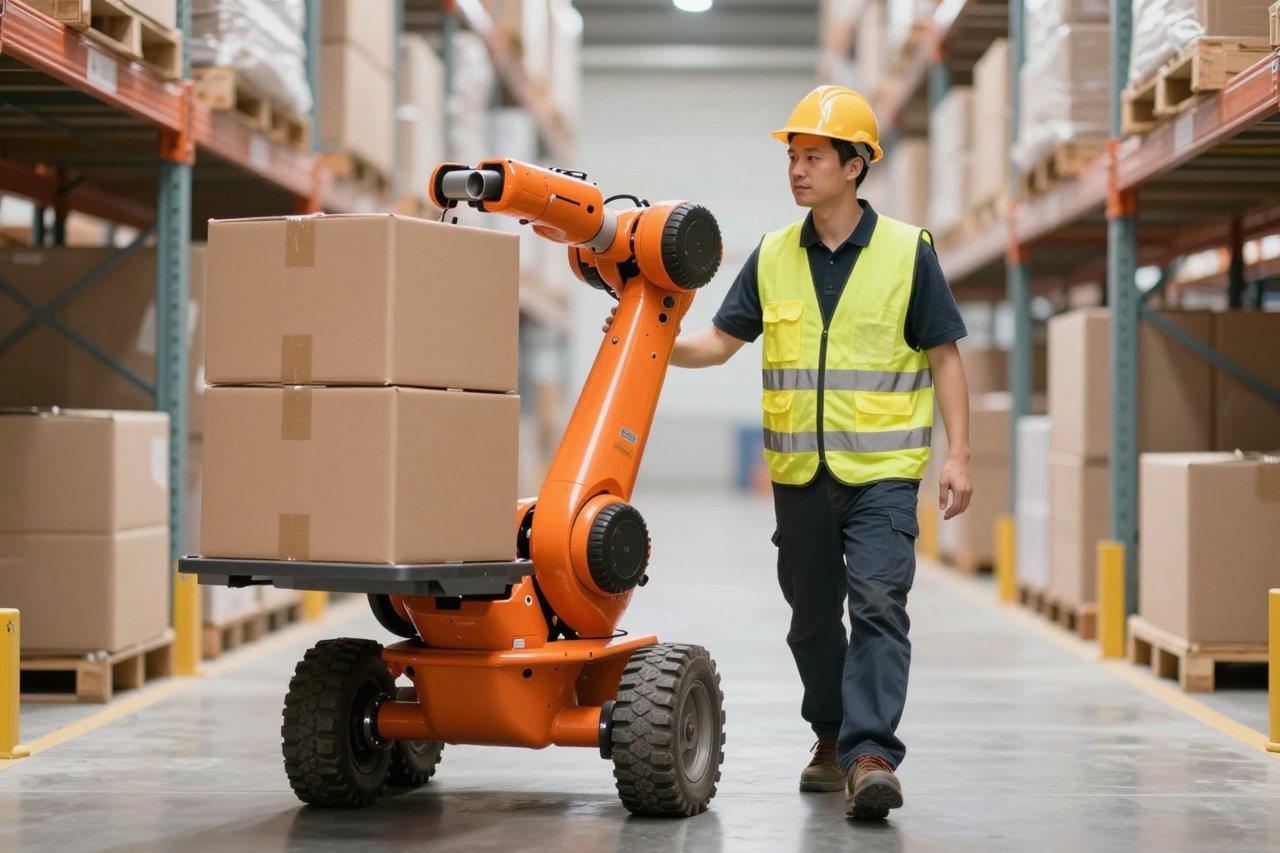
Amazon’s warehouses run on a different pattern: more than 750,000 mobile robots that carry shelving pods to human pickers, cutting the walking distance per item from a football pitch to a few steps. Agricultural equipment maker John Deere sells sprayers that use camera-based weed recognition to cut herbicide use by up to 60% by spraying individual plants instead of whole fields. Teams trying to sequence changes like these across a large operation often find a phased plan useful — this 90-day enterprise AI rollout plan walks through one with real examples.
Generative AI: the examples everyone argues about
Code assistants are the clearest measurable win so far. GitHub’s own research found developers completed a defined task 55% faster with Copilot than without. Translation tools handle routine business correspondence well enough that most people never see the machine behind it. Image generation has moved from novelty to production asset creation for marketing teams, though the legal questions around training data remain unresolved.
The honest picture is mixed. A generative model will produce a confident, well-formatted paragraph on a subject it knows nothing about. It doesn’t have a reliable sense of what it doesn’t know, which is a strange flaw to design around.
Where these examples get oversold
Epic’s Sepsis Model was used in hundreds of US hospitals to flag patients at risk. An external review published in JAMA Internal Medicine found it missed 67% of sepsis cases and triggered alerts for 18% of all hospitalised patients. The model wasn’t broken. It had been validated on data that didn’t match the hospitals using it.
Amazon scrapped an internal recruiting tool after it learned to downgrade CVs containing the word “women’s” — a direct consequence of training on a decade of male-dominated hiring decisions. The lesson isn’t that AI fails. It’s that a model inherits the biases and blind spots of its training data, and it will apply them at scale and without embarrassment. A realistic look at what AI can and cannot do is worth reading before you buy anything with a large language model attached.
How to spot the AI examples hiding in your own work
Most teams already have three or four candidates and don’t call them AI projects. Run this test over a week of work:
- Which tasks do you repeat more than 20 times a week, with roughly the same inputs each time?
- Where do you make a judgement call using more data than any one person can hold in their head?
- What gets written down twice — once in a system, once in a person’s notes?
- Which decisions get made late because someone has to gather information first?
Any answer to those questions is a candidate. Small businesses often find the best ones in odd places: a bakery forecasting Friday’s sourdough order from weather and past sales, a plumbing firm routing emergency callouts by postcode density, a two-person e-commerce shop auto-tagging returns by reason. You don’t need a data team to start — turning your existing website into an AI-assisted one is a six-step job that mostly involves wiring up tools you already pay for.
Pick one. Measure the time it takes now. Run it for a month and measure again. That single before-and-after number will teach you more about artificial intelligence than any list of examples, including this one.