

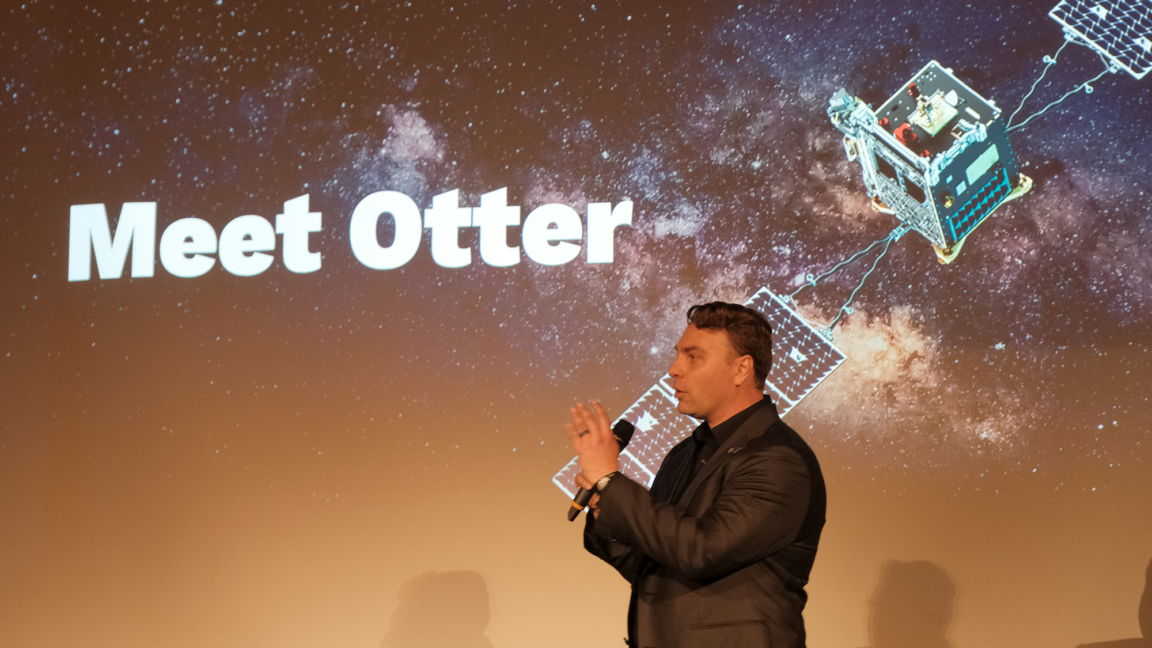
The Otter spacecraft that will be used for the SSPICY mission.
Credit:
Starfish Space
The initial missions will not refuel the Otter spacecraft, but that’s the long-term goal. The company chose water propellant precisely because it is an abundant fuel source across the Solar System.
Over Starsfish Space’s seven years of existence, Bennett and Link have kept the company fairly small. It has about 120 employees and has raised about $150 million to date. It has chosen to procure its spacecraft bus from Astro Digital and focus on developing software and maneuvering technologies to enable precise rendezvous and docking and the ability to maintain a long life on orbit to service multiple vehicles.
A long and winding road
There have been several demonstrations over the years. The first mission, Otter Pup 1, launched in 2023. But the external orbital transfer vehicle suffered a failure, and it ejected the Otter Pup 1 spacecraft prematurely at a spin rate of 330 degrees per second. Over a few weeks, the Starsfish team recovered the spacecraft, but one of its thrusters eventually failed.
It has had more success with two later demo missions, including Otter Pup 2, which launched in 2025 and has been flying in close proximity to a target spacecraft in low-Earth orbit. It has gotten to within 1 km so far, and if all goes well, a docking will occur in the coming months.
Starfish also partnered with Impulse Space last summer and used its software to fly the Mira spacecraft after that vehicle had completed its primary mission. Starfish sought to demonstrate that a single lightweight camera system, along with its closed-loop guidance, navigation, and control software, could autonomously rendezvous with another spacecraft. It worked.
Now comes the big test, however: flying a full-fledged Otter for NASA. Starfish has five more Otters in production for additional missions to showcase docking, de-orbit, and life extension capabilities. But you only get one chance to make a first impression, and Bennett said he is both nervous and excited.
“There is always a tension that comes with seeing the first of anything fly, right?” he said. “The other part of this is huge amounts of excitement. I think the excitement comes because this is a new kind of capability that’s finding its way to orbit. The pride part is the amount of effort that it took to get here from ourselves, from the team members, from people working with us, from the customers believing in that this can happen and helping us walk that path.”
“This is a moment to celebrate getting here and affording us this opportunity to go do something big,” he said.