

In October 2024, the Nobel Prize in Chemistry went to Demis Hassabis, John Jumper, and David Baker for work on proteins. AlphaFold, the system Hassabis and Jumper built, had already predicted structures for more than 200 million proteins. That is an extraordinary scientific result. It is not, however, an example of artificial general intelligence. AlphaFold is a specialist. Give it a protein sequence, and it does one job superbly. AGI would need to do much more: notice an unexplained pattern, form a hypothesis, design an experiment, interpret messy results, and decide what to try next.
The gap between those two things is where the most interesting work on AGI scientific discoveries is happening. Not in press releases about machines winning science fairs, but in the slow, unglamorous question of whether a general system can participate in research the way a good scientist does.
Narrow AI Is Already Finding Things Humans Missed
Before asking what AGI might do, it helps to be precise about what today’s systems have done. Narrow tools have produced results that working scientists treat as genuine contributions.
- AlphaFold’s protein structure database has become a default starting point for structural biologists, cutting months of lab work down to hours in some cases.
- GNoME, a Google DeepMind system, predicted 2.2 million crystal structures and flagged roughly 380,000 as stable candidates, expanding the search space for new materials.
- AlphaGeometry solved 25 of 30 olympiad-level geometry problems in a 2024 evaluation, a result that would have been unthinkable for a general-purpose model a few years earlier.
- FunSearch found new constructions for the cap set problem, a longstanding combinatorics challenge, by pairing a language model with an automated evaluator.
None of these systems chose its own research programme. Humans framed the problem, built the evaluation, and decided which outputs mattered. That is why there is a live debate about when we can honestly say AI made a scientific discovery. Prediction is not the same as understanding, and a promising candidate is not the same as a confirmed result.
What Would Make an AGI Scientific Discovery Different?
AGI is usually defined as a system that can handle unfamiliar tasks across domains at roughly human level. In science, that definition gets concrete fast. A general research agent would need to read the literature, spot an inconsistency, propose a testable explanation, and adapt when the first three experiments fail. It would also need the scientific equivalent of taste: knowing which question is worth months of effort.
From pattern-spotting to hypothesis generation
Current models are good at interpolation. They can summarise a field, suggest plausible mechanisms, and write code that fits a dataset. Real breakthroughs often require something else: noticing that a standard assumption is wrong. The 1982 work that linked H. pylori to stomach ulcers required Barry Marshall to challenge a prevailing assumption, then run a risky experiment. No model made that leap. A human did, and the human had to defend it for years.
The autonomy test
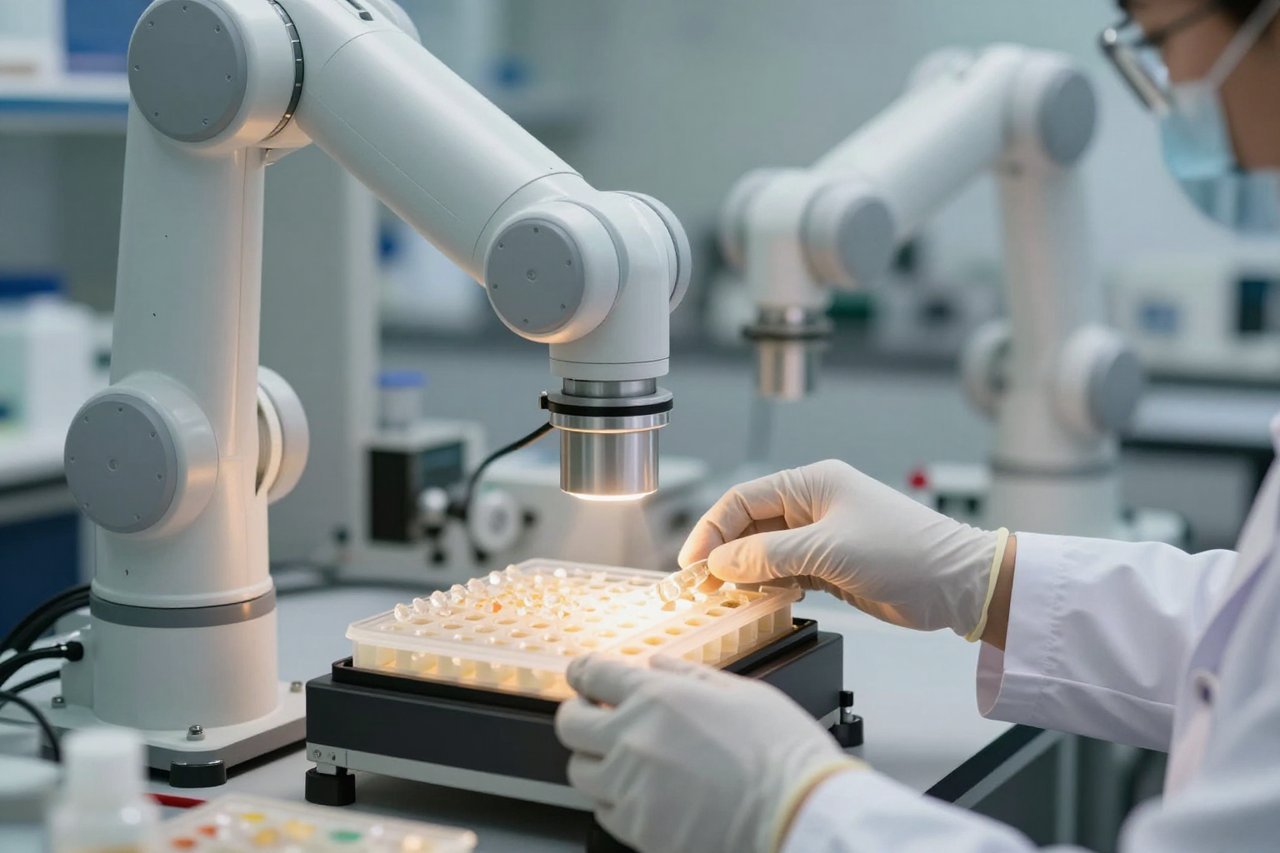
Autonomy is not binary. A system that ranks candidates for a human to test is useful. A system that decides which candidates to test, runs the experiments through robotic lab equipment, and updates its own plan is closer to the AGI story. The first credible examples are likely to appear in closed-loop labs where the system has access to real experimental feedback, not just text.
Cross-domain transfer
Many scientific advances come from importing a tool from another field. The mathematics behind MRI came from physics and signal processing. CRISPR was adapted from bacterial immune systems. An AGI that can move a technique from materials science into oncology, without being prompted, would be a different kind of research partner. That is also where evaluation gets hard, because the value of a transfer may not be obvious for years.
The Verification Bottleneck
Scientific discovery is not a generation problem. It is a verification problem. A model can produce a thousand plausible hypotheses before lunch. Checking them can take a decade. This is why AGI scientific discoveries will be judged less by the elegance of the output than by the quality of the pipeline around it.
Consider drug discovery. An AI can propose a molecule that binds a target. It cannot yet reliably predict toxicity, manufacture the compound at scale, run a clinical trial, or interpret a messy patient outcome. The bottleneck sits in wet labs and regulatory systems, not in token generation. Materials science has the same shape: a predicted crystal is a candidate until someone synthesises it and measures its properties.
Peer review adds another filter. In 2024, a team behind an automated research system generated papers that looked superficially credible but contained errors and weak experiments. That is not a reason to dismiss the approach. It is a reason to insist on independent replication. The bar for calling an AI output a discovery should include the same checks we apply to human work: controls, statistical power, and reproducibility.
Where AGI Could Move the Needle First
The first meaningful AGI contributions probably will not arrive as a single dramatic breakthrough. They will show up in fields where the feedback loop is fast, the data is rich, and the search space is too large for human teams to cover manually.
- Materials for batteries and catalysis. Combine generative models with automated synthesis and testing. The system proposes, the lab measures, the model updates.
- Protein and enzyme design. AlphaFold showed the predictive payoff. The next step is designing proteins that do something useful, then testing them in real assays.
- Mathematics and theoretical computer science. Proof assistants give models a rigid verification signal. A system that can propose lemmas and check them formally can iterate without a human in the loop.
- Climate and energy modelling. Large simulation ensembles are a natural fit for agents that design experiments, but the policy and engineering constraints are messy.
The Human Part of the Loop
Science is a social process. Credit, funding, scepticism, and reputation all shape which ideas get tested. An AGI that produces a correct result but cannot explain it in a way that convinces a review panel will struggle to change a field. Explanation is not decoration. It is how discoveries become usable.
That is also why some prominent researchers are uneasy about the current direction of AI. The man behind AlphaGo has argued that the field is taking the wrong path by chasing scale and benchmark scores rather than the kind of curiosity-driven exploration that produces real insight. His critique of the current AGI playbook is worth taking seriously. A system optimised to win evaluations may be very good at generating plausible science-flavoured text and very bad at knowing when it is wrong.
What to Watch For
Ignore demonstrations that produce a neat result in a single domain. Watch for systems that can run a full research loop: choose a question, design a test, interpret the result, and change course. Look for independent replication by scientists who were not involved in building the system.
Watch the infrastructure too. Automated labs, formal proof checkers, and standardised experimental protocols matter more than another leaderboard point. The first AGI scientific discovery may arrive quietly, in a supplementary figure or a materials database, long before anyone calls it a breakthrough. The useful question is not whether a machine can sound like a scientist. It is whether the work survives contact with reality.