

Ask ten people what Amazon’s AI strategy is and you’ll get ten different answers. One says Alexa. One says the chatbot that answers questions on product pages. Someone who works in cloud infrastructure says Bedrock, and the person who reads semiconductor news says Trainium. They’re all right, which is exactly why the question is harder than it looks.
Amazon doesn’t run one AI program. It runs four at once, at wildly different levels of maturity, and the one that matters to you depends on whether you’re a shopper, a developer, a CFO, or someone working a pick station in a fulfillment center.
The four fronts, briefly
- Consumer assistants: Alexa+, rebuilt on large language models and priced as a subscription.
- Cloud AI: Bedrock and SageMaker, which rent AI capability to other companies.
- First-party models: the Nova family, built in-house to undercut rivals on price.
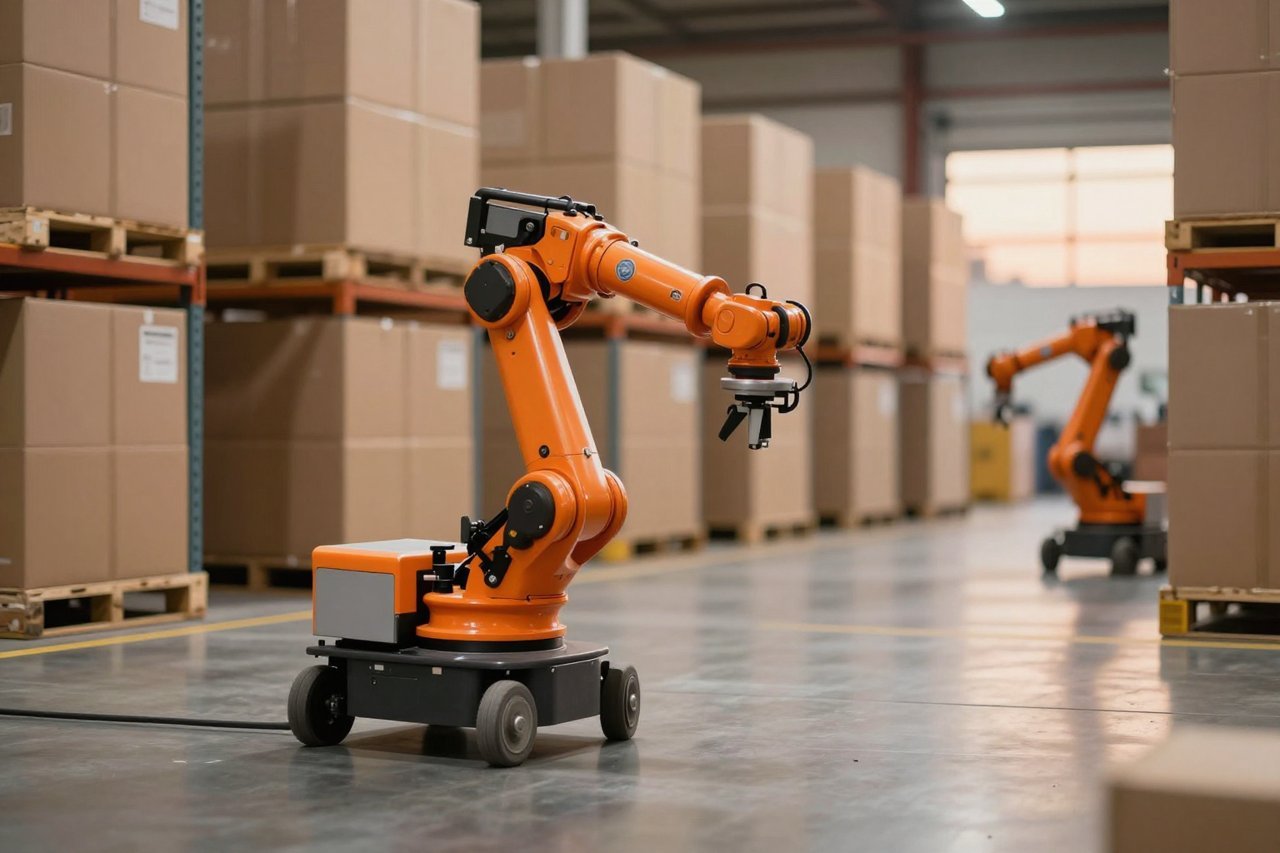
- Physical automation: more than 750,000 robots moving goods through warehouses, with more capable systems in trials.
Each of those is a real business with real revenue or real cost savings attached. Each also has a different set of weaknesses. Here’s how they fit together.
Alexa+ is the one you can actually argue with
Amazon announced Alexa+ in February 2025, and the important detail wasn’t the demo. It was the architecture. The old Alexa ran on hand-built intents and a script for every possible request. The new one sits on top of foundation models, which means it can hold a conversation, chain tasks together, and improvise when it doesn’t recognise the phrasing.
Amazon says it can book a repair, order groceries, remember that you hate cilantro, and control a smart home without you reciting exact commands. It’s included with Prime and costs $19.99 a month otherwise. Given roughly 600 million Alexa devices already sitting in people’s kitchens, that’s a huge installed base to sell into and a very cheap upgrade path for Amazon.
The catch is trust. An assistant that can act on your behalf, spending money and booking services, has to be right nearly every time. Amazon has been rolling Alexa+ out in stages rather than flipping a switch, which tells you something about how confident the company is in edge cases.
Bedrock is where the real money is
AWS is the profit engine, and Bedrock is its AI storefront. Instead of betting on one model, Amazon lets customers pick from several through a single API: Anthropic’s Claude, Meta’s Llama, Mistral’s open models, Cohere, and Amazon’s own Nova. Add Bedrock Agents, Knowledge Bases and Guardrails and you’ve got a way to build a working application without standing up any infrastructure yourself.
The Claude partnership is the load-bearing wall here. It’s one of the most popular options on Bedrock, and Amazon has poured billions into Anthropic as both an investor and a compute supplier. If you want to understand what companies are actually building with, it’s worth reading up on what Claude AI is and where it performs well before you pick a model for a production workflow.
Why the multi-model approach works
Most enterprises don’t want to be locked into one vendor’s roadmap. A bank might use one model for document summarisation and another for code review, then swap them six months later when pricing shifts. Bedrock makes that swap a config change rather than a rewrite. That’s less exciting than a flagship demo, but it’s the reason the service keeps growing.
Nova: Amazon’s own models, priced to move
Announced at re:Invent 2024, the Nova family spans a range of sizes, from a tiny text model built for speed and low cost up to a frontier-class model for complex reasoning. There’s also Nova Canvas for images, Nova Reel for short video, and Nova Sonic for speech-to-speech.
The pitch isn’t that Nova beats the best model on every benchmark. It’s that Nova is dramatically cheaper per token for the enormous volume of mundane work most applications actually do: sorting support tickets, tagging images, summarising call transcripts. Amazon’s own retail catalogue runs on this kind of processing at a scale where a fraction of a cent per request adds up to real money.
The chip story nobody talks about enough
Nvidia gets the headlines, but Amazon has spent years building its own silicon. Trainium handles model training, Inferentia handles inference, and the current generation is being deployed in very large clusters. Anthropic is using a massive Trainium-based buildout for its own model development, which gives Amazon a marquee customer to point at.
Owning the chip matters because it changes the economics. If you can train and serve models on hardware you designed, you keep more of the margin and you’re less exposed to a supply crunch. It’s a long game, and it’s the least glamorous part of Amazon’s AI operation.
The warehouse floor is where it all started
Long before chatbots, Amazon was putting AI into physical work. Its robotics division has deployed hundreds of thousands of drive units that carry shelving pods to human pickers, and newer systems like Sparrow and Proteus handle individual item manipulation and movement between stations.
This is the least discussed and most consequential strand, because it’s where AI meets physics, safety rules and labour relations all at once. If you want a sense of how messy that gets when models leave the sandbox, the piece on physical AI and what happens when models get wheels and grippers covers the gap between a demo video and a working floor.
Rufus and the shopping layer
Rufus is Amazon’s shopping assistant, embedded in the app and on product pages. It answers questions like whether a jacket runs small, compares two similar products, and explains what a specification actually means in practice. Amazon has been steadily expanding it with price history, deal alerts and the ability to search across reviews.
It is not a neutral advisor. Rufus exists to reduce returns and increase conversion, and it draws only on Amazon’s own catalogue. Useful, yes. Impartial, no.
Where the friction sits
Three problems follow Amazon’s AI ambitions around. Privacy is one: an assistant that listens, remembers preferences and acts on your behalf holds a lot of personal context. Worker impact is another, given how much of Amazon’s cost advantage comes from automation. And competitive concentration is the third, since the same company sells the cloud infrastructure, hosts the models, builds its own models, and runs the storefront where they get used.
None of those problems get solved by a policy document. They get solved by people asking uncomfortable questions early, which is the theme running through this piece on why responsible AI is a series of uncomfortable questions rather than a checkbox.
What to do with all this today
If you’re a developer, Bedrock is the practical starting point. You can get a working prototype running in an afternoon, swap models without rewriting code, and only then decide whether to fine-tune or self-host. Start with the cheaper models, measure quality on your own data, and move up only where the results justify the spend.
If you’re running a business, the honest question is whether your AI spend is going into customer-facing flash or into the boring internal work that eats staff hours. Invoice matching, ticket routing and transcript cleanup are unglamorous and they pay back fast.
If you’re just a person with an Echo on the counter, watch the Alexa+ rollout in your region and decide whether the upgrade earns its place. And if you’re still fuzzy on what any of this machinery is actually doing under the hood, a plain-English guide to how AI actually works is a better use of twenty minutes than any press release Amazon has published.
What ties the four strands together is not technology but a pattern: Amazon builds AI where it already owns the distribution. Alexa+ rides on installed speakers. Bedrock rides on AWS accounts. Nova rides on Amazon’s own workloads. Robots ride on existing warehouses. Everywhere else, the company is still working out the answer.