


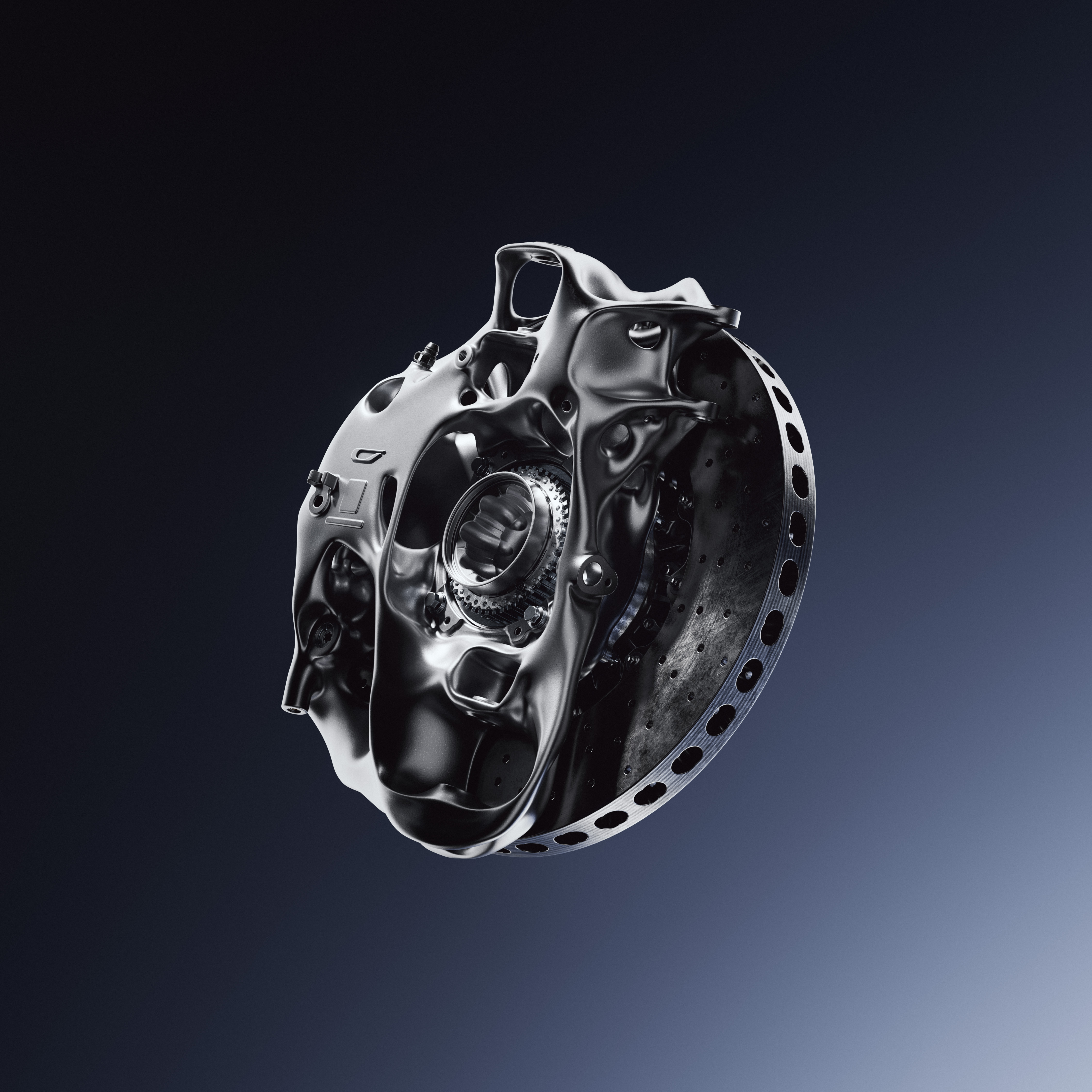
And the newest of these is Czinger’s new BrakeNode, an integrated brake assembly that combines the caliper, upright, and passages for hydraulic fluid into a single structure made from Czinger’s aluminum alloy. (Previously, Bugatti experimented with a 3D-printed brake caliper, but as far as I know, it never left the prototype stage.)
Czinger
The rear of the BrakeNode.
Czinger
The front of the BrakeNode.
Czinger
The rear of the BrakeNode.
Czinger
We saw an early version at the Goodwood Festival of Speed in 2023, but today it made its production debut with the Czinger 21C Spyder. Compared to a standard brake assembly, the BrakeNode is up to 30 percent lighter in unsprung mass. The savings were less with the 21C Spyder because the previous 21C’s suspension upright—additively manufactured like the rest—was already class-leading, but the BrakeNode still reduces unsprung mass by another 6 lbs (2.7 kg).
Czinger even says the BrakeNode is easier to service than a conventional brake assembly. There’s a drain plug at the bottom to bleed out hydraulic fluid, the pads slot in at the top, and the rotors tilt outward from the sides. Unlike a normal brake change, there’s no need to disconnect a caliper.
The new BrakeNodes are standard on the 21C Spyder, of which 30 will be made. But they can also be optioned on the 21C HDF and 21C VMax, and if you already have a 21C, you can have them retrofitted, Czinger says.