

Good morning, {{ first_name | AI enthusiasts }}. Google DeepMind just took AI’s coding strategy and applied it to math: don’t ask a model for the answer, give a team of agents the workspace.
The company’s AI co-mathematician just scored a new high on a benchmark built to stump AI for decades, with one professor even cracking an unsolved problem using a strategy buried inside a proof the system’s own reviewers had rejected.
-
Google DeepMind’s AI co-mathematician
-
The Rundown Roundtable: Our AI use cases
-
Automate any manual task with Codex
-
AI finds 100+ new exoplanets from NASA data
-
4 new AI tools, community workflows, and more
GOOGLE DEEPMIND

Image source: Pushmeet Kohli (@pushmeet on X)
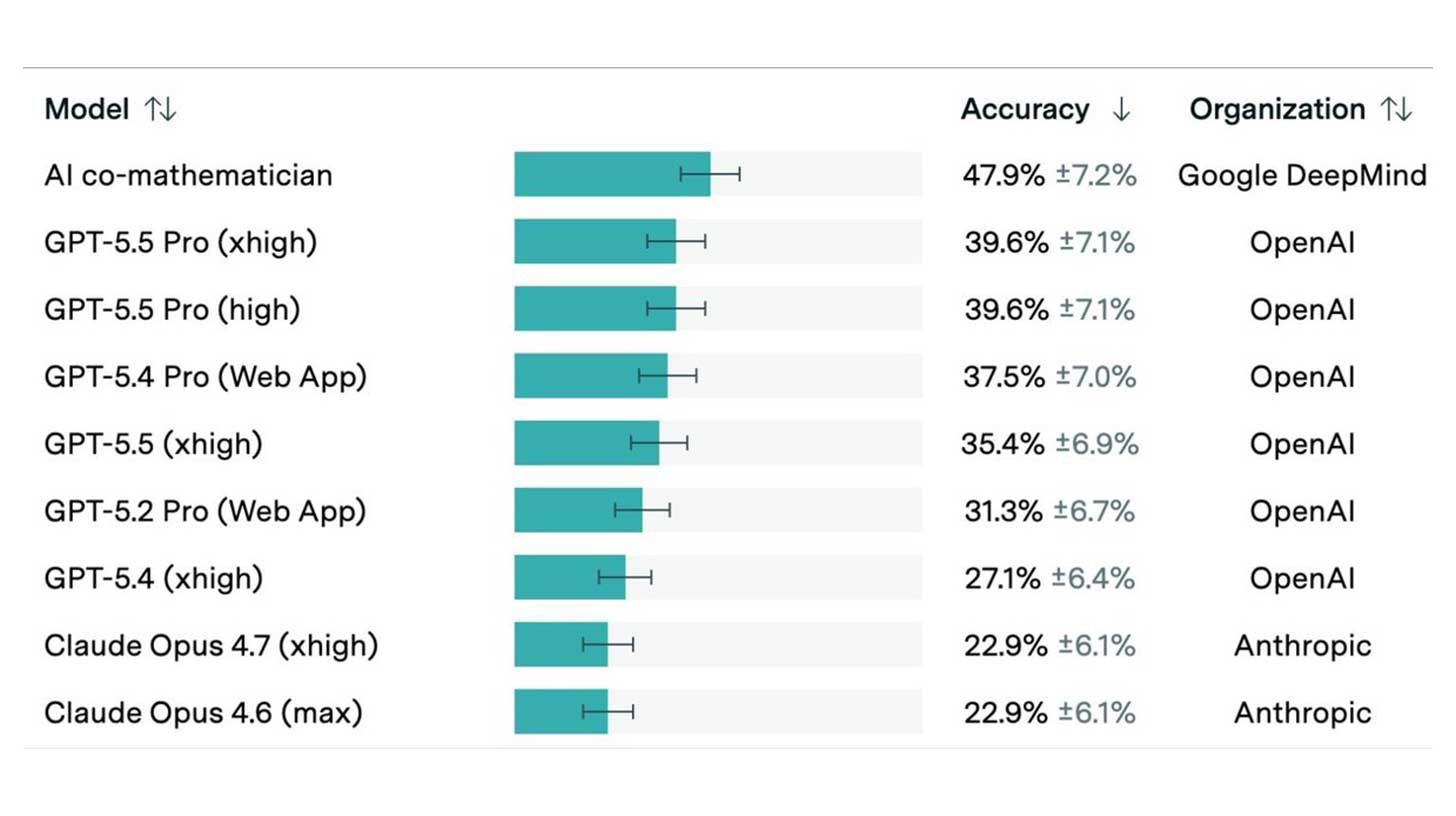
The Rundown: Google DeepMind just published a paper on its AI co-mathematician, an agentic system based on Gemini 3.1 built to help mathematicians tackle unsolved problems — setting a new high on a benchmark of research-level math problems.
-
DeepMind modeled the tool after AI coding environments like Claude Code, bringing agent teams and built-in review cycles to math research.
-
A coordinator agent breaks research into parallel workstreams, each with sub-agents that write code, search literature, and attempt proofs.
-
Oxford’s Marc Lackenby resolved an open problem in the Kourovka Notebook after spotting a ‘really, really clever proof strategy’ inside a rejected output.
-
On Epoch AI’s FrontierMath Tier 4, the system topped the leaderboard at 48% and more than doubled Gemini 3.1 Pro’s 19% raw score.
Why it matters: AI has already led to a surge in mathematics discoveries with the advances in frontier models, and similar to coding, agentic pipelines are now enabling AI systems to push even further. But as Lackenby’s discovery shows, the future is still bright for AI that enables top minds to accelerate their work, not replace it.
TOGETHER WITH GOOGLE FOR STARTUPS

The Rundown: Google for Startups’ Future of AI report is your essential guide to understanding how generative media is reshaping product development, offering founders strategic insights to build smarter, scale faster, and stay ahead of the AI curve.
Inside the report, you’ll discover:
-
How to leverage digital twinning at scale.
-
Strategic insights for AI product differentiation.
-
Expert perspectives on the generative landscape.
THE RUNDOWN ROUNDTABLE

Image source: Ideogram / The Rundown
The Rundown: The Rundown Roundtable is a weekly feature where we poll members of The Rundown staff about how we use AI in our work or daily lives.
Jason, Developer: I used /goal in OpenAI’s Codex to build a Magic: The Gathering app so my brother and I can play asynchronously without needing to coordinate a call or awkwardly play over FaceTime.
The idea is to let each of us take turns when we have time, track the board state cleanly, and keep a game going over days instead of trying to line up schedules. The command allowed Codex to continue running until everything was done, basically one-shotting exactly what I was looking for without any intervention.
Joey, Partnerships: I’ve never been to Greece, so for my upcoming trip, I went all in and handed the whole itinerary over to Claude. Flights booked, transit times dialed, restaurant lists curated city by city.
I’m now showing up with a plan tighter than most travel agents could put together!
AI TRAINING

The Rundown: In this guide, you will learn how to let Codex click through any annoying, repetitive work using Computer Use on Mac or Windows.
-
Open Codex, go to Plugins, find and enable the Computer Use plugin, and start a new task
-
Open the permissions menu and switch from Default permissions to Full access, then confirm any prompts and give Codex something real to do
-
Example: “Open Chrome and debug this web page UI I’m developing http://localhost:3000/. Click through, reproduce the bug I describe, then tell me what you think is causing it. If not sure, ask before making changes”
Pro tip: Codex can automate repetitive workflows in local apps, too — try it for Photoshop exports, Adobe Premiere cleanup, file renaming, or any other tool.
PRESENTED BY ORACLE DEVELOPERS

The Rundown: Small language models can solve harder reasoning tasks without changing their weights. Oracle Developers’ open-source agent-reasoning code shows how to add research-backed orchestration to Ollama models, with 16 reasoning strategies developers can test locally.
In the guide, you’ll explore:
-
Open-source reasoning code for Ollama
-
16 strategies, benchmarked across 4,200 runs
-
Better accuracy without retraining models
AI & ASTRONOMY

The Rundown: University of Warwick astronomers confirmed more than 100 exoplanets using an AI system called RAVEN that scanned 4 years of NASA TESS data covering 2.2M stars, with RAVEN also finding 2,000+ additional potential candidates.
-
RAVEN handles detection, vetting, and confirmation in one shot, trained on simulated planets and false-alarm signals to filter real finds.
-
The findings included 31 exoplanets never before spotted, plus strange worlds that orbit around their stars in under a day.
-
Hundreds of exoplanets were found in the “Neptunian Desert”, a region so close to a star that Neptune-sized planets shouldn’t survive the heat.
-
The system measures how common different planet types are at 10x the precision of previous systems from smarter AI alone, not new hardware.
Why it matters: Humans have confirmed just a few thousand exoplanets so far, and there are estimated to be trillions. AI and tech advances are going to help rewrite that number fast — and judging from RAVEN, all it will take is upgraded models and AI integrations to uncover knowledge about space already hiding in the data we have.
-
🔒 Incogni – Remove your personal data from the web so scammers and identity thieves can’t access it. Use code RUNDOWN to get 55% off*
-
💻 Codex in Chrome – OAI’s Codex extension for agentic tasks inside Chrome
-
🧠 ERNIE 5.1 – Baidu’s new foundation model with strong search capabilities
-
🖨️ Printing Press – CLI factory with 30+ pre-built, agent-native tools
Google’s Isomorphic Labs is reportedly raising $2B+ to expand its Drug Design Engine, which it says significantly outperforms AlphaFold 3 on specific tasks.
Greece is proposing AI protections into its constitution, requiring the tech to serve individual freedom, with PM Mitsotakis citing threats to democracy.
Baidu released ERNIE 5.1, a new AI ranking No. 4 on Arena’s Search Leaderboard, with the company claiming it cost just 6% as much to train as rival models.
OpenRouter launched Pareto Code, a free routing layer that auto-picks the cheapest coding AI above a user-set quality bar, with prices adjusting as newer models improve.
SoftBank Group’s telecom arm launched a battery business to build large-scale cells and storage systems — and meet the power demands of data centers in development.
Every newsletter, we showcase how a reader is using AI to work smarter, save time, or make life easier.
Today’s workflow comes from reader Anonymous:
“I have been using ChatGPT for various things professionally, which has been surprisingly helpful and refreshing. The greatest use I have found for it so far, though, is helping me train my 4 dogs.
I was ready to drop thousands of dollars on a professional trainer just because of how chaotic it has been, but ChatGPT has helped me identify the root causes of specific behaviors and taught me how to successfully train around and beyond them using specific techniques tailored to my individual dogs.
The confidence it has brought me, and the positive reinforcements have changed every dynamic in the household, and I wish I had started sooner.”
How do you use AI? Tell us here.
That’s it for today!
Before you go we’d love to know what you thought of today’s newsletter to help us improve The Rundown experience for you.
Rowan, Joey, Zach, Shubham, and Jennifer — the humans behind The Rundown
