

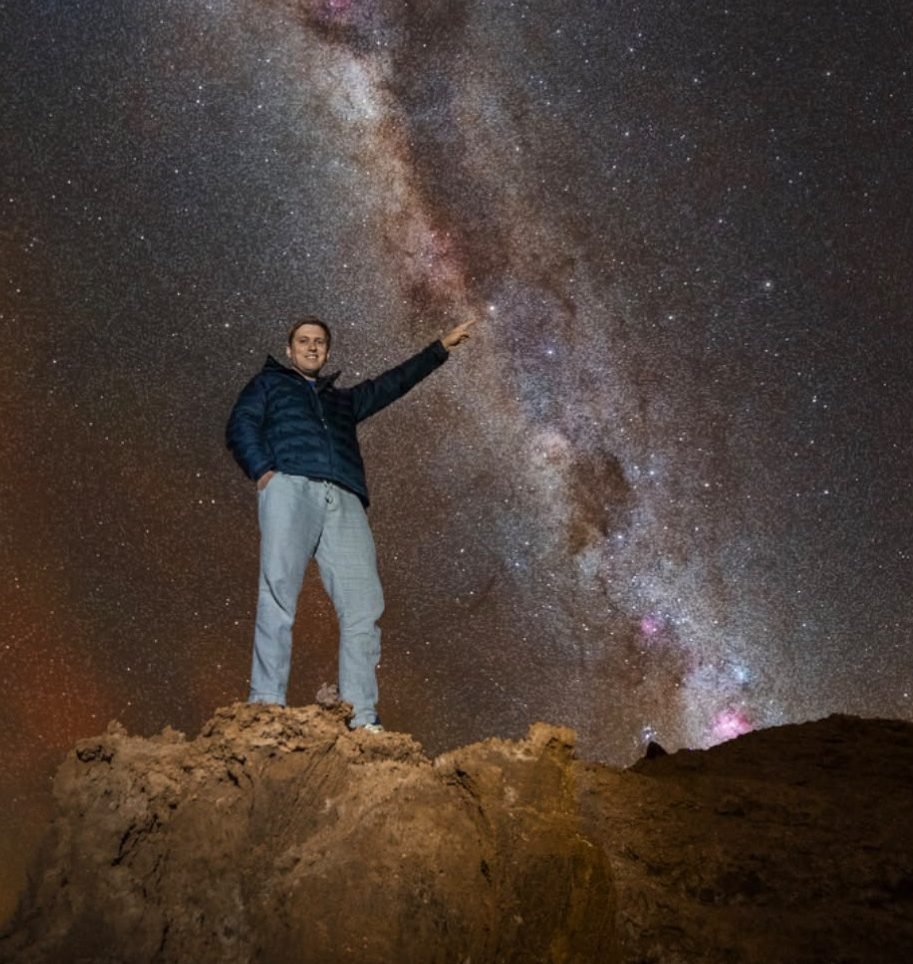
The founders behind Starcloud, a startup with plans to operate a fleet of GPUs in orbit, have a new pitch for potential investors: A plan to send a tiny spacecraft on an 80,000 year journey to Alpha Centauri.
If they do it, it will be the first human-built object explicitly aimed for another star, and the sixth to leave our solar system.
Dubbed Fermi Explorer, the non-profit behind the mission emerged today to ask for partners, donations and advice. The initial team—Starcloud founders Philip Johnston, Adi Oltean, and Ezra Feilden, along with program manager Garret Jameson—has put together a plan to use proven space technologies to send a vehicle with a 10 cm square payload, weighing 1 kilogram, into interstellar space.
The founders say they are launching this mission in the spirit of human exploration; to achieve a historical first; and to test the limits of the Fermi paradox, which attempts to explain why we have yet to find other intelligent life in the universe, and gives the mission its name.
The mission is intended to cost about $15 million, and to launch in 2029. The non-profit is soliciting vendors to build the vehicle, funding to pay them, and scientific and artistic payloads to send, ala the sensors and Golden Record onboard NASA’s Voyager space probe, the first human spacecraft to leave our solar system.
Most plans for interstellar exploration stumble when dealing with the vast distances involved and the comparatively slow methods we have to cross them. Voyager, launched in 1977, is now about 26 billion km from Earth; Alpha Centauri, the nearest star to our solar system, is 41 trillion km away.
The last time Silicon Valley took on this challenge, a nonprofit called Breakthrough Starshot, founded in 2016 by Yuri Milner and backed by Mark Zuckerberg, envisioned a multi-billion dollar effort to use a novel laser-based propulsion system to reach Alpha Centauri in twenty to thirty years. The effort collapsed in 2025, but the dream apparently remains alive.
Fermi Explorer takes the opposite tack: Rather than pushing the frontier of technology, the goal is to use what we have already to do something.
“I also got excited and then disappointed!” Johnston said of Starshot. “That’s the reason we are doing the mission. We are hell-bent on actually launching something in three years. … the big difference with most other [interstellar] missions and the Fermi Explorer is that the others all try to do it in a human lifetime, which means billion-dollar propulsion R&D programs. We have very deliberately picked 80,000 years as the minimum viable mission.”
The plan is to launch the spacecraft on a rocket rideshare, then use efficient but low-power electric propulsion to slingshot the vehicle into a series of orbits that will eventually leave it bound for Alpha Centauri. The spacecraft is intended to be active for about 12 years before entering a final coast phase toward the other solar system.
“If a dinosaur bone can last 200 million years then a metal box can easily survive the radiation environment we expect for 50,000 years,” Johnston said. “We don’t plan on powering spacecraft up at the end of the 80,000 years. We hope that a future human civilization will intercept it.”
When you purchase through links in our articles, we may earn a small commission. This doesn’t affect our editorial independence.