

Good morning, {{ first_name | AI enthusiasts }}, and welcome to our 3,137 new readers. It’s a given that OpenAI gets to put its newest models to work before the rest of us can try them. The company’s latest research report shows us what that head start actually buys.
With coding agents putting in three workdays for every human one, experiments at a record high, and its “automated AI research intern” now a reality, life inside a frontier lab is looking less and less like the one outside it.
-
OpenAI opens the books on its AI research intern
-
Insilico’s AI-designed drug hints at slowing aging
-
Turn a family scheduler idea into an app with Astra
-
U.S. voters’ rare bipartisan issue is fearing AI
OPENAI

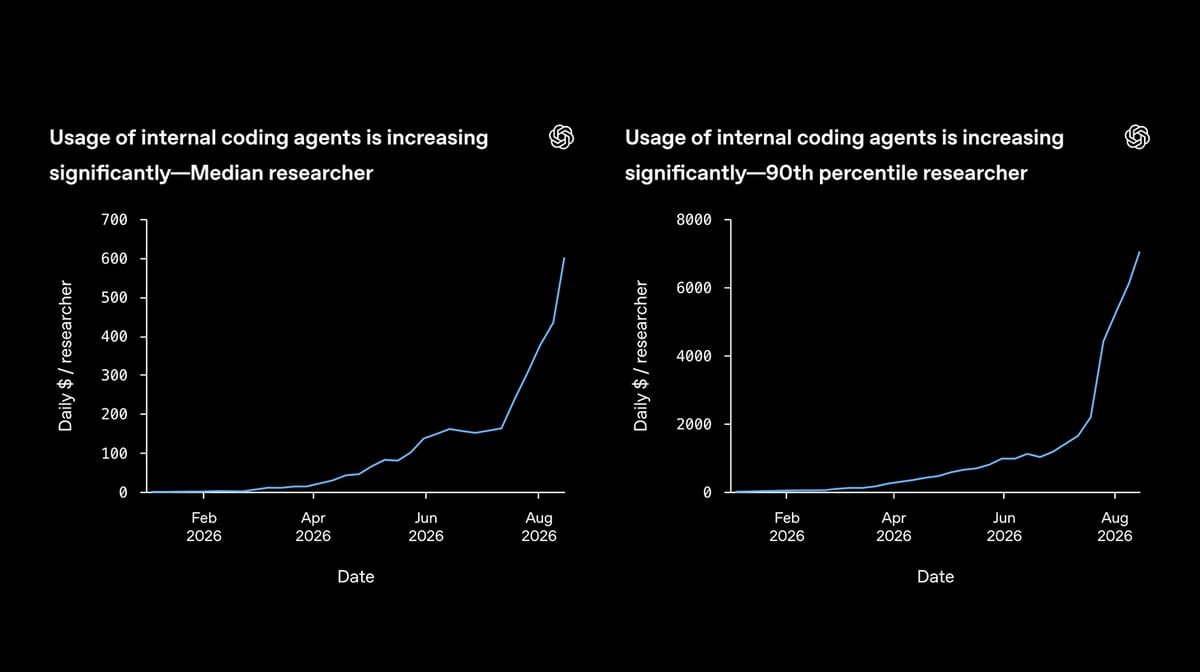
The Rundown: OpenAI released a look at how much of its own research its coding agents handle, with agents logging 3.1 workdays for every one a human puts in, and the company hitting its “automated research intern” goal Sam Altman had set for September.
-
Altman posted the timeline last October, calling for an intern-level system by this month and a fully automated researcher by March 2028.
-
The typical OAI researcher now burns $600+ a day of agent tokens, with the 90th percentile above $7,000, and token output up 124x since December.
-
Around 80% of researchers now use 4+ agents at a time, with OAI saying experiments per researcher are “at an all-time high” within the company.
-
The agents’ tasks are also evolving, with more complex, longer tasks seeing greater success and areas like tech troubleshooting surging across the team.
Why it matters: OAI’s Tibo Sottiaux called internal use of Astra before its public release the “biggest competitive advantage”, and this internal usage report shows what its competitors are truly up against. The labs with unreleased frontier models and the budget to burn tokens on them are compounding in pretty unfathomable ways.
TOGETHER WITH UNWRAP

The Rundown: A customer rating is a fire alarm with no address: something’s burning, but you don’t know where or why. Unwrap’s AI-powered feedback platform pairs a best-in-class semantic analysis engine with autonomous surveys, helping teams turn vague feedback into fixable problems.
-
Install targeted, on-site surveys in minutes, all configurable without frontend changes
-
Probe every open response with real-time AI follow-ups
-
Auto-fire targeted surveys in response to feedback gathered across channels
AI & MEDICINE

Image source: Insilico Medicine
The Rundown: Insilico Medicine published trial data showing that rentosertib, a drug its AI designed for a lung disease, left patients reading as biologically younger on all six “aging clocks” — an early signal (on a small sample) that it may help slow aging itself.
-
Rentosertib treats idiopathic pulmonary fibrosis, where scarring slowly chokes the lungs, and Insilico’s AI picked the target protein and drew the molecule.
-
The drug’s trial last year included 42 patients, with blood samples then used for the aging study and compared against a broader UK Biobank database.
-
Six aging clocks (AI models by separate teams that read age markers from blood) rated treated patients as younger, with one group’s estimates falling 2.7–3.5 years.
-
The dosing with the clearest aging signal was different than the one with the biggest lung-function gains, potentially showing effects beyond just disease relief.
Why it matters: Anthropic CEO Dario Amodei said that a real medical breakthrough can turn the tide on AI sentiment more than any marketing campaign could, and stories like this show the public what medicine may be about to become. We’re only at the starting line of a race of AI-designed drugs trying to reach the market.
AI TRAINING

The Rundown: In this guide, you will learn how to turn an idea from our Workflow Hub into your app with Astra in Codex. We’ll go from a product brief to mockups and a family planner, then test whether its calendar saves and shares events as we expect.
-
Open Codex, select Astra, and use /plan to request a product requirements document covering calendar and layouts, asking for MCQs to clarify the details
-
Ask for four design mockups showing desktop and mobile side by side, then choose a direction before building
-
Tell Astra to build your chosen design and open it in its browser, then add an event, reload, and switch users to test whether it saves and shares correctly
Pro tip: Ask Astra to find five skills on GitHub that could improve your app’s design, then choose which ones to install and use.
PRESENTED BY PAVE

The Rundown: Somewhere in your team, a spreadsheet is doing the job of software. A request is stuck three replies deep in an inbox. None of it is technically broken, but it works because you remember how it works. That’s not a process. That’s you, holding it together by hand.
-
Turn that spreadsheet into a real, working app
-
Replace the email chain with an actual approval flow
-
Build the fix once and never explain the workaround again
AI RESEARCH

The Rundown: NBC News released a new poll of 7,105 adults on how Americans feel about AI, finding that 70% feel more worried than excited, and the concern spans both major parties — even as a growing share of Americans report using the tech.
-
52% use AI very often or sometimes, up six points from June 2025, but just 18% trust AI-generated information most or almost all of the time.
-
Local data centers are a universal issue, with 69% against having one nearby and 45% strongly against, next to just 31% who would somewhat or strongly support.
-
70% believe AI is costing people jobs, and majorities expect it to hurt schools and elections, with science and healthcare as the only net positive wins.
-
Washington’s AI rules fall short for 81%, and when asked which party they trust on AI policy, 44% say neither, with Democrats at 20% and Republicans at 16%.
Why it matters: AI sentiment has been on the mind of the industry’s top CEOs, but the polling is still moving in the wrong direction. Data centers have become the face of the issue, and the backlash is turning into a live campaign topic heading into the midterms. The other problem is that voters also don’t trust either party to handle it.
COMMUNITY AI WORKFLOW OF THE DAY
Today’s workflow comes from reader Sanjay Singhal:
“I love playing poker, both online and live. One month, I performed poorly. Although it felt like the cards were running badly, I wondered whether I had developed a problem in my game and was blaming my losses on bad luck. I asked around, including asking AI, whether a tool existed that could measure luck from poker hand histories. It did not.
I’m not a coder, but I started building a luck-detection app in a Claude chat. Claude built the UI directly in the chat window and advised me on the formulas I was using to calculate luck for the cards dealt, my performance on the flop, and my performance when I went all-in.
The result astonished me. I fixed two major leaks in my game and felt better knowing that bad luck really was the main problem. I liked the tool so much that I decided to turn it into a full web app with Claude Code, and now an iPhone app that I may let other people use for free.”
Get more from Claude – Your style, voice, and data, supercharged. Unlock Claude’s full potential with custom skills. Download the guide.*
U.N. rights chief Volker Türk said he shares fears that “advanced AI could pose an existential risk to humanity,” adding that a few men hold “almost unlimited power over AI.”
TikTok parent ByteDance is reportedly building a world model on top of its Seedance video AI, with founder Zhang Yiming running the project and a launch possible in Oct.
Chinese lab OpenBMB open-sourced MiniCPM5-2B, a new 2B-parameter model that ranks first among open models under 4B parameters on AA’s Intelligence Index.
OpenAI and Microsoft are facing a new lawsuit from the Seattle Times and Newsday over illegal training, with the outlets saying AI is breaking journalism’s economic cycle “beyond repair.”
That’s it for today!
Before you go we’d love to know what you thought of today’s newsletter to help us improve The Rundown experience for you.
Rowan, Zach, Shubham, Jennifer, and Nate — the humans behind The Rundown
