

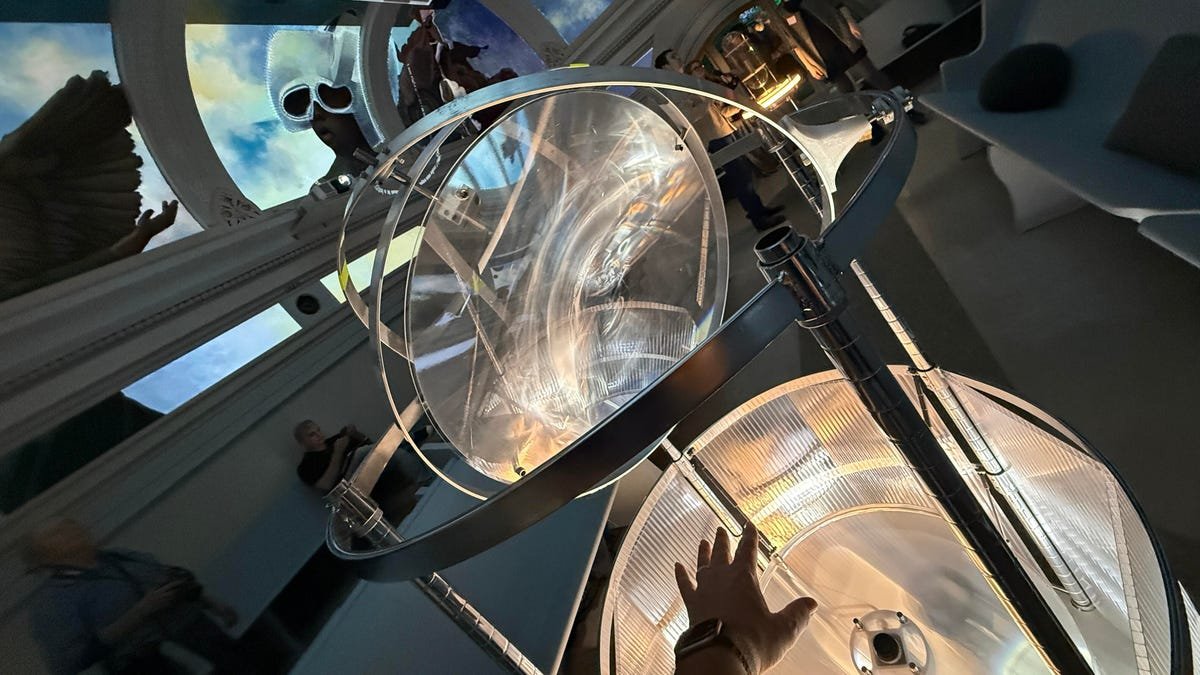
Climbing up flights of stairs in a bank building full of rooms draped in surrealist art, tunnels with lurking beasts called “skin horses” and exhibits of keepsakes imaginary and real, I find myself looking at an art mural across a domed ceiling that I can explore with instruments next to me. Speaking into a microphone, I see my words scroll across the edges. My hands, thrust into a small chamber, are projected across the ceiling, highlighting parts of the mural. Suddenly, AI-generated descriptions emerge where I’d put my hands.
This is the Ministry of Awe, a new installation experience in Philadelphia that I was lucky enough to visit ahead of its opening, and it’s a welcome East Coast dose of strangeness. Created by Meg Saligman and over 100 other artists, it’s a six-story space that makes me think of Meow Wolf or long-time LA oddity the Museum of Jurassic Technology — or even London’s very real Sir John Soane’s Museum.
This “skin horse” lurks in the basement, if you look hard enough.
The former bank building’s now an immersive art gallery full of hands-on experiences to unravel and a storyline too: messages in drawers, phones that can be dialed or answered, bathrooms that record your “deposits” with audio messages. Everything at the Ministry is an exploration of the meaning of banks and their associated power. But what drew me here just as much was the idea of how tech would fold into a space like this.
Watch this: I Saw the Future of Tech Art in Philly
Much like Meow Wolf’s explorations of layers of tech into artist installations, something I talked about at SXSW recently, Ministry of Awe is playing with tiny doses of AI — nothing that generates or replaces the work of artists but rather in a way that highlights and possibly enhances. The Ministry of Awe’s signature fifth-floor artwork, The Heavens, is a giant mural work by Saligman that’s projected across the segments of the ceiling. Angled seats let visitors hang around and gaze up, but several “instruments” in the room let you play with the space, too, created by the tech company Spatial Pixel.
A full look at the projector-filled room where the Heavens mural exists, along with interaction instruments. This is just one room of many in the Ministry.
Spatial Pixel is focused on “spatial computing for spaces, not faces,” and was founded by Violet Whitney, former director of product and associate director of design at Google Sidewalk Labs, and William Martin, an architect and designer. Both also teach a course in spatial AI at Columbia University.
Exploring AI through art
The Heavens’ interaction tools and how they’re designed to feel integrated and somewhat invisible are part of Whitney and Martin’s explorations of where AI could work in subtler space-aware ways. This fascinates me because AI, smart glasses in particular, are already trying to solve for this with very mixed success. What I’ve found is that art and entertainment can often be better places to explore ideas of AI in contained ways, with rules deliberately made to respect the work and art.
Spatial Pixel’s team in the room they helped design.
Whitney and Martin met Saligman in the same Philadelphia neighborhood, which is how they ended up collaborating on the Ministry of Awe’s exhibits. The Heavens experience is run using Spatial Pixel’s open-source platform, called Procession, that blends multiple AI models into a system that works in physical spaces. Whitney and Martin already have an interactive lab space for it at Columbia, but the Ministry of Awe is a public test-bed, working off art that they want to keep sacred.
“A lot of what we’ve been doing is finding ways of changing the mural, or the way that you see the mural through light. A core way we’ve been trying to allow visitors to interact with it is to pick up on the things that they’re saying in the space,” said Whitney. “We want to take the things they’re saying and change the mural based on their words and what they point at.”
The Ministry of Awe’s multilevel former bank building has many rooms inside, many of them interactive, and they were designed differently by different artists.
Right now, a lot of the mural interactions are simple and ephemeral: My words disappear, my highlights fade. But the Ministry of Awe’s toying with the theme of banking in personal data, too. And the software being used to run the installation is programmable, so Spatial Pixel aims to keep evolving what happens over time.
“Our goal is eventually to record what the people are contributing, with the right consent. But then maybe those ideas become like this bank. It is a bank, after all, to store these ideas, and then Meg can use them and review them and use it to evolve the painting and physical space. And so it becomes this sort of perpetual dialogue with the muralist,” said Martin.
It’s part of the thinking that Spatial Pixel wants artists to play with, as opposed to tech companies.
Words overlay with art, depending on how you interact. The work changes slightly over time.
“What if you could actually talk to a painting? What if you could actually interact with a work of art and then explore it in new ways? We realized,” said Martin, “that accessing these tangible computing techniques, like being able to recognize gesture, move objects around — there’s certainly a lot of academic groups that are discussing this, but it’s still really inaccessible to the actual designers that want to make experiences in that way.”
The idea echoes experimental AI art I saw in Austin at SXSW just days after my Ministry of Awe visit — questions about agency and ownership, where boundaries between AI and personal work get drawn. And as I toured the Ministry space with Meta’s smart glasses on my face, it made me think about how smart glasses — and most AI tools — right now have almost no consideration for this delicate line.
But they’ll need to. And maybe art spaces are the places to begin to think it out, with no glasses or personal wearable tech needed at all.