

Close Menu
AI News TodayAI News Today

    Subscribe to Updates

    Get the latest creative news from FooBar about art, design and business.

    What's Hot

    Meet the 2026 Ig Nobel Prize winners

    The unusually muted Tesla Cybercab launch

    The sameness problem behind those unappetizing AI-generated menus

    Facebook X (Twitter) Instagram
    • About Us
    • Contact Us
    Facebook X (Twitter) Instagram Pinterest Vimeo
    AI News TodayAI News Today
    • Home
    • AI News
    • AI Reviews
    • AI Tools
    • AI Tutorials
    • Chatbots
    • Free AI Tools
    • Artificial Intelligence
    AI News TodayAI News Today
    Home»AI News»Just like a fruit fly, a new algorithm never forgets old scents
    AI News

    Just like a fruit fly, a new algorithm never forgets old scents

    By No Comments2 Mins Read
    Share Facebook Twitter Pinterest LinkedIn Tumblr Reddit Telegram Email
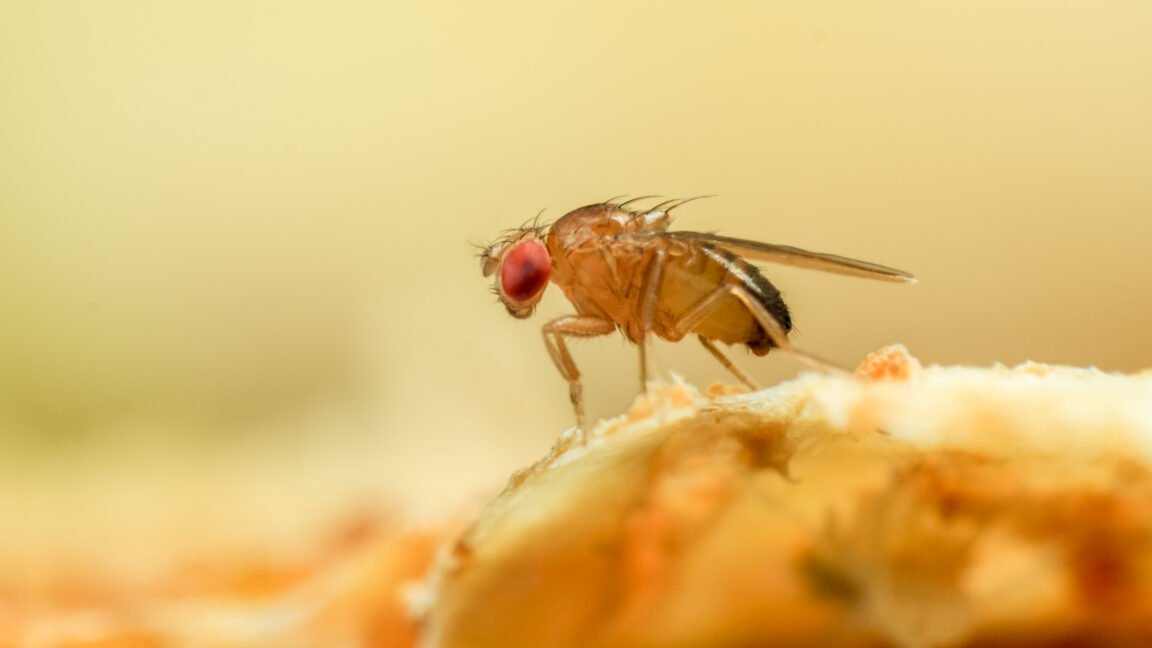
    A male fruit fly stands on the edge of a piece of yellow material.
    Share
    Facebook Twitter LinkedIn Pinterest Email

    In Max and Shen’s work, sensor readings become a stream of spikes, projected sparsely and randomly onto a hidden layer that stands in for the Kenyon cells, with neurons inhibiting each other instead of relying on a single APL-like referee. From there, the hidden layer connects to an output layer, one neuron per labeled odor, waiting to learn which barcode belongs to which smell.

    A simple rule

    What actually gets learned is the connection between a barcode and its label, following a simple, decades-old neural network rule: Every time a hidden neuron fires alongside the correct answer, that link gets a little stronger.

    Nothing more. There’s no need for backpropagation, the technique co-invented by 2024 physics Nobel laureate Geoffrey Hinton that trains most modern neural networks by working backward through every layer to calculate exactly who’s to blame for a mistake.

    In their tests, the simplified system works. On a set of odors picked up by common gas sensors, Spi-Fly peaks after just three exposures to each one, while backpropagation needs roughly 70 to get there.

    Feed the network new odors a couple at a time—a stress test for catastrophic forgetting—and Spi-Fly barely blinks, holding onto old smells with almost no accuracy loss, while backpropagation crashes down into near random-guessing territory.

    There’s another practical hurdle: memory. The whole point of designing a network this simple is to eventually run it on neuromorphic chips—a fast-developing technology that builds hardware that mimics the brain directly by processing spikes instead of running conventional software. Those chips typically don’t have much memory to work with. Any algorithm running on one has to make do with a fraction of what a regular computer takes for granted. Spi-Fly degrades far less than backpropagation does under those constraints.

    There’s a ceiling, though, as Max himself admits. “If the sparse code layer contains 100 neurons, and each odor is represented by 5 neurons, the theoretical upper limit of odor capacity is ‘100, choose 5,’” he explained in an email—roughly 75 million possible “barcodes.” But real-world noise erases nearly all of that headroom. “The same odor is almost never represented by the same sparse code in two exposures, due to noise, airflow conditions, etc.,” Max wrote. “Given the parameters of our model, it should be able to represent a couple hundred odors, but it also depends on what type of odors, and the similarities between them.”

    Algorithm fly forgets Fruit scents
    Share. Facebook Twitter Pinterest LinkedIn Tumblr Email
    Previous ArticleVMware migration reduces Tottenham Hotspur’s licensing fees by 85 percent
    Next Article Accel reportedly in talks to lead $1B round for Thinking Machines at $40B valuation
    • Website

    Related Posts

    AI News

    Meet the 2026 Ig Nobel Prize winners

    AI News

    The sameness problem behind those unappetizing AI-generated menus

    AI News

    Tesla is asking people if they want to buy and run Cybercab fleets

    Add A Comment
    Leave A Reply Cancel Reply

    Top Posts

    Meet the 2026 Ig Nobel Prize winners

    0 Views

    The unusually muted Tesla Cybercab launch

    0 Views

    The sameness problem behind those unappetizing AI-generated menus

    0 Views
    Stay In Touch
    • Facebook
    • YouTube
    • TikTok
    • WhatsApp
    • Twitter
    • Instagram
    Latest Reviews
    AI Tutorials

    Quantization from the ground up

    AI Tools

    David Sacks is done as AI czar — here’s what he’s doing instead

    AI Reviews

    Judge sides with Anthropic to temporarily block the Pentagon’s ban

    Subscribe to Updates

    Get the latest tech news from FooBar about tech, design and biz.

    Most Popular

    Meet the 2026 Ig Nobel Prize winners

    0 Views

    The unusually muted Tesla Cybercab launch

    0 Views

    The sameness problem behind those unappetizing AI-generated menus

    0 Views
    Our Picks

    Quantization from the ground up

    David Sacks is done as AI czar — here’s what he’s doing instead

    Judge sides with Anthropic to temporarily block the Pentagon’s ban

    Subscribe to Updates

    Get the latest creative news from FooBar about art, design and business.

    Facebook X (Twitter) Instagram Pinterest
    • About Us
    • Contact Us
    • Terms & Conditions
    • Privacy Policy
    • Disclaimer

    © 2026 ainewstoday.co. All rights reserved. Designed by DD.

    Type above and press Enter to search. Press Esc to cancel.