

“We know that after about three years, it will be wise to replace your battery with a new one,” said Hatton. “Batteries aren’t meant to last forever, but your phone on the whole can last a lot longer than a battery.”
While the Fairphone is designed to be disassembled, what about the long haul? The Fairphone 6+ is mostly plastic rather than metal like a Pixel or iPhone. The phone still manages to feel solid, though, thanks to its internal metal frame, and the company has worked to ensure the device doesn’t become progressively less sturdy as you tinker with it.
“When we’re in our product development cycle, we introduce tests that are specifically dedicated to disassembly and reassembly,” said Hatton. “So we’re looking in part at the robustness.”
Robots work the assembly line, but humans are less predictable. Hatton pointed to tests that examine, for example, what happens when someone over-tightens screws while servicing their device. Does it warp the casing? Damage any nearby components?
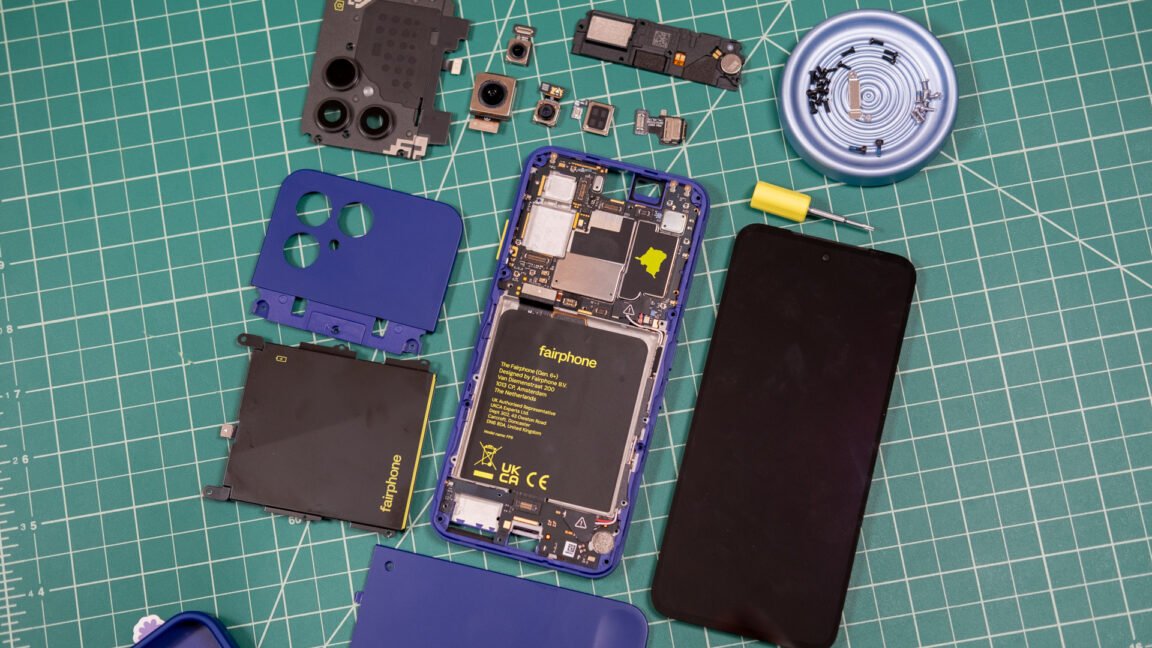
Hatton said it takes her 15 minutes to fully disassemble a Fairphone Gen 6+, but she did have a hand in designing it. That said, it shouldn’t take a novice much longer. After a couple of minutes perusing Fairphone’s documentation, I was able to take the phone apart and remove all of the user-serviceable components in about 20 minutes. Everything went back together without issue and still works perfectly, with no new gaps or wobble.
The process is pretty intuitive, with most of the parts held in with flat board-to-board cable connectors. Just pop them off with a spudger or your fingernail, and the component lifts right out. There are a good number of screws to remove to get all the way down to the metal frame and screen, but again, they all use the same T5 Torx bit.