

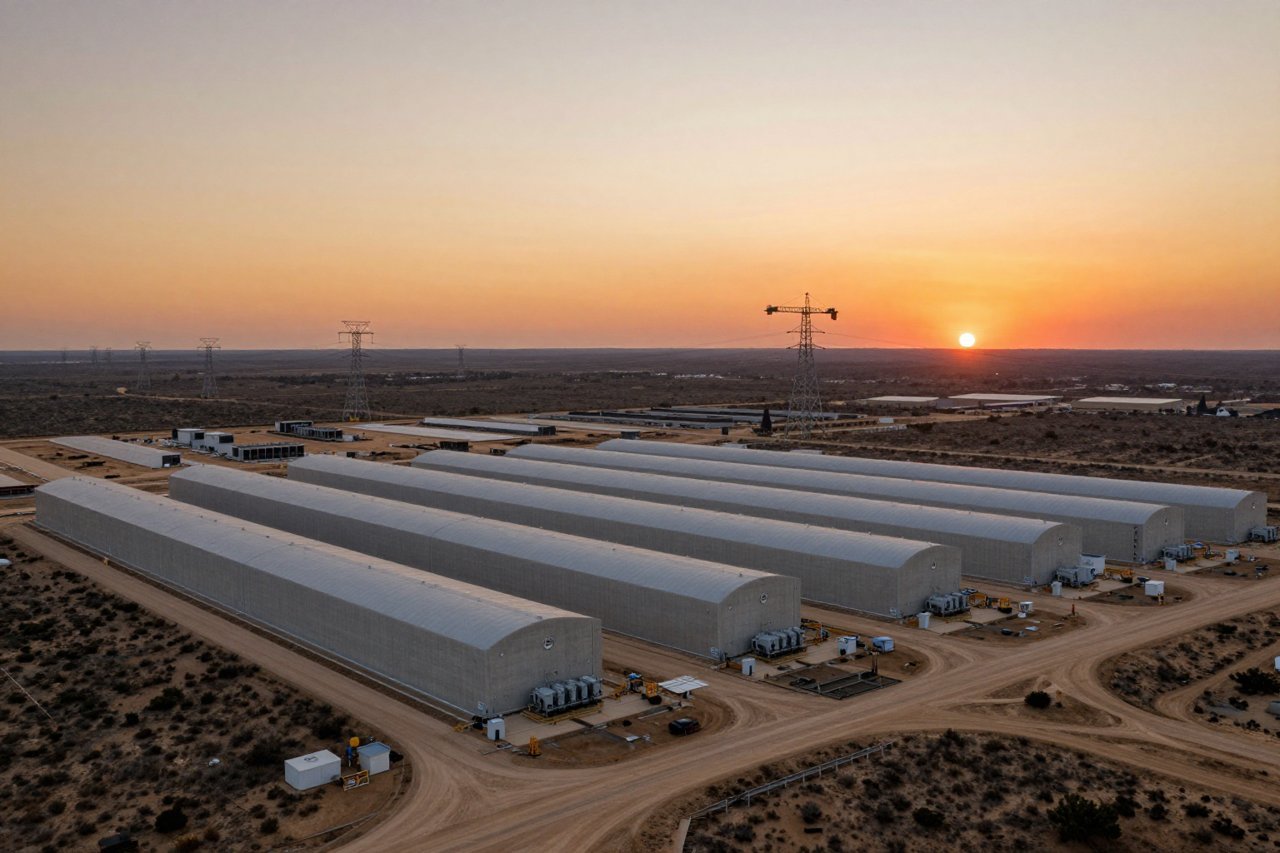
Drive south-west out of Abilene, Texas, past the cotton fields and the wind turbines, and you eventually reach a construction site that looks less like a tech campus and more like an industrial town being poured from scratch. Concrete shells, on-site gas turbines, switchyards, and a power appetite measured in gigawatts. This is Stargate’s first flagship campus, and it is the most honest answer you will get to the question of what OpenAI’s AGI infrastructure actually consists of.
The public conversation still tends to treat AGI as a software milestone: a training run that eventually tips over some threshold. The physical build-out tells a different story. Whatever the models end up being capable of, they will be capable of it inside buildings that must be financed, permitted, wired and cooled first.
What “AGI infrastructure” actually means inside OpenAI
The phrase covers four layers that all have to line up at once.
- Silicon: the GPUs and custom accelerators doing the arithmetic, plus the high-bandwidth memory and packaging that feed them.
- Buildings: shell space, cooling plants, backup generation and physical security.
- Power: the interconnection agreements, substations, turbines and long-term supply contracts.
- Orchestration: the networking fabric, schedulers and storage systems that let a training run survive a failure on rack 4,000 without starting from zero.
Weakness in any one layer caps the other three. That is why the company’s roadmap now reads a little like an infrastructure prospectus stapled to a research agenda. To get a sense of the scale, a single Nvidia GB200 NVL72 rack pulls roughly 120 kilowatts. A 100,000-GPU cluster lands somewhere around 150 megawatts once cooling and electrical losses are counted, which is the load of a mid-sized town, permanently.
Stargate and the gigawatt arithmetic
Announced in January 2025 with Oracle, SoftBank and MGX, Stargate was framed as a $500 billion commitment over four years, with an initial $100 billion tranche. For context, that headline figure is roughly the annual GDP of a mid-sized European economy, spent on compute and the buildings around it.
The Abilene site is designed to scale to about 1.2 gigawatts across multiple buildings, with the first halls energised during 2025. Additional sites have been announced or scouted in Texas, New Mexico, Ohio and the Middle East. Each one follows the same logic: land is cheap and plentiful, so the real constraint is whether you can get electrons to the fence line fast enough.
Why the sites follow the substations, not the talent
Grid interconnection queues in the United States routinely run three to seven years for large loads. That timeline is incompatible with a company shipping model generations every few months, so OpenAI and its partners have leaned hard on behind-the-meter generation: gas turbines on site, power purchase agreements with nuclear operators, and speculative deals with small modular reactor developers whose first commercial units are still years from producing a single megawatt-hour. Some of that is genuine capacity. Some of it is an option on future capacity, bought early because the option itself is scarce.
The silicon layer: Nvidia, AMD and the custom-chip hedge
Nvidia remains the default. A letter of intent between the two companies sketched out up to 10 gigawatts of Nvidia systems alongside a large equity investment, which tells you how tightly the compute supply chain and the model developer are now entangled.
The more interesting shift is diversification. In October 2025, OpenAI and AMD announced a multi-gigawatt agreement, with the first gigawatt of AMD Instinct MI450 hardware scheduled from the second half of 2026. Reports of work with Broadcom on custom accelerators point the same direction. Running a frontier lab on a single vendor is a supply risk, and for inference specifically it is a margin risk, because serving a reasoning model to millions of users is mostly a cost-per-token problem.
Mixed fleets are not free, though. Different memory hierarchies, different kernels, different compiler quirks. Engineers end up maintaining two or three parallel optimisation paths, and the effective utilisation of the second vendor often trails the first for the better part of a year.
Microsoft, Oracle and the spreading compute web
Microsoft was the original backbone of OpenAI’s compute, and the Azure relationship still anchors a huge share of training. What changed is exclusivity. Oracle supplies Stargate capacity, CoreWeave and others fill gaps, and SoftBank’s energy and infrastructure arms have become part of the stack. For researchers, a multi-cloud reality means the training job has to be portable. Portability costs performance, but it buys leverage.
Five bottlenecks that decide the timeline
Anyone modelling when the next capability jump arrives should watch these rather than the model announcements.
- Grid capacity. Interconnection approvals and behind-the-meter generation permits.
- High-voltage equipment. Large power transformers have lead times stretching past two years in some cases.
- Advanced packaging. CoWoS capacity at TSMC remains a hard ceiling on how many accelerators ship each quarter.
- Cooling. Direct-to-chip liquid cooling is now standard for dense racks, and water rights in arid states are a genuine permitting fight.
- Skilled trades. Electricians, pipefitters and commissioning engineers are the quietest shortage in the whole build-out.
Why the infrastructure shapes the research, not just the bill
Compute does not simply make models bigger. It changes what kind of model is economically viable to run. A system that deliberates for thirty seconds before answering costs vastly more per query than one that fires once, and the shift toward reasoning models has pushed a large share of total compute from training into inference. That is a different infrastructure requirement: lower latency, higher availability, and geographic distribution near users.
Long-horizon agents compound the effect. A browsing or coding agent that takes dozens of steps per task consumes tokens the way a video call consumes bandwidth. The engineering behind agent technology and browser automation is only half the story; the other half is a serving fleet that can absorb millions of sequential calls without collapsing under its own queue depth. If you want a grounded read on where the model side stands, this look at what OpenAI’s models can actually do is a useful reality check against the marketing.
The governance question hiding in the substation
Scale also concentrates risk. A training run that occupies a 150-megawatt campus is visible, auditable and geographically pinned in a way that a smaller job never was. That has consequences for oversight: regulators can count megawatts even when they cannot inspect weights. The internal decision process for shipping a model matters more when a single deployment reaches hundreds of millions of people within days, and the contractual fine print around when AGI is deemed to have arrived is where a lot of the real leverage sits, as this breakdown of OpenAI’s AGI policy clauses makes clear.
What to watch over the next 18 months
Three concrete signals will tell you more than any keynote. First, whether the Abilene halls reach full energisation on schedule; a slip there cascades through every downstream commitment. Second, AMD MI450 volume shipments in the second half of 2026, which determine whether the multi-vendor strategy is real or decorative. Third, the ratio of capital expenditure to inference revenue in OpenAI’s disclosures. If compute spending keeps outrunning the money coming back from serving models, the gigawatt pledges get renegotiated, and the AGI timeline quietly reshapes itself around the balance sheet rather than the research.
Watch the switchyards. They move slower than the papers, and they are harder to argue with.