

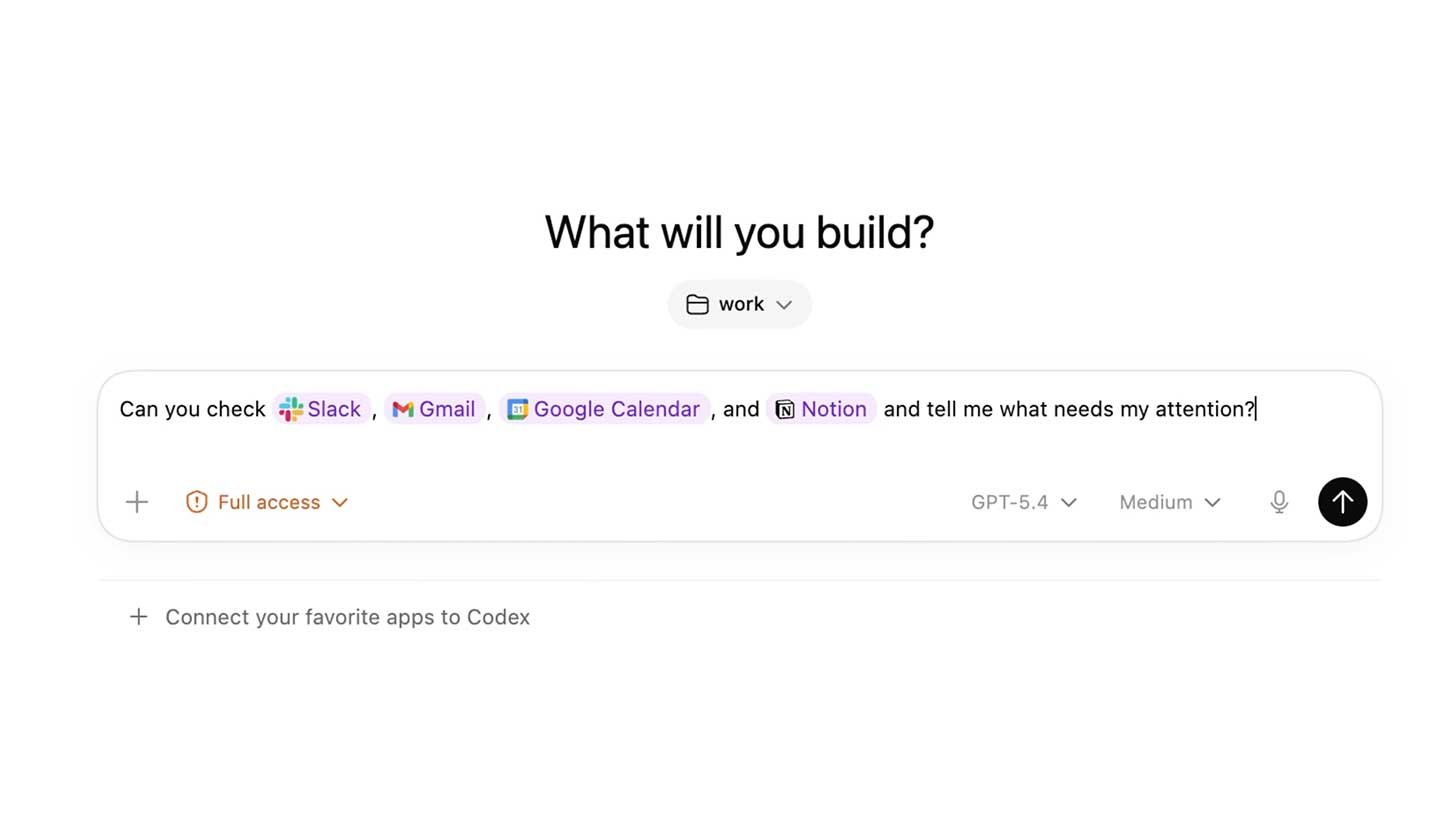
Good morning, {{ first_name | AI enthusiasts }}. OpenAI has been teasing a superapp for months. Today, it shipped a major first piece.
With a major Codex update bringing new features like background computer use, an in-app browser, parallel agents, and more, the rollout is OpenAI’s clearest step yet toward the all-in-one platform it’s been building out in the open.
-
OpenAI’s superapp shift with Codex update
-
Anthropic’s Opus 4.7 tops rivals, trails Mythos
-
Run an LLM on your laptop for free with Ollama
-
OpenAI’s first science domain-specific model
-
4 new AI tools, community workflows, and more
OPENAI

The Rundown: OpenAI just updated its Codex platform, shifting it from a coding agent to a cohesive ChatGPT + Atlas + Codex app with features like background computer use, parallel agents, an in-app browser, image generation, and more.
-
Background computer use lets Codex operate any Mac app on its own, with several agents also able to work at once, even in apps without APIs.
-
Memory (in preview) now retains preferences and context across sessions, while automations let Codex pick up long-running tasks days later.
-
An Atlas-powered in-app browser lets developers mark up pages to direct Codex, while inline gpt-image-1.5 creates mockups without switching apps.
-
Codex hit 3M weekly users with 70% month-over-month growth, and Codex head Thibault Sottiaux said OpenAI is “building the super app out in the open.”
Why it matters: Anthropic hit a home run with Claude Code and Cowork, and this is OpenAI’s biggest challenge to it yet — bringing Codex on a similar playing field with an expansion of capabilities far beyond just an agentic coding assistant. With the company building a ‘superapp’, this feels like a big first shift towards that vision.
TOGETHER WITH LOVABLE

The Rundown: Hiring developers or learning to code used to be the only way to bring a product to life. Lovable removes that barrier entirely — its AI builds real, usable apps and websites from a simple text description.
Millions of users are already building with Lovable to:
-
Go from idea to a functional, customer-ready app in minutes, not months
-
Launch Shopify stores, admin tools, landing pages, and more with simple prompts
-
Launch real businesses, validate ideas, and save thousands in dev costs
ANTHROPIC

The Rundown: Anthropic just released Claude Opus 4.7, the company’s new top publicly available model that tops GPT-5.4 and Gemini 3.1 Pro on agentic coding — though still lags behind the company’s own unreleased Mythos Preview.
-
Opus 4.7 jumps from 4.6’s 53.4% on SWE-bench Pro coding benchmark to 64.3%, with the gated Mythos Preview still ahead at 77.8%.
-
The model is priced identically to Opus 4.6 for API usage, though the upgrade uses tokens significantly faster than its predecessor.
-
Other rollouts include a Claude Code default ‘xhigh’ effort in between high and max, and an /ultrareview slash command that flags bugs and design issues.
-
The release comes amid user complaints of degraded performance on 4.6, with 4.7 early reactions also coming out divided on capabilities despite benchmarks.
Why it matters: Anthropic is now running two parallel tracks: a fast 2-month public release cadence and a gated frontier line in Mythos, accessible only to exclusive partners. That split lets the company stress-test its most powerful models, but also marks one of the first times public access feels behind the true frontier.
AI TRAINING

The Rundown: In this guide, you will learn how to install Ollama and run a real AI model on your laptop for free. No subscription, no account, and no data leaving your machine.
-
Go to ollama.com/download, get the installer for your Mac / Linux / Windows PC, and set it up. Open the app once it’s installed
-
In the app, go to New Chat, select a lightweight model like gemma3 (about 3GB, suitable for any 8GB RAM laptop), and wait for it to download
-
After the model downloads, type a prompt and hit enter. That’s it. You’re chatting with a real AI running entirely on your laptop
-
Try turning on airplane mode and sending another message to watch it work with no internet at all
Pro tip: You can use Ollama’s API to give your model access to web and other tools. You can also point a coding agent like Claude Code at the model and run it for free.
PRESENTED BY FIDDLER

The Rundown: Evaluating agents with external LLMs looks affordable. Until your agent traffic grows. Fiddler’s guide breaks down how to reduce Total Cost of Ownership while eliminating risk gaps in production.
-
Evaluate every trace without sampling
-
Evaluate agents in-environment with batteries-included Trust Models
-
Reduce API costs at scale
OPENAI

The Rundown: OpenAI launched GPT-Rosalind, the first model in a new life sciences series built for drug discovery and biological research, and the company’s first real step into domain-specialized reasoning — following Tuesday’s GPT-5.4-Cyber.
-
Rosalind can read scientific papers, query lab databases, design experiments, and generate biological hypotheses, simplifying the research process.
-
The model shows strong jumps on science-specific benchmarks for biochemistry, experiment design, tool usage, and more over GPT-5.4.
-
On a blind RNA test from gene therapy lab Dyno Therapeutics, Rosalind’s answers scored better than 95% of human scientists on prediction tasks.
-
The model is available to qualifying enterprise users during the test phase, with companies like Amgen, Moderna, and the Allen Institute already using it.
Why it matters: Tuesday, it was GPT-5.4-Cyber, and today, it’s GPT-Rosalind. That’s two domain models in three days, showing a trend — the flagship may be good at everything, but the actual massive wedges at the top of industries like defending networks or designing drugs may need purpose-built models.
-
🤖 Claude Opus 4.7 – Anthropic’s new top AI with advanced agentic coding
-
⚙️ Windsurf 2.0 – Agentic IDE with new command center, Devin cloud agent
-
🚀 Codex – OAI’s coding agent, now with computer use, in-app browser, more
-
🧠 HY-World 2.0 – Tencent’s world model that creates interactive 3D scenes
Perplexity rolled out Personal Computer, a Max-tier Mac app that runs agents across 20+ frontier models to drive native apps, read files, and pilot its Comet browser 24/7.
Windsurf launched 2.0, adding an Agent Command Center with a new command center view for fleets of parallel cloud and local agents and bringing Devin into the IDE.
Tencent’s Hunyuan team open-sourced HY-World 2.0, a world model that generates editable 3D scenes with physics-aware movement, pushing directly into 3D pipelines.
The U.S. government is reportedly preparing to give certain agencies access to Anthropic’s Mythos AI, despite the blacklist and current legal battle with the company.
Alibaba’s ATH team introduced Happy Oyster in beta, a new world model that can create interactive 3D environments on the fly from multimodal inputs.
Every newsletter, we showcase how a reader is using AI to work smarter, save time, or make life easier.
Today’s workflow comes from reader Jerry G. in Gig Harbor, WA:
“I’m a 73-year-old author and screenwriter. I have been using Claude to build my last two books. Claude helped design the book covers, formatted the interior, and even suggested titles for my stories.
Now that they are printed, Claude helps me market them to book clubs, libraries, and social media sites. Claude helped me build a Substack following and post bi-weekly new stories on Instagram and BlueSky. I’m a Claude convert and won’t write any more books with his assistance.”
How do you use AI? Tell us here.
That’s it for today!
Before you go we’d love to know what you thought of today’s newsletter to help us improve The Rundown experience for you.
Rowan, Joey, Zach, Shubham, and Jennifer — the humans behind The Rundown
