

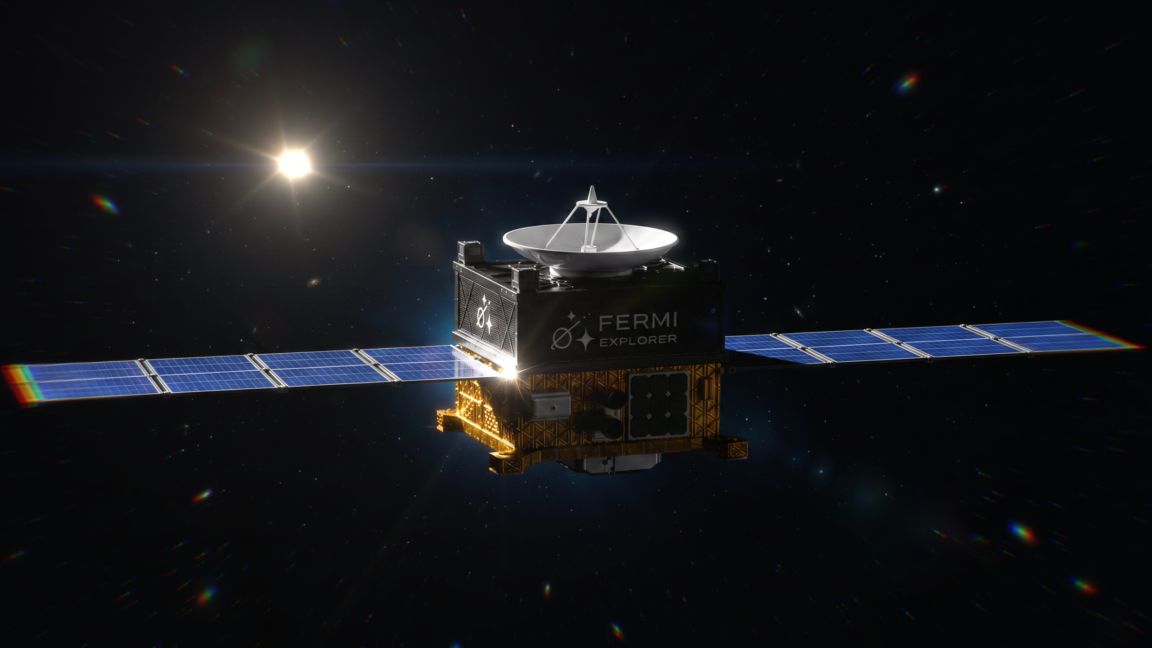
The goal was not to run to NASA and try to get it to fund a $1 billion mission or seek to develop a new propulsion technology like the Breakthrough Starshot mission proposed a decade ago. Rather, the Fermi Explorer team wanted to use existing technology to do something cheap, fast, and launch by 2029.
“So we were like, ‘Fuck it, let’s send a spacecraft for the cheapest amount possible, a bog-standard minimum viable mission to Alpha Centauri,’” he told Ars.
The main stumbling block involves getting the probe—essentially a large tank of Xenon gas and some solar panels for solar-electric propulsion, and a few small scientific payloads—moving fast enough. Solar-electric propulsion is super efficient, but once a spacecraft is beyond Jupiter, the solar energy flux is low enough that it might as well be zero for a spacecraft the size of the Fermi Explorer. Johnston and a small team spoke with many people, including trajectory experts at NASA’s Jet Propulsion Laboratory, to find a solution.
Introducing the Fermi Explorer mission.
Nothing worked until Johnston linked up with Alex Wissner-Gross, a physicist who founded Physical Superintelligence, an AI technology company. They fed the mission parameters into the AI, and it returned an 18-page technical feasibility assessment that offered a novel mission profile. It involves hanging around our Sun for more than a decade before charging out to Alpha Centauri.
Essentially, after launching into low-Earth orbit on a rideshare mission, the spacecraft would fly retrograde arcs to decrease its distance from the Sun at perihelion from 1 astronomical unit (Earth-Sun distance) to 0.42 astronomical units. At these close approaches to the Sun, taking advantage of the higher solar flux as well as the Oberth effect, the spacecraft would operate its propulsion system to increase its velocity with “perihelion pump” maneuvers.