

Close Menu
AI News TodayAI News Today

    Subscribe to Updates

    Get the latest creative news from FooBar about art, design and business.

    What's Hot

    DeepMind’s hurricane model bought forecasters an extra day

    Details Leak on OpenAI’s Doughnut-Shaped Speaker

    How to Disable Gemini in Gmail and Google Docs

    Facebook X (Twitter) Instagram
    • About Us
    • Contact Us
    Facebook X (Twitter) Instagram Pinterest Vimeo
    AI News TodayAI News Today
    • Home
    • AI News
    • AI Reviews
    • AI Tools
    • AI Tutorials
    • Chatbots
    • Free AI Tools
    • Artificial Intelligence
    AI News TodayAI News Today
    Home»Chatbots»Researchers devise a full-color night vision goggle
    Chatbots

    Researchers devise a full-color night vision goggle

    By No Comments2 Mins Read
    Share Facebook Twitter Pinterest LinkedIn Tumblr Reddit Telegram Email
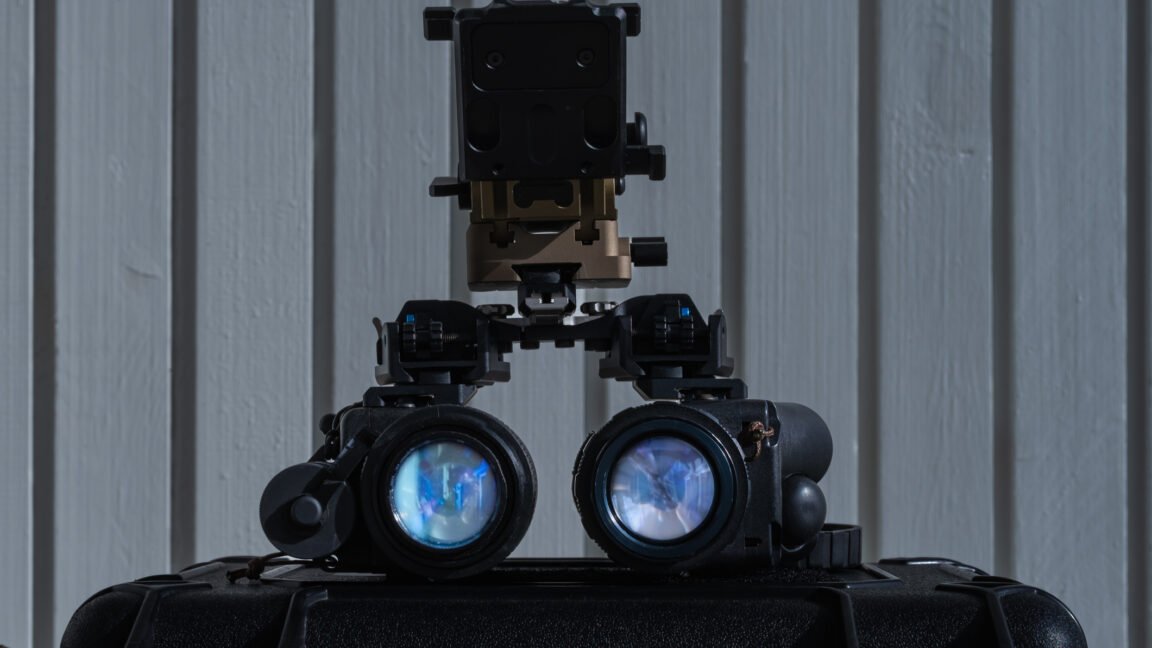
    Front view of modern binocular night vision goggles (NVG) with a mount, sitting on top of a black protective case.
    Share
    Facebook Twitter LinkedIn Pinterest Email

    The solution Tang’s team arrived at starts with the way infrared light is registered in the first place.

    Selective quantum dots

    Bulk semiconductors routinely used in IR detectors have continuous energy bands, which means they absorb a broad, undifferentiated swath of the infrared spectrum. This doesn’t preserve much information about which specific wavelength arrived. The mercury telluride colloidal quantum dots the Chinese team picked for their device behave differently. Due to their tiny size, roughly 4 nanometers across, quantum confinement breaks their energy levels into discrete steps rather than a continuous chunk. Photons of different infrared wavelengths and intensities excite different electronic transitions, moving an electron between discrete energy levels within the dot, rather than just producing more or less of a single signal.

    At wavelengths of around 2 micrometers, the longest the team tested, incoming photons have just enough energy to bump an electron across the dot’s fundamental bandgap, producing a modest number of charge carriers, either negatively charged electrons or positively charged holes that move around the dot.

    At shorter infrared wavelengths, photons carry more energy per particle, and they can access additional, higher-energy electronic transitions inside the dot. In some cases the excess energy in a carrier can be enough to kick loose more than one electron-hole pair per photon. These processes open extra channels for generating charge carriers. The effect is that shorter infrared wavelengths and more intense infrared light push more positively charged holes out of the quantum dot layer and toward the OLED side of the device.

    But getting a variable number of holes dependent on the wavelength and intensity of infrared light out of the detector was only half the problem. The other half was translating this signal into a color image at the other side.

    The barrier

    The team achieved this by building the OLED with two separate emissive layers stacked on top of each other. One layer, closer to where the holes enter, was doped with a red-emitting phosphor. The other one, positioned farther away, was doped with phosphor-emitting cyan light. The key component that made full-color vision work was an energy barrier of about 0.82 electron volts between these two layers.

    devise fullcolor goggle Night researchers vision
    Share. Facebook Twitter Pinterest LinkedIn Tumblr Email
    Previous ArticleWould you get tattooed just to interview at a 7-days-a-week AI startup?
    Next Article GM and Ford are talking less and less about EVs
    • Website

    Related Posts

    Chatbots

    Grab the entire Lord of the Rings trilogy on 4K Blu-ray for $50

    Chatbots

    Microsoft Edge is about to lock out older ad blockers, just like Chrome did

    Chatbots

    Volkswagen plans to win America back with a pickup, report says

    Add A Comment
    Leave A Reply Cancel Reply

    Top Posts

    DeepMind’s hurricane model bought forecasters an extra day

    0 Views

    Details Leak on OpenAI’s Doughnut-Shaped Speaker

    0 Views

    How to Disable Gemini in Gmail and Google Docs

    0 Views
    Stay In Touch
    • Facebook
    • YouTube
    • TikTok
    • WhatsApp
    • Twitter
    • Instagram
    Latest Reviews
    AI Tutorials

    Quantization from the ground up

    AI Tools

    David Sacks is done as AI czar — here’s what he’s doing instead

    AI Reviews

    Judge sides with Anthropic to temporarily block the Pentagon’s ban

    Subscribe to Updates

    Get the latest tech news from FooBar about tech, design and biz.

    Most Popular

    DeepMind’s hurricane model bought forecasters an extra day

    0 Views

    Details Leak on OpenAI’s Doughnut-Shaped Speaker

    0 Views

    How to Disable Gemini in Gmail and Google Docs

    0 Views
    Our Picks

    Quantization from the ground up

    David Sacks is done as AI czar — here’s what he’s doing instead

    Judge sides with Anthropic to temporarily block the Pentagon’s ban

    Subscribe to Updates

    Get the latest creative news from FooBar about art, design and business.

    Facebook X (Twitter) Instagram Pinterest
    • About Us
    • Contact Us
    • Terms & Conditions
    • Privacy Policy
    • Disclaimer

    © 2026 ainewstoday.co. All rights reserved. Designed by DD.

    Type above and press Enter to search. Press Esc to cancel.