

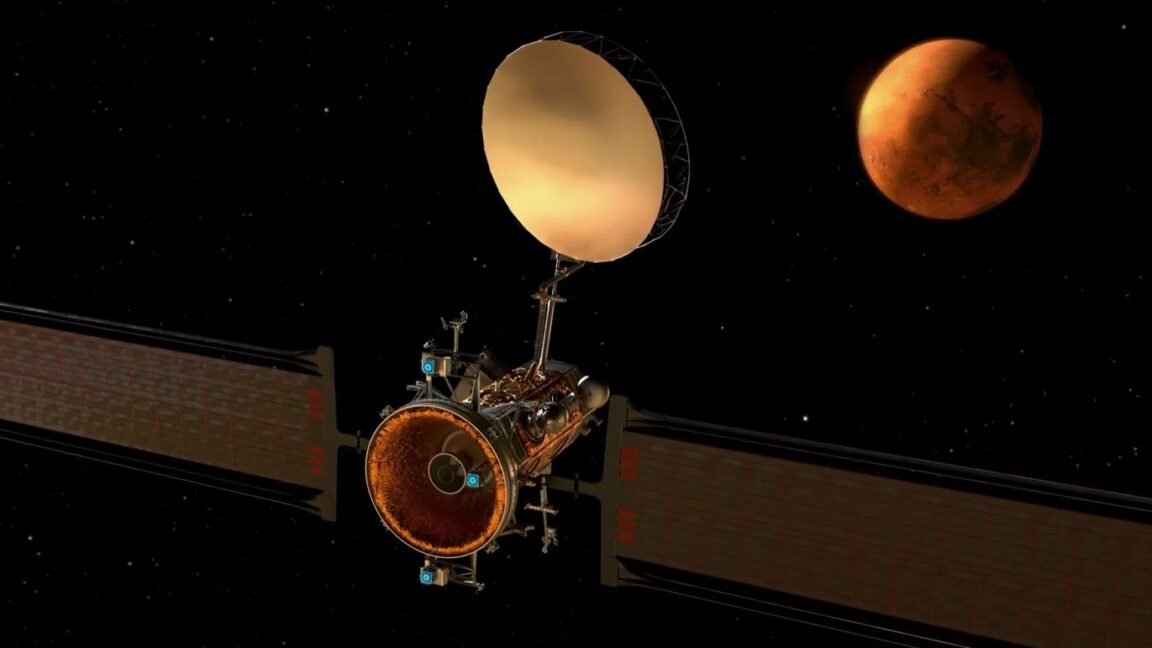
In theory, developing a spacecraft that will fly to Mars, insert itself into orbit around the red planet, and relay transmissions back and forth to large satellite dishes on Earth is a relatively straightforward proposition.
NASA’s procurement of a “Mars Telecommunications Network” spacecraft, however, has turned out to be one of the most engrossing dramas of the year for the US space agency.
The agency finally reached a decision earlier this month, selecting Blue Origin to develop, launch, and operate a $700 million spacecraft at Mars. However, the main competitor for the award, Rocket Lab, was not happy—at all. On Friday, the company filed a protest of NASA’s decision with the US Government Accountability Office.
“NASA’s award decision appears to be inconsistent with the eligibility criteria mandated by Congress,” the company said on X. “In addition, the agency’s punitive review of Rocket Lab’s technical volume was inconsistent, making incorrect assertions and conclusions.”
One Big Beautiful spacecraft
Rocket Lab’s protest announcement references “eligibility criteria mandated by Congress,” and this appears to be the heart of the issue at hand.
The origin of the Mars Telecommunications Network spacecraft came as part of the supplemental funding package for NASA provided by the “One Big Beautiful Bill” passed by the US Congress in 2025. It was not widely expected in the space community, but the new start was welcome, given that NASA’s spacecraft orbiting Mars are aging.
This NASA-specific legislation, led by Sen. Ted Cruz (R-Texas), included some curious wording. It specified that the Mars orbiter must be selected from among US companies that “received funding from the Administration in fiscal year 2024 or 2025 for commercial design studies for Mars Sample Return; and had proposed a separate, independently launched Mars telecommunication orbiter supporting an end-to-end Mars sample return mission.”
The reference to “commercial design studies” meant companies that proposed faster and more affordable missions to return samples from Mars, which were selected in 2024 and 2025. Rocket Lab is one of several companies eligible to compete based on this commercial design study requirement. Other eligible bidders include: Blue Origin, L3Harris, Lockheed Martin, Northrop Grumman, SpaceX, Quantum Space, and Whittinghill Aerospace.