

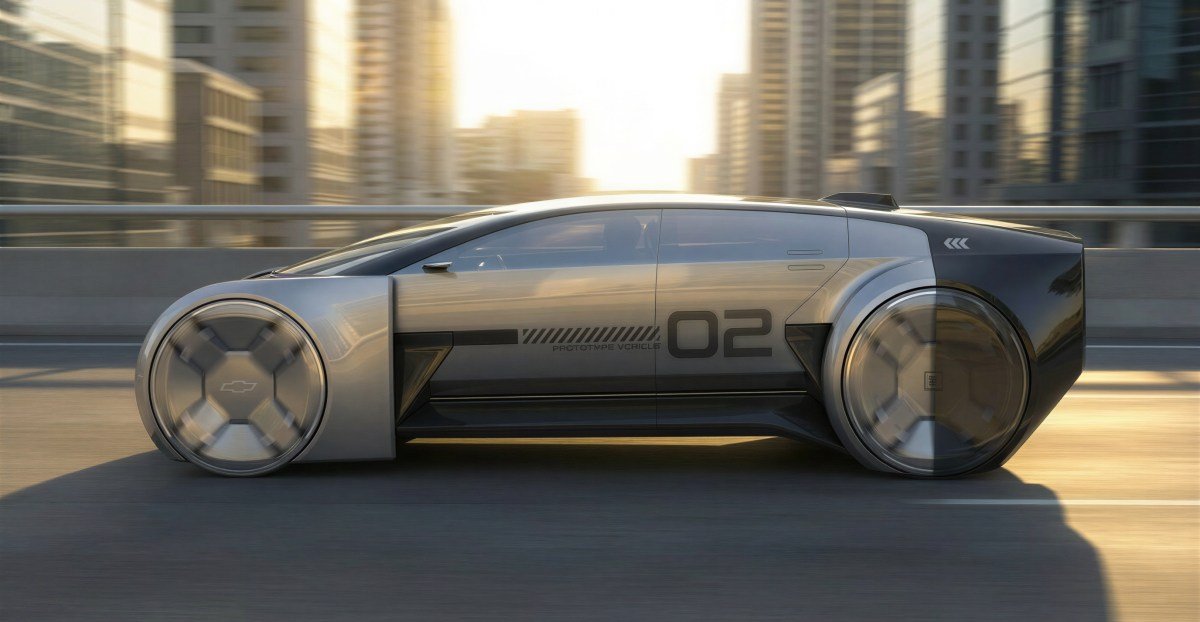
The auto design world is full of advanced 3D visualization tools and VR sculpting platforms, but your average new car still enters the world as a sketch.
Those sketches traditionally see endless iteration and refinement from all angles before being turned into 3D models by hand, some dying in the digital world, others sculpted into clay to better visualize lines and profiles. That’s just the beginning of a design and development process that often takes a half-decade or more.
That means many new cars hitting dealerships this summer were first sketched in 2020 or 2021, initiatives kicked off when alternative fuel incentives were widespread, EV chargers were spreading like wildfire, and internal combustion’s days were numbered.
Today, everything has changed. The Trump administration’s second act has quashed all sorts of EV incentives while slinging tariffs and import/export restrictions. Auto manufacturers that once pledged to go all-electric by the end of the decade are now shoving engines into anything that moves and factories are hurriedly being re-tasked to dodge the worst of the import restrictions.
Amidst all that, we have the agentic AI boom, which an increasing number of manufacturers are leveraging to reel in that 60-month new car design and development window. As with most aspects of AI, the potential is huge. So, too, are some more disturbing ramifications.
At GM, that new-car development process is getting an AI injection in the design phase. Dan Shapiro, creative designer at General Motors, walked me through the workflow, which always starts with a human design. “That’s what the sketches are for,” he said, “and AI helps us see it sooner.”
By feeding hand-drawn sketches into a commercially available tool called Vizcom, Shapiro was able to create a fully realized 3D model and animation in hours, a process he said previously took “multiple teams multiple months.”
Shapiro’s example was a concept car with aggressive lines that would have looked at home on the streets of Night City. Writing prompts like: “Create a dynamic view action shot of this Chevy concept vehicle… Empty elevated streets. Modern city,” he created a simple animation. Soon it was rolling across the sorts of perpetually wet roads that are de rigueur in a cyberpunk future.
In some iterations, the vertical wheel covers disappeared, but a few prompt revisions and re-renderings quickly fixed that.
For now, at least, these animations are only used internally as rolling mood boards to help GM’s teams see what works. And, Shapiro was adamant that it’s always the human designers shaping things, not the AI: “We’re still the monks deciding what feels like a Buick, a GMC, a Cadillac, and in this case, a Chevy.”
But AI is having an influence there, too.

Image: GM
Computational fluid dynamics (CFD) is the science of determining just how well a fluid flows around a given shape. CFD helps EVs go a little farther on a charge, and big trucks offer slightly improved wind resistance. Since 2018, a Swiss company called Neural Concept has been bringing the power of neural networks to the art of CFD. Tasks that formerly took hours on supercomputers can be simulated in minutes on GPUs like those from Nvidia.
Neural Concept has applied its tech to everything from family sedans to Formula One racers (Williams Racing is a customer), and while most of its clients would rather remain unnamed, keeping the details of their design tools and processes secret, Jaguar Land Rover (JLR) has recently been singing the tech’s praises. At this year’s Nvidia GTC, Chris Johnston, a senior technical specialist at JLR, said aero jobs that previously took 4 hours are now completed in 1 minute.
GM is on the same path, developing what it calls an “AI-powered virtual wind tunnel.” Scott Parrish, technical fellow and lab manager at GM R&D, gave me a demo. “We’ve developed an AI model to provide a near-instantaneous prediction of drag,” he said. Designers and engineers can push and pull surfaces and get near-instant feedback.
It’s not just cars getting reshaped. GM’s process is also changing. Where designers formerly handed models off to CFD engineers, who would test for days or weeks before providing feedback, now it’s more iterative. And, since designers can quickly churn out 3D models, the CFD work can start earlier.
These automated procedures aren’t perfect, however. “We’re building autonomous systems that design cars with strong human oversight,” Neural Concept CEO and co-founder Pierre Baqué said. “The value comes from the combination of AI speed and human judgment, not from removing the human from the equation.”
How a car looks and cuts through the air aren’t the only aspects that contribute to a half-decade development roadmap. Coding is an increasingly big task. The push for software-defined vehicles means more complex integration efforts that have delayed launches and cost billions. AI is seen as a potential boon here, too.
At Nissan, the main focus is automating some menial tasks of software development, like unit tests. Takashi Yoshizawa, corporate executive at Nissan in charge of software-defined vehicles, told me these code-generation tools “improve both development speed as well as quality.”

Image: GM
A common refrain among companies diving into AI is that they’ll bolster worker productivity by wiping away menial tasks, not cutting headcount. GM representatives were adamant on that point. “That hits on something that is a concern for a number of people, but the way that we’re really leveraging is allowing people to do what they really came to GM to do,” Bryan Styles said. He’s the director of design innovation and technology operations at GM Global Design.
Pierre Baqué at Neural Concept said the same of its clients: “Our platform is designed to amplify engineering teams, not reduce them.”
Matteo Licata isn’t so sure. A former automobile designer, he’s currently a professor at IAAD (Istituto di Arte Applicata e Design) in Turin. “Jobs in design studios may not disappear right away, but the way I see it, only a fool will believe that such a massive productivity boost isn’t going to affect a studio’s headcount one way or the other,” he said.
This has some more troubling implications for Licata’s students. “Getting into car design was already very difficult before AI, and now it’s only going to get harder,” he said.

Image: GM
Whether AI is a boon or a debacle largely depends on how judicious manufacturers are in deploying it. Some are displaying better judgement than others. Dodge recently posted some supposed “old family photos” of its most popular models from 20 years ago. In reality, the AI-generated pictures barely looked like the real thing.
Marketing missteps aside, the goal of the moment is speed. The AI injections into GM’s design process are already being used for its next-generation cars, but nobody there would comment on when those will hit the market. For its part, Nissan is working towards a 30-month goal for new cars as it works to regain momentum in the US market.
Is that fast enough? We’ll find out in 2029.