

Close Menu
AI News TodayAI News Today

    Subscribe to Updates

    Get the latest creative news from FooBar about art, design and business.

    What's Hot

    DOGE’s wild, unverifiable savings claims discredited in US government report

    The best instant cameras for 2026

    New official 30th anniversary Quake mission pack adds new maps and mechanics

    Facebook X (Twitter) Instagram
    • About Us
    • Contact Us
    Facebook X (Twitter) Instagram Pinterest Vimeo
    AI News TodayAI News Today
    • Home
    • AI News
    • AI Reviews
    • AI Tools
    • AI Tutorials
    • Chatbots
    • Free AI Tools
    • Artificial Intelligence
    AI News TodayAI News Today
    Home»AI Reviews»The world’s biggest solar telescope caught vortexes on the Sun’s surface
    AI Reviews

    The world’s biggest solar telescope caught vortexes on the Sun’s surface

    By No Comments2 Mins Read
    Share Facebook Twitter Pinterest LinkedIn Tumblr Reddit Telegram Email
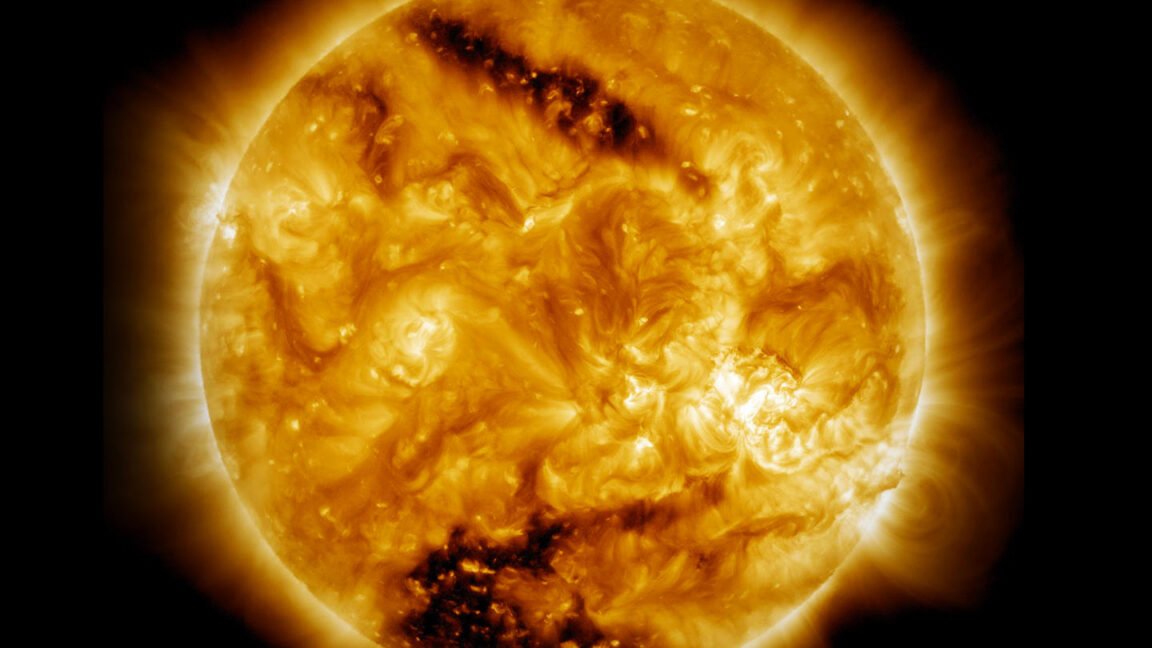
    Image of the surface of the Sun, showing lots of dynamic features.
    Share
    Facebook Twitter LinkedIn Pinterest Email

    For the observer hovering above one of these boundaries, Kuridze says, the view would depend on the time of arrival. The instability runs through two phases. “The first is the linear phase, when things are more relaxed, very well organized, regular and beautiful,” he says. “If you see them from close range you will see something like cloud-type things, which are rolling.”

    But when the peaceful phase is over, it’s chaos. “At some point everything turns into a non-linear regime and then things get messy,” Kuridze explains. “You are basically getting turbulence—very chaotic turbulence.

    Why do the curls form at the interfaces and not elsewhere? That’s due to the direction the magnetic field is pointing. Magnetic field lines act a bit like elastic threads running through the plasma, and they resist being bent. When those threads lie along the direction of the flow, they pull a rippling boundary back, which flattens and suppresses the instability before it can grow. When they run across the flow, they do nothing to stop it.

    In the strong magnetic regions DKIST observed, the field points almost straight up out of the surface, while the granular flows sliding past it move sideways. The threads are strung the wrong way to hold the boundary together, so the curls grow with nothing to limit them.

    Double-checking

    Because Kuridze, Wöger, and their colleagues saw something nobody has seen before, they made sure the observation wasn’t just an artifact of image processing. “Everything looked like it should be Kelvin-Helmholtz, but of course this is not enough,” Kuridze says. “You need theoretical proof to make sure that it is really Kelvin-Helmholtz.”

    To get that theoretical proof, researchers ran computer simulations modeling a patch of photosphere roughly 6 megameters on a side at a grid spacing of 3.2 kilometers, seeded with a magnetic field map of the actual observed region. Then, they synthesized images that the DKIST should have registered while looking at this simulated patch.

    biggest caught solar Suns Surface Telescope vortexes worlds
    Share. Facebook Twitter Pinterest LinkedIn Tumblr Email
    Previous ArticleThe Problem with pandas Isn’t Performance. It’s Cognitive Overhead.
    Next Article Scientists Used AI to Create 16 New Viruses
    • Website

    Related Posts

    AI Reviews

    New official 30th anniversary Quake mission pack adds new maps and mechanics

    AI Reviews

    Work, Study and Play Better With the Lenovo IdeaPad Slim 3i, Now $500 Off at Best Buy

    AI Reviews

    Sony could release a cheaper version of its WH-1000XM4 headphones, according to leaks

    Add A Comment
    Leave A Reply Cancel Reply

    Top Posts

    DOGE’s wild, unverifiable savings claims discredited in US government report

    0 Views

    The best instant cameras for 2026

    0 Views

    New official 30th anniversary Quake mission pack adds new maps and mechanics

    0 Views
    Stay In Touch
    • Facebook
    • YouTube
    • TikTok
    • WhatsApp
    • Twitter
    • Instagram
    Latest Reviews
    AI Tutorials

    Quantization from the ground up

    AI Tools

    David Sacks is done as AI czar — here’s what he’s doing instead

    AI Reviews

    Judge sides with Anthropic to temporarily block the Pentagon’s ban

    Subscribe to Updates

    Get the latest tech news from FooBar about tech, design and biz.

    Most Popular

    DOGE’s wild, unverifiable savings claims discredited in US government report

    0 Views

    The best instant cameras for 2026

    0 Views

    New official 30th anniversary Quake mission pack adds new maps and mechanics

    0 Views
    Our Picks

    Quantization from the ground up

    David Sacks is done as AI czar — here’s what he’s doing instead

    Judge sides with Anthropic to temporarily block the Pentagon’s ban

    Subscribe to Updates

    Get the latest creative news from FooBar about art, design and business.

    Facebook X (Twitter) Instagram Pinterest
    • About Us
    • Contact Us
    • Terms & Conditions
    • Privacy Policy
    • Disclaimer

    © 2026 ainewstoday.co. All rights reserved. Designed by DD.

    Type above and press Enter to search. Press Esc to cancel.