

Good morning, {{ first_name | AI enthusiasts }}, and welcome to our 8,982 new readers. Jeff Holden helped create Amazon Prime and ran Uber’s self-driving program. Now he wants to make building a machine as easy as editing a line of code.
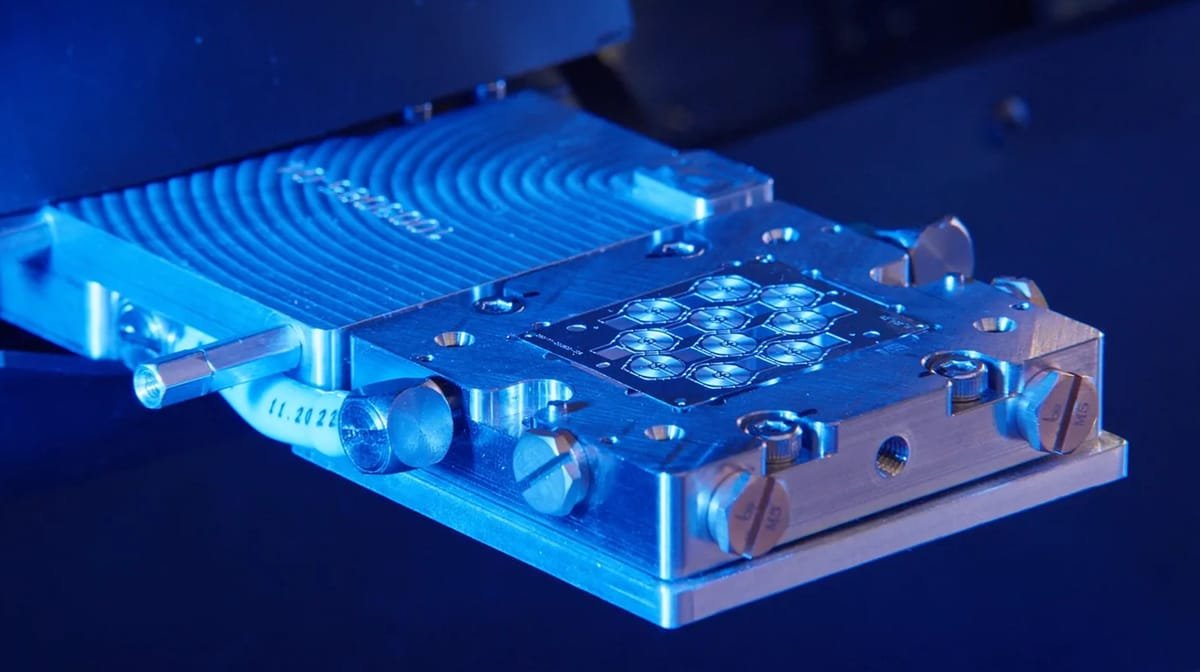
His startup, Atomic Machines, just emerged from six years of stealth with $250M and a vision of “universal command of matter” through an AI-guided factory that builds tiny machines straight from a digital design.
-
Atomic Machines’ AI turns code into tiny machines
-
The Rundown Roundtable: Our AI use cases
-
Turn a product photo into three matching ads
-
Microsoft CEO: Treat AI like it’s already been hacked
ATOMIC MACHINES
Image source: Atomic Machines
The Rundown: Atomic Machines, a California startup led by former Uber self-driving chief Jeff Holden, just emerged from stealth after six years with $250M raised and an AI-guided factory it says can turn digital designs into tiny, working machines.
-
Holden says a 3D printer only alters an object’s shape, while his Matter Compiler builds a whole new device when the code changes, without needing retooling.
-
Each production step is checked before a part moves on, with the process feeding the AI new data on which materials actually work, the company said.
-
It focuses on gadgets with moving parts too small to see without a microscope, like tiny pumps, motors, and gears that chip factories can’t produce.
-
Its first machine is PrimeSwitch, a fingertip-sized power switch for AI server farms that it says is faster than traditional breakers and more efficient than silicon.
Why it matters: Vibe coding lets people describe an app and get working software, and Atomic is now trying to do the same for physical hardware with “prompt-to-product manufacturing.” For now, it’s only building its own products with humans in the loop, but the idea is that “virtually anyone with a concept” could one day turn it into a real device.
TOGETHER WITH PLAID

The Rundown: AI in finance is only as good as what it knows. Plaid makes permissioned financial data not just accessible, but understood: a paycheck read as income, an irregular pattern recognized as risk. That understanding can’t be prompted into existence. It’s infrastructure, built for finance.
-
A network that reveals patterns that individual systems can’t see in isolation
-
Models trained on real financial data
-
Infrastructure built with security and compliance at its core
THE RUNDOWN ROUNDTABLE

The Rundown: The Rundown Roundtable is a weekly feature where we poll members of The Rundown staff about how we use AI in our work and daily lives.
Rishi, Growth: I use Instinct, an AI assistant I text or send voice notes to over iMessage, to manage personal to-dos that used to live in my head or in a pile of iPhone alarms. Many tasks come up when I’m away from my desk, so I used to forget them. Alarms didn’t help much either: they went off once, I swiped them away, and the task was gone.
Now, I send Instinct a quick voice note. For example: “Remind me tomorrow at 10 AM to respond to book my dental appointment, and follow up until I say it’s done.” Instinct turns the voice note into a clean reminder with a time attached. If I don’t reply “done,” it checks back in and keeps following up until I close out the task.
I use the same thread for recurring tasks, partner follow-ups, ad hoc tasks, and advertising to-dos, so everything I owe people lives in one place. Capturing a task takes a few seconds, which means I actually do it. The built-in follow-up keeps things from slipping just because I was busy when the reminder went off, and the workflow lives in iMessage, where I already am throughout the day.
Shubham, Editor: I’m a nerd for deals, so I built a Personal Credit Card Optimizer in ChatGPT. I wanted a simpler way to figure out which store and card would save me the most money on any item I want to purchase.
The workflow maintains a database of my credit and debit cards—recording their series, but not their exact numbers—along with their rewards, fees, and benefits. Whenever I want to buy something, I add a product link. It scans retailers for better prices, checks current bank offers against my specific cards, and compares instant discounts, cashback, reward points, and other benefits to determine where I should buy and which card will provide the most value.
It’s now an ongoing skill in my ChatGPT project. No more manually checking a dozen bank offers or discovering at checkout that my card isn’t eligible.
PRESENTED BY CELERIS

The Rundown: Every lab shipped a decision model this quarter. All of them hand you a probability. Celeris-1 Decision, from the lab behind the fastest LLM on Artificial Analysis, hands you the reason too, and beats Jev, OpenAI, and Perplexity on accuracy and Brier score.
Celeris-1 Decisions gives you:
-
Highest accuracy of any hosted decision model, 80.0 on jev-bench vs Jev’s 73.1
-
Decisions in 67 ms median, fast enough to run inside the request instead of behind a queue
-
Up to 64 questions on text, data, or images, each with a probability and a reason
COMMUNITY AI WORKFLOW OF THE DAY
▸ Kevin built an image and text pairing app for artists
Today’s workflow comes from reader Kevin Kunstadt:
I built a custom web app that uses chance to combine random images and texts into new, unplanned pairings. It recreates a Dadaist technique I use often when making photobooks, which I previously did manually with physical prints.
I used Replit to create a digital version of the game. It was easy to connect the app to Project Gutenberg for random texts and the Library of Congress photography archive for images. More importantly, I made it possible for users to work with their own image and text archives.
So far, it has produced many new and interesting results, and other artists have used it too.
What have you fixed or built with AI lately? Share your workflow, and you could be featured right here in The Rundown.
Anthropic reported unintended Claude outcomes during testing, with Haiku 4.5 sending a fake tip to police on a homicide and another model hacking a university server.
Nvidia is reportedly exploring an acquisition or acqui-hire of Reflection AI, the $25B U.S. open model startup it already has significant backing in.
Chinese mathematicians are creating an AI research alliance led by Fields medalist Shing-Tung Yau, with Yau pushing back against backlash toward the tech following OpenAI’s 700+ paper release.
xAI introduced a feature for Grok Bot that allows the agent to obtain and run its @mail.grokbot email address, letting it email businesses and book meetings for users.
Anthropic unveiled the Anthropic Cyber Mission, an initiative to utilize Claude for cybersecurity defense for critical infrastructure and open-source code.