

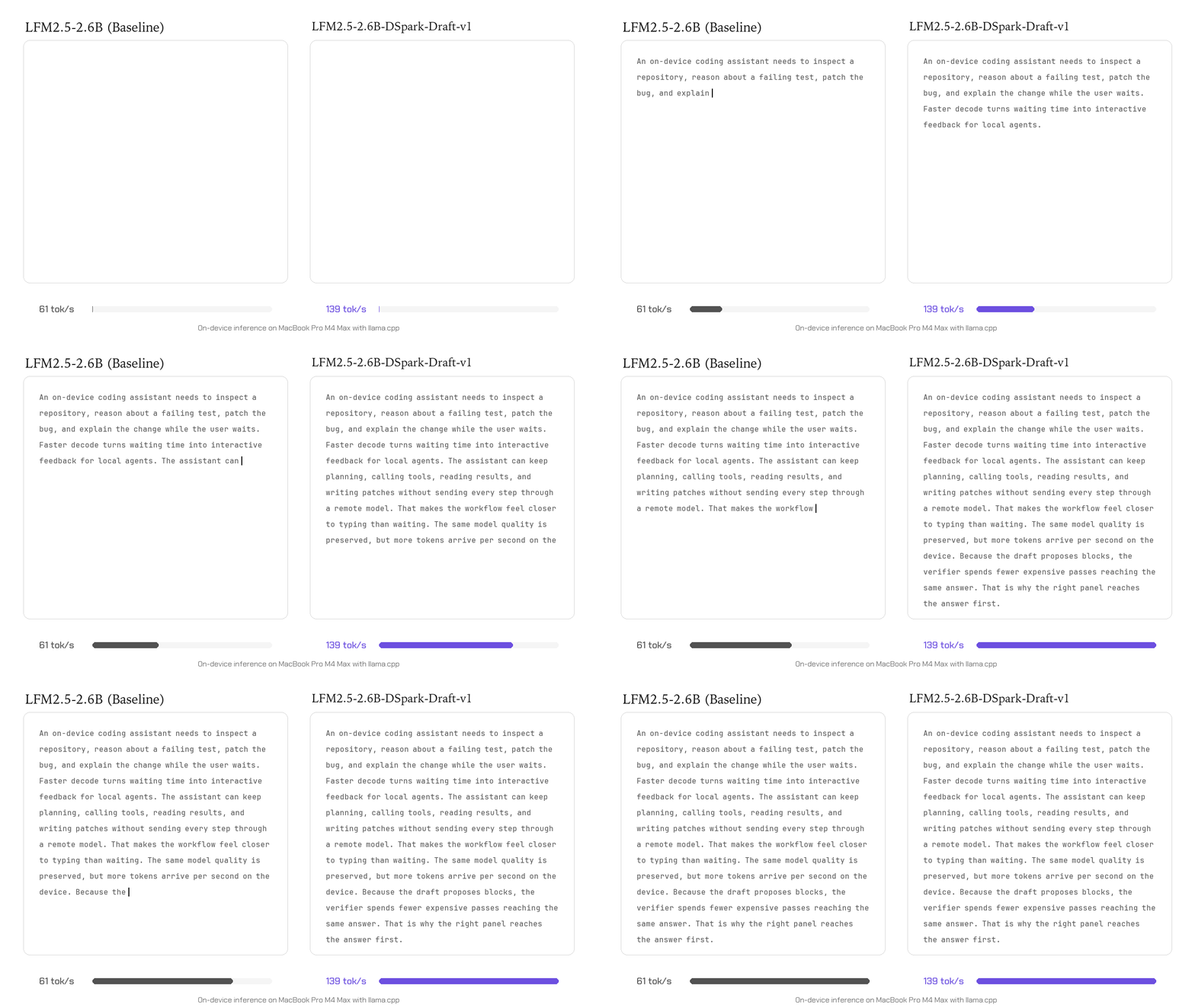

Today, we release DSpark draft model checkpoints for three models from our LFM2.5 family: LFM2.5-1.2B-Instruct, LFM2.5-2.6B, and LFM2.5-8B-A1B. These add a speculative decoding path that trades a minimal memory increase for a large decoding speedup without changing output quality:
- Faster inference: up to 3.18 throughput improvement on a GPU and up to 2.87x on-device.
- Toward on-device agentic inference: cuts function-calling latency by 57% on average for LFM2.5-2.6B
- Day-one support for llama.cpp and SGLang: LFM-compatible DSpark integration is open-sourced upstream
How does DSpark work
The decode phase in LLM inference is traditionally memory-bound. Most latency comes from streaming weights from DRAM into SRAM, not from intense computation. Speculative decoding addresses this by using a lightweight draft model to produce candidate tokens, then having the target model verify them all in a single forward pass, sharing the cost of loading the weights across all tokens we verify.
Over the years, multiple approaches of speculation have been proposed, with the most prominent being EAGLE-3, DFlash, and, most recently, DSpark, which combines three components:
- DFlash-style parallel backbone conditioned on the target model’s context features, producing hidden states for all draft tokens in a single forward pass.
- A lightweight sequential head, modeled as a Markov chain between neighboring tokens, that adds inter-token dependency, raising the acceptance rate at later positions.
- A confidence-scheduled verifier that predicts each token’s survival probability and prunes low-confidence suffixes when verification would cost more than it saves.

Training and Architecture
We follow the DSpark recipe with a larger and more diverse data mix covering SFT, chat, code, and function-calling data. Based on our ablations, the first versions of the draft models are simplified attention-only draft models, with 5 layers and a block of 9. For each draft model, we ran 15 epochs on the entire dataset and selected the epoch with the highest acceptance rate rather than the lowest loss.
The resulting draft models are relatively small, with each around ~300M parameters.
| Component | LFM2.5-1.2B-Instruct | LFM2.5-8B-A1B | LFM2.5-2.6B |
|---|---|---|---|
| Decoder stack (5 layers) | 241.2M | 241.2M | 241.2M |
| Hidden-state projection | 21.0M | 21.0M | 21.0M |
| Markov head | 33.6M | 65.5M | 65.5M |
| Norms + confidence head | 27.5k | 27.5k | 27.5k |
| Total | 295.7M | 327.7M | 327.7M |
Quality parity
Under greedy decoding, a draft token is only accepted if it matches the target model’s distribution. On rejection, the target model’s own token takes its place. The emitted sequence is therefore identical to baseline greedy by construction, so benchmark accuracy (pass@1 or exact match) is unchanged.
Inference Speed Up on CPU and GPU
Our DSpark draft models for LFM2.5 ship with day-one support for llama.cpp (implementation builds on top of the official codebase, which we run with experimental metal kernels) and **SGLang (**implementation builds on the official SGLang implementation of DSpark).
We measure on-device throughput with llama.cpp and Metal on an M4 Max MacBook Pro using FP16 GGUF weights and up to 256 output tokens. We measure GPU throughput with SGLang on a single H100 80 GB in BF16. Both configurations use a DSpark block size of 9, a batch size of 1, and a temperature of 0. We evaluate them on five benchmark datasets.
All three drafter models deliver noticeable throughput improvements on both the large-scale accelerator (H100) and the edge deployment (M4 Max MacBook).
For LFM2.5-2.6B, speedup on the MacBook is especially noticeable, as it pushes the interactivity level a user can enjoy far beyond the throughput offered by most proprietary cloud models (around ~140 tok/s, depending on the dataset).
| Dataset | Acceptance (of 10) | Speedup on H100 | Speedup on M4 Max |
|---|---|---|---|
| MATH500 | 5.42 | 3.06x 326 → 1000 tok/s | 2.25x 61 → 137 tok/s |
| HumanEval | 4.54 | 2.56x 326 → 835 tok/s | 2.63x 61 → 161 tok/s |
| MBPP | 4.71 | 2.64x 326 → 861 tok/s | 2.11x 62 → 132 tok/s |
| GSM8K | 4.32 | 2.22x 312 → 693 tok/s | 2.36x 60 → 143 tok/s |
| MT-Bench | 5.07 | 2.87x 325 → 933 tok/s | 1.99x 62 → 123 tok/s |
| Mean | 4.81 | 2.67x 323 → 864 tok/s | 2.27x 61 → 139 tok/s |
Across various multi-tool scenarios, DSpark reduces the latency by 57% on average for LFM2.5-2.6B.

For LFM2.5-1.2B-Instruct, we see much more variance in dataset acceptance rates, so speedup varies by as much as 52% depending on the underlying text distribution.
| Dataset | Acceptance (of 10) | Speedup on H100 | Speedup on M4 Max |
|---|---|---|---|
| MATH500 | 6.02 | 2.56x 668 → 1712 tok/s | 2.62x 140 → 366 tok/s |
| HumanEval | 5.31 | 2.26x 664 → 1499 tok/s | 2.87x 136 → 389 tok/s |
| MBPP | 5.52 | 2.37x 667 → 1578 tok/s | 2.74x 137 → 375 tok/s |
| GSM8K | 4.34 | 1.67x 624 → 1041 tok/s | 2.73x 140 → 381 tok/s |
| MT-Bench | 3.90 | 1.66x 657 → 1091 tok/s | 1.72x 137 → 237 tok/s |
| Mean | 5.02 | 2.10x 656 → 1384 tok/s | 2.54x 138 → 350 tok/s |
For LFM2.5-8B-A1B, the acceptance rate increases compared to two dense models, yet on-device we get only an 18% improvement on average. This gap is due to the current MoE implementation in llama.cpp’s Metal backend, and to the fact that verifying k tokens activates more experts and thus more weight traffic than a single decode step.
| Dataset | Acceptance (of 10) | Speedup on H100 | Speedup on M4 Max |
|---|---|---|---|
| MATH500 | 8.27 | 3.18x 428 → 1362 tok/s | 1.21x 93 → 112 tok/s |
| HumanEval | 7.02 | 2.58x 426 → 1100 tok/s | 1.12x 91 → 101 tok/s |
| MBPP | 6.93 | 2.64x 426 → 1122 tok/s | 1.09x 89 → 97 tok/s |
| GSM8K | 4.02 | 1.29x 385 → 496 tok/s | 1.44x 90 → 129 tok/s |
| MT-Bench | 8.52 | 3.02x 426 → 1288 tok/s | 1.04x 87 → 90 tok/s |
| Mean | 6.95 | 2.54x 418 → 1074 tok/s | 1.18x 90 → 106 tok/s |
How to use LFM2.5-DSpark
Running the DSpark draft models with SGLang requires an SGLang build with DSpark support for LFM2 targets (PR #31041). Launch the target with the draft attached:
python -m sglang.launch_server
  --model-path LiquidAI/LFM2.5-2.6B
  --speculative-algorithm DSPARK
  --speculative-draft-model-path LiquidAI/LFM2.5-2.6B-DSpark
  --speculative-draft-attention-backend flashinfer
  --disable-radix-cache --mem-fraction-static 0.75 --port 30000
Then query the OpenAI-compatible endpoint at http://localhost:30000/v1. The block size is read from the draft’s config.json; the baseline is the same command without the three --speculative-* flags.
Running them with llama.cpp requires the respective llama.cpp build (PR#27383).
llama-server -m LFM2.5-2.6B-F16.gguf
  -md LFM2.5-2.6B-DSpark-F16.gguf
  --spec-type draft-dspark --spec-draft-n-max 10 --spec-draft-n-min 0
  -fa on -ngl 99
The block size is read from the sidecar metadata (n-max is clamped to it). Speculative decoding is exact: the target verifies every proposed token, so greedy output equals the target alone; per-response timings report draft_n / draft_n_accepted.
Get Started
The DSpark draft model checkpoints are available on Hugging Face as Safetensors and in GGUF format:
We can’t wait to see what you build.
Citation
For citations, please use the following reference or BibTeX:
Liquid AI, “LFM2.5-DSpark: Up to 3.2x Faster Inference from H100 to MacBook”, Liquid AI Blog, Aug 2026.
@article{liquidAI2026dspark,
  author = {Liquid AI},
  title = {LFM2.5-DSpark: Up to 3.2x Faster Inference from H100 to MacBook},
  journal = {Liquid AI Blog},
  year = {2026},
  note = {www.liquid.ai/blog/lfm2.5-dspark},
}