

Close Menu
AI News TodayAI News Today

    Subscribe to Updates

    Get the latest creative news from FooBar about art, design and business.

    What's Hot

    2K launches new studio to build its ‘next blockbuster sports franchise’

    How to Utilize OKF Efficiently to Enable Knowledge Exchange Among LLMs

    Record, train, and deploy from one place with Strands Agents, LeRobot, and Hugging Face Storage Buckets

    Facebook X (Twitter) Instagram
    • About Us
    • Contact Us
    Facebook X (Twitter) Instagram Pinterest Vimeo
    AI News TodayAI News Today
    • Home
    • AI News
    • AI Reviews
    • AI Tools
    • AI Tutorials
    • Chatbots
    • Free AI Tools
    • Artificial Intelligence
    AI News TodayAI News Today
    Home»Chatbots»We’ve flown a radiation-blocking vest to the Moon and back, and it worked
    Chatbots

    We’ve flown a radiation-blocking vest to the Moon and back, and it worked

    By No Comments2 Mins Read
    Share Facebook Twitter Pinterest LinkedIn Tumblr Reddit Telegram Email
    We've flown a radiation-blocking vest to the Moon and back, and it worked
    Share
    Facebook Twitter LinkedIn Pinterest Email

    StemRad engineers, though, figured dressing as a medieval knight doesn’t really get you all that much. The human body, Milstein explains, isn’t uniformly vulnerable to radiation. “Tissues like the bone marrow are a lot more sensitive to radiation compared to the brain,” he says. Following this idea, StemRad developed a belt for nuclear first responders, worn around the hips, which hold roughly half the body’s bone marrow, the tissue that makes blood cells. Protecting even a fraction of the bone marrow lets a person regrow it and survive a high-dose exposure.

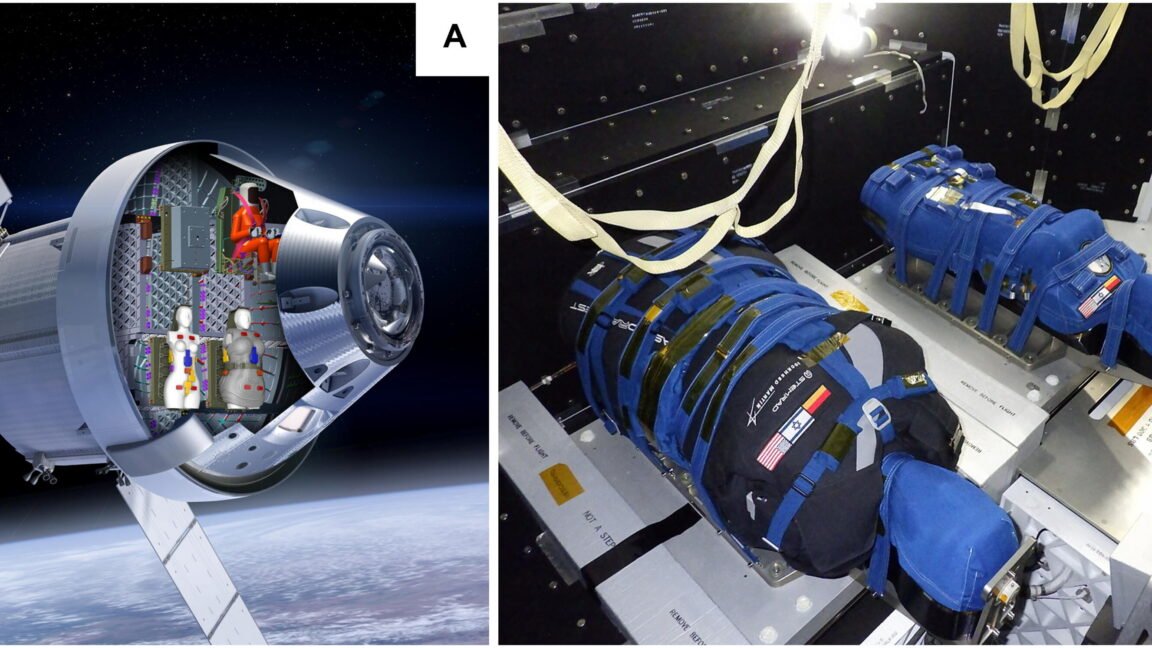
    So, StemRad, working with Lockheed Martin, expanded this idea into a female vest that, aside from the hips, also covered the breasts, stomach, colon, and reproductive organs. These are all less immediately life-threatening when irradiated, but carry a long-term cancer risk.

    “It still gets people surprised,” Milstein says. “Everybody asks, what about the head? But we’re actually able to reduce the effective dose by 60 percent without protecting the head, the arms, or even the legs.” But choosing where to put shielding was just one part of the problem. Picking the material and making a design that would not hinder the astronaut’s movements was another.

    A division problem

    “The primary factor in how effective a shielding material is is its atomic number divided by its atomic mass,” Houri says. Hydrogen, which has no neutrons, has roughly double that ratio of any other element, which is why water is often cited as a good space radiation shield. High-density polyethylene (HDPE), an ordinary plastic, packs even more hydrogen by mass than water, and, unlike water, it’s a solid, so you don’t have to worry about leaks.

    The problem with a solid, rather stiff material like HDPE is that when made thick enough to offer good radiation protection, it can compromise comfort. To go around it, StemRad’s team broke it apart into hexagonal rods of varying lengths and cross-sections. “We divided up the shielding panels into thousands of hexagonal tessellated rods of HDPE,” Houri says. These rods, sandwiched between two layers of elastic fabric, made the vest extremely flexible and fluid-like. “It almost behaves the same way that water would, while still remaining solid,” Houri claims.

    flown Moon radiationblocking vest weve worked
    Share. Facebook Twitter Pinterest LinkedIn Tumblr Email
    Previous ArticleAnthropic could be worth $2 trillion when it goes public
    Next Article X open sources its ranking algorithm, letting users see if they’ve been ‘shadowbanned’
    • Website

    Related Posts

    Chatbots

    Ford on track to complete $2B factory overhaul for Fathom EV truck

    Chatbots

    Does Google even want to win at AI?

    Chatbots

    Amazon gets out of the MMO game

    Add A Comment
    Leave A Reply Cancel Reply

    Top Posts

    2K launches new studio to build its ‘next blockbuster sports franchise’

    0 Views

    How to Utilize OKF Efficiently to Enable Knowledge Exchange Among LLMs

    0 Views

    Record, train, and deploy from one place with Strands Agents, LeRobot, and Hugging Face Storage Buckets

    0 Views
    Stay In Touch
    • Facebook
    • YouTube
    • TikTok
    • WhatsApp
    • Twitter
    • Instagram
    Latest Reviews
    AI Tutorials

    Quantization from the ground up

    AI Tools

    David Sacks is done as AI czar — here’s what he’s doing instead

    AI Reviews

    Judge sides with Anthropic to temporarily block the Pentagon’s ban

    Subscribe to Updates

    Get the latest tech news from FooBar about tech, design and biz.

    Most Popular

    2K launches new studio to build its ‘next blockbuster sports franchise’

    0 Views

    How to Utilize OKF Efficiently to Enable Knowledge Exchange Among LLMs

    0 Views

    Record, train, and deploy from one place with Strands Agents, LeRobot, and Hugging Face Storage Buckets

    0 Views
    Our Picks

    Quantization from the ground up

    David Sacks is done as AI czar — here’s what he’s doing instead

    Judge sides with Anthropic to temporarily block the Pentagon’s ban

    Subscribe to Updates

    Get the latest creative news from FooBar about art, design and business.

    Facebook X (Twitter) Instagram Pinterest
    • About Us
    • Contact Us
    • Terms & Conditions
    • Privacy Policy
    • Disclaimer

    © 2026 ainewstoday.co. All rights reserved. Designed by DD.

    Type above and press Enter to search. Press Esc to cancel.