

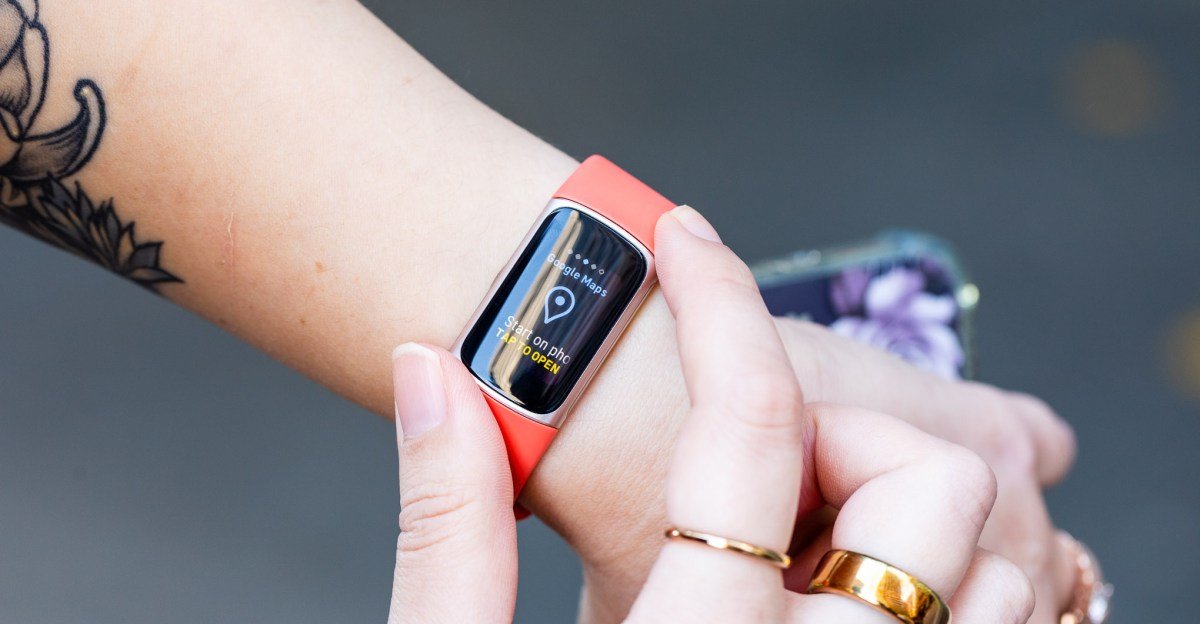
This is Optimizer, a weekly newsletter sent every Friday from Verge senior reviewer Victoria Song that dissects and discusses the latest gizmos and potions that swear they’re going to change your life. Opt in for Optimizer here.
A fitness band is for bettering yourself, but casually. It’s lightweight, easy to wear, and not something you have to think too hard about. It’s cheaper than a smartwatch. You get your steps, basic heart rate, and some sleep tracking. Maybe you can see the time, maybe you can’t. But unlike many wearables today, a fitness tracker wasn’t truly meant to be a companion for your phone and all the overwhelm that comes with it. It was a simple tool with a simple purpose: to make you move more.
Ten years ago, nobody was better at this than Fitbit.
For a time, it was the Kleenex or Band-Aid of wearables — a brand so ubiquitous that it was synonymous with an entire product category. Your mom probably doesn’t remember a Jawbone, FuelBand, or a Mio Slice. But for a while, everybody called a fitness band a Fitbit.
But Fitbit hasn’t been quite the same since Google acquired the company in 2021.
The distinction between Fitbit and Google products has been murky ever since. In many ways, it echoed how Google handled acquiring Nest. At first, the two felt like relatively separate entities. Then, slowly over the years, users were encouraged to migrate accounts from Nest to Google. Products were first rebranded as Nest by Google, then Google Nest. The Nest app is still available, but it’s in maintenance mode. It works with older products, but you can’t pair it with new ones.
The Nest-ification of Fitbit has differences — for example, there was a particular rough patch where Fitbit suffered several major server outages, and users were enraged when Google started sunsetting beloved social features. (2023 was a tough transition year.) But one of the most confusing aspects was the product lineup. When the Google Pixel Watch debuted in 2022, it was alongside a new Fitbit Versa 4 and a Fitbit Sense 2. That’s three smartwatches total, with the two Fitbit watches having nerfed features. Differentiating them all was a headscratcher. The Fitbit Charge 6 followed a year later, and there has been radio silence until the Fitbit Air announcement earlier this week. (I don’t really count the Ace LTE — that was for kids.)
In the meantime, Fitbit became Fitbit by Google. Users are being encouraged to migrate their Fitbit accounts to Google accounts. The Air is the Google Fitbit Air now. And on May 19th, the Fitbit app will be no more. The green-and-white Fitbit icon will be replaced by a multicolored heart icon for Google Health.
“Fitbit’s DNA is a great tracker — an accessible tracker that everyone can go and use,” explains Rishi Chandra, Google’s vice president of health and home. “One question I get is, ‘Well, why did it take so long to launch new hardware?’ The truth is, we didn’t want to launch just another tracker.”
Hence why Google bundled it with its Google Health Coach and Health app announcement. Sure! But why not just call the Air a Pixel Band and be done with it?
“Pixel is Android-only,” Chandra says bluntly. “It’s targeted to really make sure we can build the most high-end, highest-quality wearable technology with the latest sensors possible for that user base. Fitbit is designed to work with every iOS and Android phone from the get-go.”
Chandra adds that Google views these as two very different segments and will continue to do so for the foreseeable future. Fitbits are the entry-level, simple software for the everyman. Pixel Watches are the premium, Android-only counterpart. But, everywhere else, whatever remains of the old Fitbit has essentially been absorbed into the larger Google machine.
Again, this has been a long time coming. But it’s also a bittersweet denouement for what was the iconic wearable brand.
Fitbit’s struggles didn’t start with the Google acquisition. By 2021, Fitbit was squeezed. It hadn’t managed to successfully figure out a killer smartwatch, outshone by Apple, Samsung, and even Garmin in that arena. And at that time, smartwatches were where all the exciting stuff was happening as far as health tech features. In the tracker space, cheaper Chinese knockoffs undercut Fitbit’s prices while offering much of the same basic tracking capabilities.
In 2026, it’s a bit of a different story. Increasingly, I hear from readers that they’re tired of the smartwatch. Screenless devices like Whoop and Oura are inspiring dupes left and right. And even as screentime increases, people lament left and right that they’d like less overstimulation from a barrage of notifications and pinging. At the same time, wearable companies are zeroing in on comfort because as AI becomes increasingly stuffed into these devices, it’s imperative that people actually wear them with as few breaks as possible. (After all, part of a wearable’s draw is that it allows companies to learn about you 24/7.) So it makes sense that Google’s decided to return to Fitbit’s roots with a simpler, affordable fitness band.

But the Fitbit Air isn’t truly a resurgence on its own. Chandra emphasized to me that it’s a one-two punch with the Google Health Coach. AI in fitness trackers has always been there in the form of algorithms and machine learning to crunch data. But generative AI in fitness trackers — these “coaches” that deliver insight — arrived long after Fitbit started playing second fiddle to the Pixel Watch.
Part of the pitch is simplicity. Do you have data overload with the forty bazillion metrics and biomarkers you now have to keep track of? Well, here’s AI to parse that all for you and deliver personalized health. You can now take control of your own health! These were all points Chandra highlighted as well. That, and fragmented health data storage, is a fundamental problem in the health tech space. I can’t argue with Google’s health game plan on paper. The thing I want to gently challenge, however, is the concept of AI making any of this as simple as what an old-school Fitbit used to be.
In 2015, a Fitbit Charge HR was my very first tracker. Eventually, I graduated to the Alta HR, and for many years, some kind of Fitbit was my daily driver. A Fitbit was what helped me get a polycystic ovary syndrome diagnosis after two years of being baffled by my data. It documented some monumentally weird moments in my life — like when I got a call from the FBI or got stampeded at a movie theater during a false alarm for a shooting. In the case of the latter, the massive spike in heart rate in my Fitbit data was the only real proof that false alarm had happened.

In many moments, I was a bit of a data detective. It was tedious. I always had to cross-reference dates and biometric data with my analog journal entries. Ten years ago, I think I would’ve been more open to the deluge of logging features and tags that I’ve since come to resent. But looking back, I wonder how Google Health Coach would interpret something like a moment of sheer terror? Would I get a tone-deaf morning summary the next day, advising me to get checked out by a doctor? Would I have to explain the stresses of my life in order to get that personalized context? This was never an issue with the old Fitbit. Even as I appreciate how advanced this category has become, how health features are genuinely lifesaving, there is a part of me that longs for how it was. A simple, sometimes tedious, bare minimum.
I know I’m not alone there. Google knows too. When I spoke to Chandra about the Air, he told me that its main purpose was to serve the many people who find wearables too bulky, complicated, and expensive. But what I think he’s getting at is the wearable overwhelm. The data fatigue. And while I can get behind the theory of AI making data insights easier to find, my lived experience thus far has told me it creates a different kind of exasperation. We might be seeing a resurgence in simple hardware, but the software, the metrics, and the sheer amount of data collected are a whole new ballpark.
In the hours since the Air was announced, I’ve had plenty of friends, peers, and colleagues reaching out to me for my opinion. Many of them are asking because they’re over all the bells and whistles a smartwatch promises. They’d like to opt out of data fatigue, and maybe a familiar Fitbit is just the trick. First off, I never comment on my final opinion before testing is done. But speaking as a onetime Fitbit diehard? A return to the old Fitbit isn’t what’s being offered here. This is something new. I’m not exactly sure what that is yet. What I do know is that type of tracker is long gone.