


Introducing the “underpants index”
Priska Koller, Agroscope
Slightly or heavily decomposed? The more active the soil organisms, the faster the cotton material decomposes.
Priska Koller, Agroscope
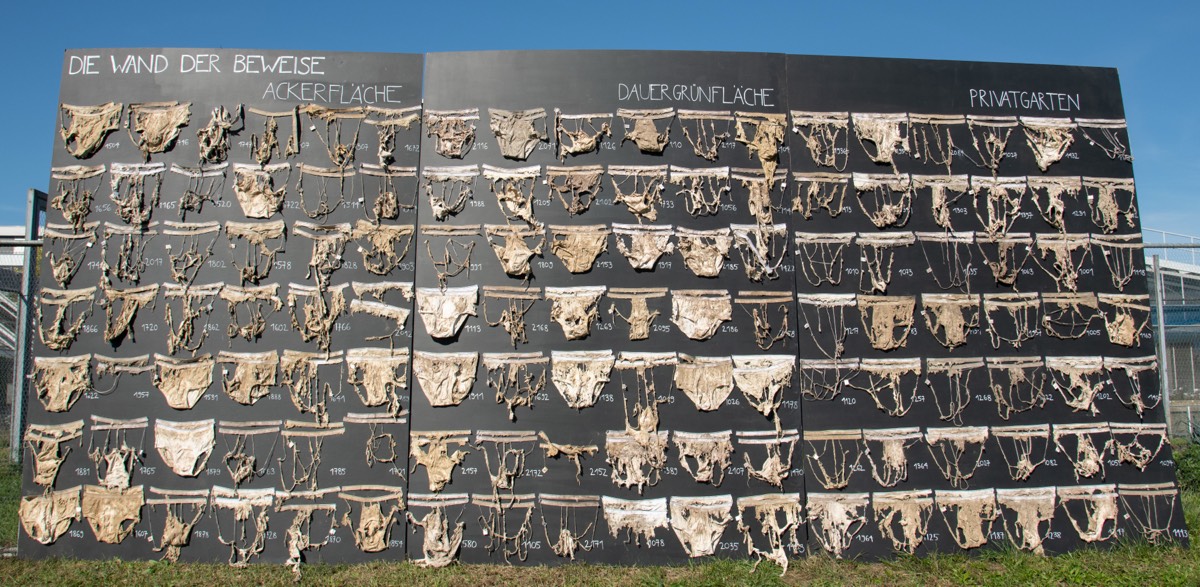
Priska Koller, Agroscope
A selection of the more than 2,000 cotton underwear items in various stages of decomposition that were buried in fields, meadows, and gardens.
Priska Koller, Agroscope
Slightly or heavily decomposed? The more active the soil organisms, the faster the cotton material decomposes.
Priska Koller, Agroscope
A selection of the more than 2,000 cotton underwear items in various stages of decomposition that were buried in fields, meadows, and gardens.
Priska Koller, Agroscope
Van der Heijden et al. recruited 1,000 Swiss citizens across the country—240 of whom are listed as co-authors on the paper—and sent them an activity pack: two pairs of organic cotton men’s underpants, 12 teabags, and a sampling bag for soil collection, along with detailed instructions. Each volunteer selected a site, dug a hole, and collected a soil sample. Then they inserted the two pairs of underpants vertically, side by side, with the synthetic waistband visible on the surface.
They also placed six teabags in front of each of the garments to compare how the underpants performed vs. the TBI in terms of decomposition assessment, and then refilled the hole. Participants dug up the first pair of underpants and associated tea bags after 30 days and the second after 60 days, documenting the condition of the items and mailing all the materials to the scientists for analysis.
The results: Land use was the most important factor. Underpants decomposed the fastest in private gardens, where soil analysis also revealed the highest levels of organic matter, making it an ideal environment for earthworms, fungi, bacteria, and so forth. Lawns showed the least activity of soil organisms, with agricultural fields and meadows ranging in the middle. Temperature and moisture levels also affected organism activity, particularly if conditions were too cold or too dry, as did soil nutrient levels.
Overall, the authors found that their “underpants index” provided equally meaningful information about soil conditions as the TBI, including chemical and physical properties, elevation, and moisture. And unlike TBI, the underpants “provide a direct visual and haptic measure of decomposition that is easier to interpret,” they wrote. This makes it “an ideal tool to be used in citizen science projects and to raise awareness for soil-related issues.”
DOI: Plants People Planet, 2026. 10.1002/ppp3.70259 (About DOIs).