

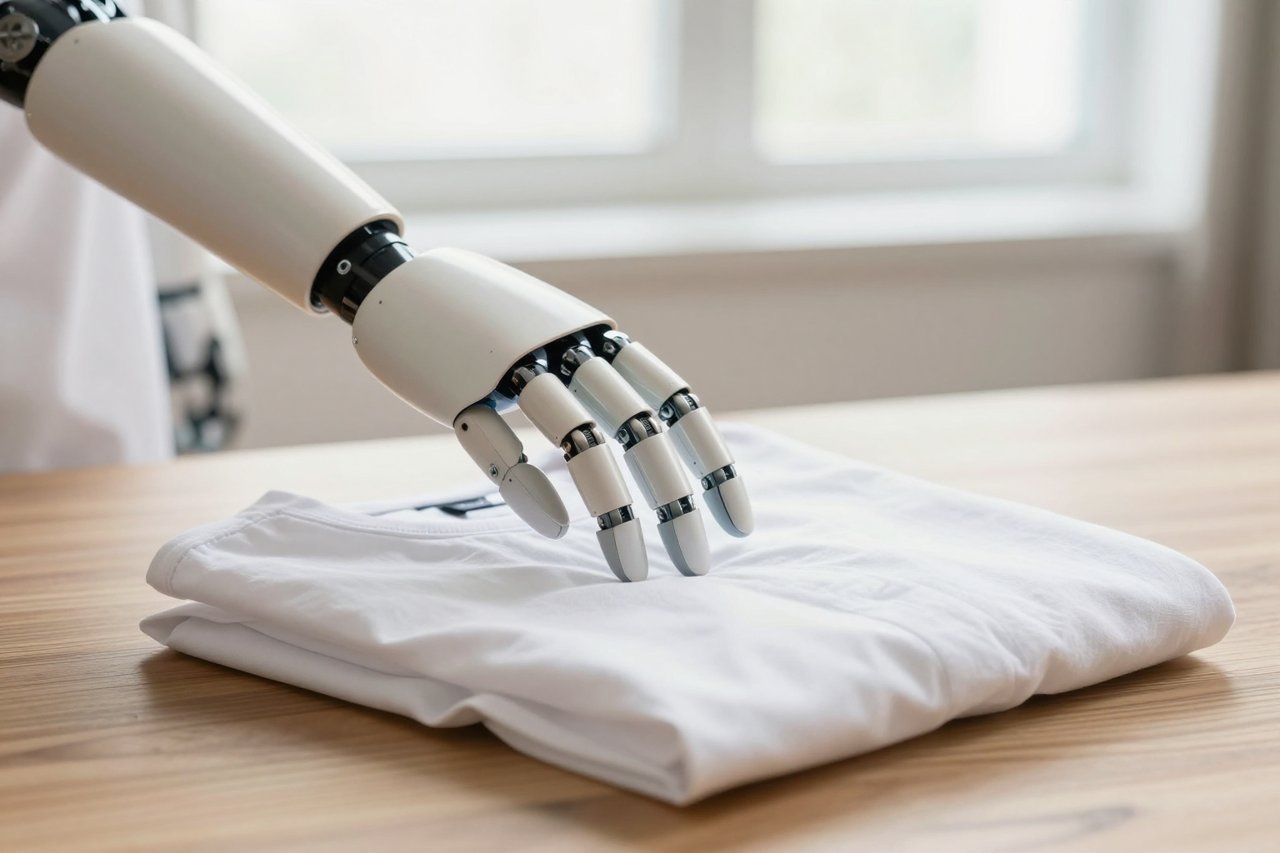
Every few months, a new video appears of a human-shaped machine doing something that looks oddly human. One version can run and jump. Another can fold a T-shirt, pour a fizzy drink, or sketch a cat. The clip often goes viral, the stock ticker gets a small bounce, and then… silence. The AI robot hasn’t disappeared. It just hasn’t arrived in your living room.
That gap between hype and reality matters. If you’re trying to make sense of robotics today, you need a clear picture of what AI robots already do, why they’re still far from replacing a human worker, and what the next decade actually looks like. Not a rosy press release — just a grounded read.
AI robot versus software AI: why the physical part matters
There’s a quiet revolution happening in software that people interact with every day. AI chatbots online can draft emails, summarise legal documents, and answer questions reasonably well. But a chatbot never has to crawl on a roof, grip a slippery oyster, or navigate a narrow supermarket aisle without knocking down a wine display. It lives in its own perfect, weightless world.
An AI robot, by contrast, connects machine intelligence to a physical body. It has to deal with gravity, friction, unpredictable objects, and interrupted Wi-Fi. That makes the problem much harder. It also makes the payoff potentially much bigger.
- Software AI improves writing, coding, images, and analysis.
- AI robots can inspect pipelines, pack boxes, harvest crops, and eventually help care for the elderly.
The difference comes down to agency in the physical world. A robot that can pick up a cup and hand it to a shaking person’s hand has to do something more impressive than a model generating a Shakespearean sonnet.
Where AI robots already work
Hardware development has been quietly happening for decades, but only recently have AI models given robots something resembling common sense. That has unlocked several real use cases.
Warehouses and logistics: the quiet success story
Far before humanoids became a corporate stage prop, smaller robots were already proving themselves in logistics. Companies like Amazon use over 750,000 mobile robots to shuffle shelving units through fulfilment centres. They’re not doing fancy tricks; they’re following navigation AI that traces the fastest path without colliding with a human picker.
Pick-and-place robotic arms driven by neural networks sort items of remarkably different shapes — a flimsy t-shirt alongside a glass bottle of vitamins. Systems built by companies like Covariant and Plus One merge vision and gripping sensors, so the machine’s ‘hand’ adjusts its approach in milliseconds when an object moves slightly.
These machines aren’t artificial general intelligence by any stretch. They are narrow-task AI robots, but the economic payoff is real.
Industrial inspection and predictive maintenance
Some robots climb wind turbines, fly through steel mills, or dive into water pipelines to look for cracks. Equipped with computer vision and anomaly-detection AI, they capture thousands of images and flag tiny flaws that human eyes could easily miss. A Boston Dynamics Spot, for example, checks breaker positions and gas leaks at electrical substations, sending its findings back to a control room before the worker has finished morning coffee.
Healthcare and the human touch problem
Robots already handle a surprising amount of clinical physics. In a growing number of operating rooms, robotic arms guided by medical AI assist surgeons with knee replacements, tumour excisions, and spinal fusions. The da Vinci system alone supports more than ten million minimally invasive procedures globally. That’s still a human-controlled machine with automated safety limits — not an autonomous robot surgeon.
What artificial intelligence can and cannot do becomes especially clear in medicine. AI can analyse a three-dimensional scan and suggest a precise cutting range, but the deft handling of tissue, blood vessels, and surprise anomalies requires a skilled human with a running background of experiences.
The humanoid obsession: real progress or elegant PR?
Humanoid robots get most of the attention. Tesla’s Optimus, Boston Dynamics’ all-electric Atlas, Figure’s F.02, and China’s Unitree G1 are constantly in the news. Their bodies bend, squat, and rotate with eerie fluidity. They visibly learn to fold laundry or sort batteries.
But there’s a catch. Much of the capability comes from remote teleoperation or pre-scripted motion routines. The robot isn’t autonomously deciding to tidy your bedroom. An operator behind a joystick is still holding its hand in many cases.
Do genuinely autonomous humanoids matter? Yes, because a human body shape fits seamlessly into spaces designed for people — stairs, turnstiles, doors, ladders. If they can learn to operate reliably without hand-holding, the workforce implications are enormous.
Companies racing for universal in-home labour that might replace a house cleaner or a care worker are still pushing against a massive technological wall. That hasn’t stopped billions of dollars from flowing into programs run by leading AI companies in 2025, many hoping to dominate the first commercial generation of humanoids.
What is hidden under the ‘wow’ videos
Highly polished demo situations hide four deeply difficult problems that still plague real-world AI robots.
Physical unpredictability
A shelf in a lab never tilts accidentally. A battery is never sticky with old coffee. In your home, every floor plan is unique, every mug is dented, every dog can bite a wire. Train an AI robot on a thousand scenarios and you still won’t prepare it for the one-day-a-year edge case, like an armchair hiding a dropped toy.
Compliant touching and sensing
A robot’s fingertip needs to feel roughness, wetness, and resistance all at once while squeezing delicately. Many models still output force as a cruder binary: too hard or not hard enough. Otherwise they’d crush a tomato or drop an egg reliably. AI-assisted tactile sensor development is progressing, but it is years away from matching a human’s fine finger control.
Energy and heat
Humanoids, by design, use a lot of power. Walking alone demands huge torque in each joint. Most commercial prototypes seek a battery life measured in minutes, not hours. Compare that to a warehouse robot that can recharge in a parking spot and stay on the job 24/7.
Trial-and-error learning takes thousands of hours
Teaching a humanoid to pick up an object is turning out to be far slower than teaching someone to find a good job through teleoperation training. A typical fine manipulation skill may require 5,000–10,000 demonstrations before a neural network can replicate it in varied positions. That is why companies use massive data farms with many tele-operated robot bodies working at the same time.
The missing step to full autonomy: generalisation
A machine that can fold a specific shirt on one particular table has learned a memorised task. A machine that can fold any shirt out of a laundry pile, on any table, in any light, with a child pulling at the fabric — now you’re at what artificial general intelligence researchers describe as broad generalisation. The gap between the two versions of that sentence is not small.
Some robotics groups try to bridge it with “world models”. Rather than memorising every single action, the robot builds a continuously updating mental picture of what happens if it shifts a bowl two centimetres to the left, or how a blanket will fall when tugged in a certain direction. New developments in vision-language-action models allow robots to grasp objects they’ve never encountered by following simple text instructions from a human.
Yet true generalisation would mean, for instance, one robot able to work in a hospital, a farm, a construction site, and a kindergarten within the same week. That most likely requires an architecture that reasons abstractly about cause and effect, not merely pattern-match from its own training set. That kind of artificial general intelligence is still hypothetical.
Could AI robots eventually become home and office companions?
Yes, but for more grounded reasons than futuristic hype. Already, small robots with limited AI are helping with rehabilitation exercises. Robots in Japanese eldercare facilities guide residents through stretching and measure their range of motion. A few home-cleaning robots now pick up a sock and put it in a hamper — a slow, clumsy process that nevertheless reduces the burden for people with back pain or arthritis.
The larger leap could come from adding reliable physical hands to an AI assistant that already manages your calendar, answers the doorbell, and controls your lighting. Once an embodied robot shares the same conversational brain, it gains a new, genuinely useful ability. You can ask it, in natural speech, to lift the laundry basket from the hallway and put it on the bed. It will not need a human specialist coding each individual move.
In that world, the AI robot becomes something between a thoughtful colleague and a personal concierge that moves objects for you. That’s still closer to a useful servant than to a person-like companion, but it is no less significant for daily living.
What to watch for next
Ignore the flashy demo reels for a moment and watch for quieter signs of real progress. Look at how many humanoid demos are performed without a backup operator’s hand on a joystick. Watch whether battery life jumps from twenty minutes to two hours. Notice whether Chinese and American roboticists start publishing identical failure cases about everyday clutter. The solution will come not from a single new model, but from hundreds of smaller engineering wins that slowly add up.
In the end, the first massively successful AI robots won’t be dancers on a corporate stage. They’ll be invisible machines in dark warehouses, on farm fields, and in hospital corridors — doing one repeated, tiring job impossibly well. The humanoids will follow. And when they do, the moment they truly master the world’s messy edges, our homes and workplaces will start to feel very different.”