

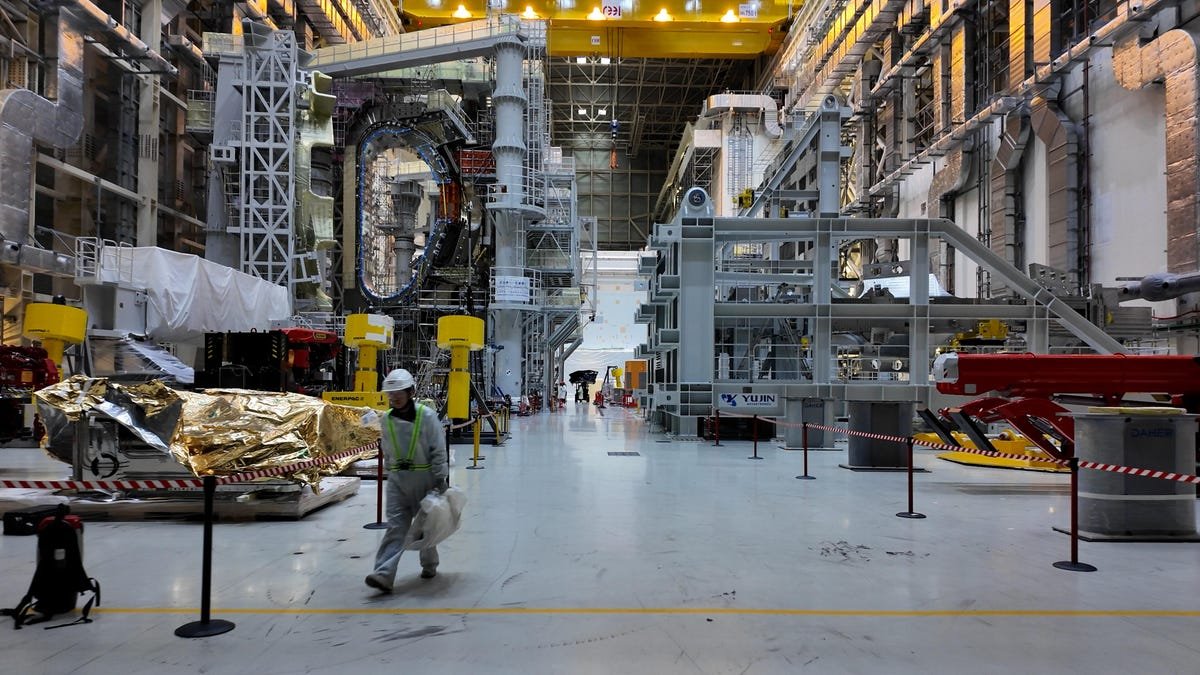
Nestled in the countryside of southern France is a sprawling industrial complex where scientists and engineers from around the world have converged to build the world’s largest-ever fusion reactor: a doughnut-shaped vacuum chamber designed to contain temperatures 10 times hotter than the core of the Sun.
At an estimated cost of $22 billion, the International Thermonuclear Experimental Reactor is the world’s biggest bet on fusion energy: a project so daunting in scale that longtime geopolitical rivals have pooled their resources to share in its potential risks and rewards.
ITER’s central solenoid (left) is the largest magnet in the world. It will play a key role in starting and maintaining ITER’s fusion reactions.
As ITER’s chief strategic advisor Laban Coblentz put it, “That China and Russia were going to collaborate with the US and Europe, and add in Korea, India, and Japan — that’s either genius or insane.”
Controlled fusion reactions produce millions of times more energy than the burning of fossil fuels, and four times more energy than the reactions powering traditional nuclear power plants — without the risk of meltdown, long-lasting radioactive waste and carbon emissions. All humans have to do is create the right conditions for it to happen, but that’s far easier said than done.
Watch this: 10 Times Hotter Than the Sun: Inside World’s Largest Fusion Reactor
Containing ITER’s 150-million-degree Celsius plasma will require superconducting magnets kept just a few degrees above absolute zero. To make that possible, engineers must place one of the hottest environments ever created right next to one of the coldest, with only a thin heat shield separating the two.
Cracks in the piping of this heat shield were discovered in 2020, along with distortions caused by welding and disruptions due to the COVID-19 pandemic, which led to a years-long delay in ITER’s timeline and the need for an additional $5 billion to cover repair costs. At the same time, private fusion startups have been multiplying, with many hoping to beat ITER to major milestones.
Cracks in ITER’s thermal shields were part of a series of setbacks that led to a years-long delay and a $5 billion increase in cost.
Despite the pressure and criticisms generated by these overruns and delays, the people I met at ITER all spoke about the project like an open book. “This is a publicly funded project,” said Javier Artola, a scientist working on modeling the behavior of ITER’s plasma. “It is the knowledge of the world.”
A publicly funded project like ITER helps de-risk the research and development needed for commercial-scale fusion, making it easier for private companies to place their own big bets on the technology. Every problem ITER solves is one less problem private fusion companies will have to figure out.
ITER scientist Javier Artola points out the different components powering the largest-ever tokamak.
Every member state of the ITER agreement (which includes more than 30 countries) will have access to all the science that comes out of ITER, and the construction of ITER itself is developing a global fusion energy supply chain. If the member states agree to share it with them, even non-member states may benefit from ITER’s science.
“We have become a model for how countries of unlike persuasion can work over decades, only through the shared vision of a better world that everybody wants for the next generations,” said Coblentz.
More than 30 countries are collaborating on ITER, each contributing components to the massive machine.
Fusion is one of those technologies that people often joke is always a decade away. But seeing firsthand what ITER is building gave me hope that we may truly be living in the last decade when fusion is still spoken of as a distant dream.
To see our journey into the heart of this one-of-a-kind experiment in fusion energy and international collaboration, check out the video in this article.