

Jensen Huang walked onto the GTC stage in his leather jacket and held up a silicon wafer the size of a dinner plate. That was 2024, and by then Nvidia had already stopped being a graphics company in any meaningful sense. Its chips were training the models that write code, summarise case files and generate video, and the company’s market value had sailed past $3 trillion.
The Nvidia AI story is worth understanding for reasons that have nothing to do with the stock chart. Underneath it sits a bet on parallel computing made back in 2006, a software ecosystem that rivals spent a decade failing to clone, and a supply chain that now shapes export policy in Washington.
The bet that looked like a costly mistake
In 2006 Nvidia shipped CUDA, a toolkit that let programmers use its graphics cards for things other than rendering games. Investors shrugged. The company kept pouring money into developer tools with no obvious payoff, year after year.
The payoff landed in 2012, when a team at the University of Toronto trained AlexNet on two consumer GTX 580 cards and blew past every entry on the ImageNet image-recognition benchmark. Researchers realised neural networks are mostly linear algebra, and that Nvidia’s hardware did linear algebra faster than anything else on a shelf.
Why the software moat is harder to cross than the chip
Any well-funded fabless company can tape out a competitive accelerator. What it can’t easily buy is nearly two decades of libraries — cuDNN, TensorRT, NCCL — plus every graduate student who learned to think in CUDA and every framework that compiles to it first. Nvidia puts its developer count somewhere around six million. The switching cost is measured in years of retraining, not in licensing fees.
What Nvidia actually sells in 2025
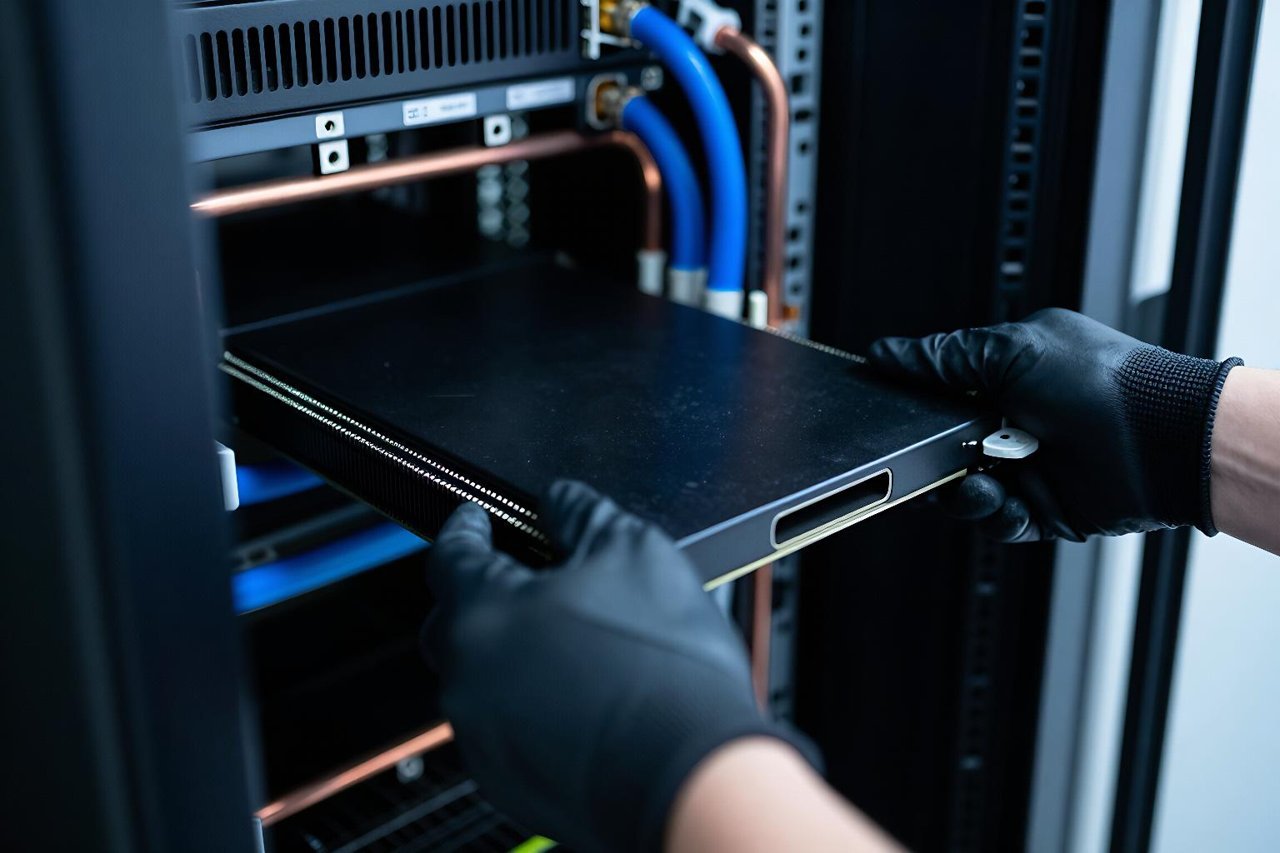
A single H100 isn’t really a product the way a GeForce card is. It’s a component in a rack-scale system. The flagship GB200 NVL72 packs 72 Blackwell GPUs and 36 Grace CPUs into one liquid-cooled cabinet, stitched together with NVLink switches so the whole thing behaves like one very large accelerator.
That’s the strategic shift nobody priced in early. Nvidia sells the interconnect, the networking, the reference design and, increasingly, the software layer sitting on top of all of it.
- Compute: Blackwell GPUs, alongside Grace and Vera Arm CPUs
- Networking: NVLink inside the rack, InfiniBand and Spectrum-X Ethernet between racks
- Systems: DGX and HGX reference designs that server makers build from
- Software: AI Enterprise, NIM microservices, Omniverse simulation
The roadmap has become the product
Nvidia now announces chips years before they ship. That does two useful things at once. It freezes buyers who might otherwise wait to see what AMD offers, and it lets Nvidia reserve memory and advanced packaging capacity at TSMC and the HBM suppliers long before rivals know what they need.
The cadence is roughly annual now: Blackwell in 2024, Blackwell Ultra in 2025, Rubin in 2026, Rubin Ultra a year after that. Each generation leans on faster memory and tighter integration rather than raw clock speed, because at this scale the bottleneck has moved from arithmetic to moving data around.
The numbers behind the noise
For fiscal 2025, Nvidia reported $130.5 billion in revenue. Data centre alone accounted for $115.2 billion of it. A handful of hyperscalers drive a big chunk of that total, which is simultaneously the bull case and the single largest risk in the story.
Gross margins in the mid-70s are the tell. Companies that sell commodity silicon don’t earn those numbers. Companies that sell an integrated system plus a software ecosystem do.
The competition is real, but it isn’t a fair fight
AMD’s MI300 and MI355X are credible parts with a genuine performance story, and they’re winning design slots. Google’s TPUs and Amazon’s Trainium exist for a blunt reason: the biggest buyers would rather not hand one vendor that much leverage. The custom-silicon push running through Amazon’s AI stack, from Alexa+ to Bedrock and the Nova models, is the clearest sign that the largest customers are quietly building their own exits.
Cerebras attacks from a completely different angle — a wafer-scale chip that skips the GPU cluster entirely and keeps memory on the same piece of silicon. It won’t replace Nvidia at scale, but for inference-heavy workloads it’s a real alternative.
Then there’s efficiency, which may be the sneakiest threat of all. When DeepSeek showed how cheaply a frontier-quality model could be trained and served, the market briefly knocked hundreds of billions off Nvidia’s valuation in a single day. The panic was overdone, but the underlying point holds: if models get dramatically more efficient, buyers need fewer chips per unit of useful output.
The squeeze points: power and export rules
Two constraints have nothing to do with engineering talent.
The first is electricity. A single GB200 rack draws around 120 kilowatts, and data centre operators in Virginia, Ireland and Singapore are already being told to wait in line for grid connections. Nvidia’s roadmap is pushing performance per watt hard for exactly this reason.
The second is geopolitics. US export controls cut Nvidia off from selling its fastest chips into China, forcing the H20 workaround and, in April 2025, a charge of roughly $4.5 billion tied to unsold inventory. China was once a fifth of the business. That door is now mostly shut, and it isn’t reopening on any predictable timeline.
Nvidia AI away from the data centre
The consumer side gets less attention but matters for adoption. An RTX 5090 in a workstation will fine-tune a 7B model overnight. DGX Spark, a $3,000-ish desktop box with 128GB of unified memory, now sits on desks doing local inference that would have needed a server rack three years ago.
Simulation is the other frontier. Omniverse and the Cosmos family of generative video models are being used to build synthetic training environments, a strand of research that overlaps heavily with work on world models that let machines predict what happens next. The same silicon that trains chatbots also trains robots, and Nvidia’s Isaac and GR00T platforms are aimed squarely at that.
For anyone on the procurement side of all this, the practical question has shifted from “which GPU” to “which vendor can actually deliver a working stack” — a playbook for buying from the top AI companies is worth reading before signing anything.
Signals that will tell you where this goes next
Forget the quarterly headline number. Watch these instead.
Rubin’s yield on HBM4. Every generation since Ampere has been gated by memory supply. If next-gen memory comes up short, the roadmap slips and so does the growth story.
Customer concentration. If four customers still account for roughly half of data centre revenue two years from now, Nvidia has a fragility problem no amount of software can fix.
Inference share. Training is a land grab that already happened. Inference is the long tail, and it’s where custom ASICs, Cerebras-style architectures and cheap open models have their best shot at taking share.
Software revenue as a slice of the pie. Nvidia rarely breaks this out, but the closer it gets to being a platform company with recurring subscriptions, the less its valuation depends on the next chip cycle.
One more thing worth tracking: power purchase agreements. When a chip company’s growth starts being reported through utility filings and gas turbine orders, you know the AI buildout has stopped being a tech story and become an infrastructure one. That’s where the next round of surprises will come from.