

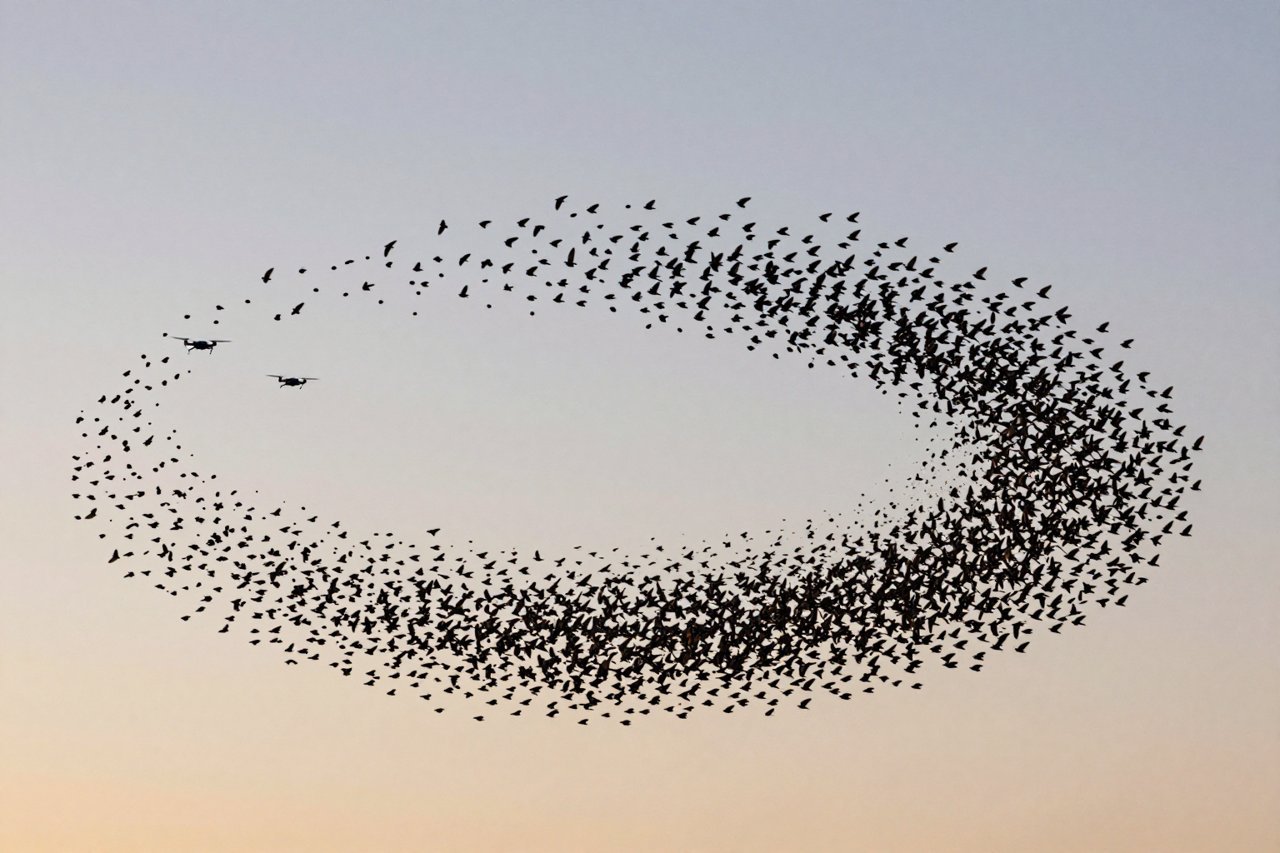
Picture a murmuration of starlings at dusk. Thousands of birds twist and turn as a single fluid shape, never colliding, reacting to each other in milliseconds. No leader gives orders. Each bird follows a few simple rules: stay close, don’t crowd, match your neighbor’s direction. The result is one of nature’s most stunning displays of collective intelligence.
That same principle is now being harnessed in technology under the name Swarm AI. Instead of building one giant, centralized artificial intelligence, researchers and engineers are creating systems where many small, simple AI agents work together. They communicate locally, adapt to changes, and produce emergent behavior that no single agent could achieve alone.
What Exactly Is Swarm AI?
Swarm AI is a decentralized approach to artificial intelligence inspired by social insects, flocking birds, and schools of fish. In a swarm AI system, each agent is relatively simple—maybe a drone with a basic sensor, or a software bot with limited decision-making. But when hundreds or thousands of these agents interact, they can solve problems that are too complex, too dynamic, or too large for a single AI.
The key ingredients are:
- Decentralization: No central controller. Each agent makes its own decisions based on local information.
- Local interactions: Agents only communicate with nearby neighbors, not the entire group.
- Simple rules: Each agent follows a small set of behavioral rules.
- Emergence: Complex, intelligent group behavior arises from these simple interactions.
This is different from traditional AI, which often relies on a single powerful model—like a large language model or a deep neural network—running on a central server. Swarm AI distributes the intelligence across many small parts.
How Swarm AI Works in Practice
You’ve probably already seen swarm AI in action, even if you didn’t know the term. Drone light shows at concerts and Olympics use swarms of hundreds or thousands of drones. Each drone knows its own position and a few basic rules about spacing and timing. Together they create intricate 3D shapes in the sky.
In robotics, researchers use swarm algorithms like Particle Swarm Optimization (PSO) and Ant Colony Optimization (ACO). PSO is used for everything from tuning neural networks to coordinating robot teams. ACO helps find optimal routes in logistics and network routing. The classic “Boids” model, created by Craig Reynolds in 1987, simulates flocking with just three rules: separation, alignment, and cohesion.
What makes swarm AI powerful is its scalability and resilience. If one drone in a light show fails, the others adjust and the shape barely changes. If a robot in a warehouse swarm breaks down, the rest reroute around it. There’s no single point of failure.
Real-World Applications of Swarm AI
Military and Defense
Defense agencies are investing heavily in drone swarms for surveillance, reconnaissance, and even combat. A swarm of cheap drones can overwhelm a single expensive defense system. But this raises serious ethical questions. As we’ve explored before, the idea of having humans in the loop in an AI war is often an illusion—when swarms operate at machine speed, human operators can’t keep up. The technology is advancing faster than the policies to govern it.
Space Exploration
Space agencies and private companies are looking at swarm AI for satellite constellations and asteroid mining. Instead of one large satellite, you launch dozens of small, cheap ones that cooperate. They can monitor Earth’s climate, provide global internet, or explore distant moons. But with thousands of satellites already in orbit and more launching every week, it’s a Wild West in space, with no clear authority managing traffic or collisions. Swarm AI could help satellites avoid each other autonomously, but it also adds more complexity to an already crowded environment.
Agriculture and Environmental Monitoring
Small robot swarms can plant seeds, monitor soil health, and target weeds with precision. They cover large fields faster than a single robot and adapt to uneven terrain. In environmental monitoring, swarms of floating sensors can track ocean currents or detect pollution plumes.
Search and Rescue
After a disaster, a swarm of drones can map rubble, detect body heat, and relay communication signals. They can cover a search area in minutes that would take a human team hours. Each drone doesn’t need to be smart; the swarm is.
Entertainment and Gaming
Video games have long experimented with swarm AI. In real-time strategy games, you command groups of units that move and fight as a collective. Upcoming titles like The Expanse: Osiris Reborn let players control fleets of ships in a decentralized, tactical way. It’s a fun way to experience the feel of swarm coordination, even if the underlying AI is simplified.
Why Swarm AI Matters
The benefits of swarm AI go beyond novelty. Here’s why researchers and companies are excited:
- Resilience: No single point of failure. If one agent dies, the mission continues.
- Scalability: Need more coverage? Add more agents. The system handles it gracefully.
- Cost-effectiveness: Many cheap robots often beat one expensive one.
- Adaptability: Swarms can respond to changing environments in real time.
- Speed: Parallel action means tasks finish faster.
Think about a warehouse. A single robot might take 10 minutes to fetch an item. A swarm of 20 robots can retrieve 20 items in roughly the same time, and if one gets stuck, the others keep working. That’s a massive efficiency gain.
The Challenges and Open Questions
Swarm AI isn’t magic. It comes with real difficulties.
Coordination is hard. Getting 1,000 agents to move together without collisions requires robust communication and algorithms. In the real world, communication can be spotty or delayed. Agents might have conflicting information.
Security is a nightmare. A swarm can be hacked. An attacker could spoof signals, turn agents against each other, or take control. Defending a decentralized system is much harder than defending a central server.
Ethics and accountability. If a swarm of military drones kills civilians, who is responsible? The programmer? The commander? The swarm itself? As noted earlier, human oversight becomes nearly impossible when swarms act faster than we can react. This is a major unresolved issue.
Energy and computation. Each agent needs power and processing. Swarms of thousands can be energy-hungry. Researchers are working on energy-efficient communication and onboard AI chips.
Swarm AI vs. Traditional AI: When to Use Which
Swarm AI and traditional AI aren’t competitors—they’re tools for different jobs. Traditional AI excels at tasks that require deep reasoning, pattern recognition, or language understanding. A single large model can write an essay, diagnose a disease from an image, or translate a language.
Swarm AI shines when the problem is distributed, dynamic, and benefits from many simple actors. If you need to search a large area, monitor a pipeline, or coordinate a fleet of vehicles, swarm AI wins. If you need to understand a complex document or have a conversation, traditional AI is better.
Some researchers are combining them: using a central AI to set high-level goals, and swarm AI to execute them. This hybrid approach could be the best of both worlds.
What’s Next for Swarm AI
We’re still in the early days. Current swarms are fragile and often require careful human supervision. Future systems will need to be more autonomous, self-healing, and capable of operating in unstructured environments like forests, cities, or other planets.
One promising direction is human-swarm interaction. How do you give commands to a swarm without micromanaging? Researchers are testing gestures, voice commands, and even brain-computer interfaces. Imagine a firefighter pointing at a building and a swarm of drones flows inside to map the layout.
Another frontier is swarm learning, where agents share what they learn in real time. A drone that finds a survivor could instantly teach the rest of the swarm where to look. That kind of collective learning could make swarms dramatically more effective.
We may also see swarms at the microscale: tiny robots swimming through blood vessels to deliver drugs or clear blockages. Medical nanobots are still science fiction, but the algorithms are being developed today.
The most interesting part of swarm AI is that it flips our intuition about intelligence. We usually think smarter means bigger, more centralized, more powerful. Swarm AI shows that intelligence can be small, distributed, and emergent. A thousand dumb agents following simple rules can outsmart a single genius. That’s a profound idea, and we’re only beginning to explore what it can do.