

Close Menu
AI News TodayAI News Today

    Subscribe to Updates

    Get the latest creative news from FooBar about art, design and business.

    What's Hot

    Spotify billionaire’s body scan startup has come to America

    Measuring the Creativity Potential of LLM Agents

    The dawn of the age of the exoskeleton

    Facebook X (Twitter) Instagram
    • About Us
    • Contact Us
    Facebook X (Twitter) Instagram Pinterest Vimeo
    AI News TodayAI News Today
    • Home
    • AI News
    • AI Reviews
    • AI Tools
    • AI Tutorials
    • Chatbots
    • Free AI Tools
    • Artificial Intelligence
    AI News TodayAI News Today
    Home»AI News»The dawn of the age of the exoskeleton
    AI News

    The dawn of the age of the exoskeleton

    By No Comments2 Mins Read
    Share Facebook Twitter Pinterest LinkedIn Tumblr Reddit Telegram Email
    The dawn of the age of the exoskeleton
    Share
    Facebook Twitter LinkedIn Pinterest Email

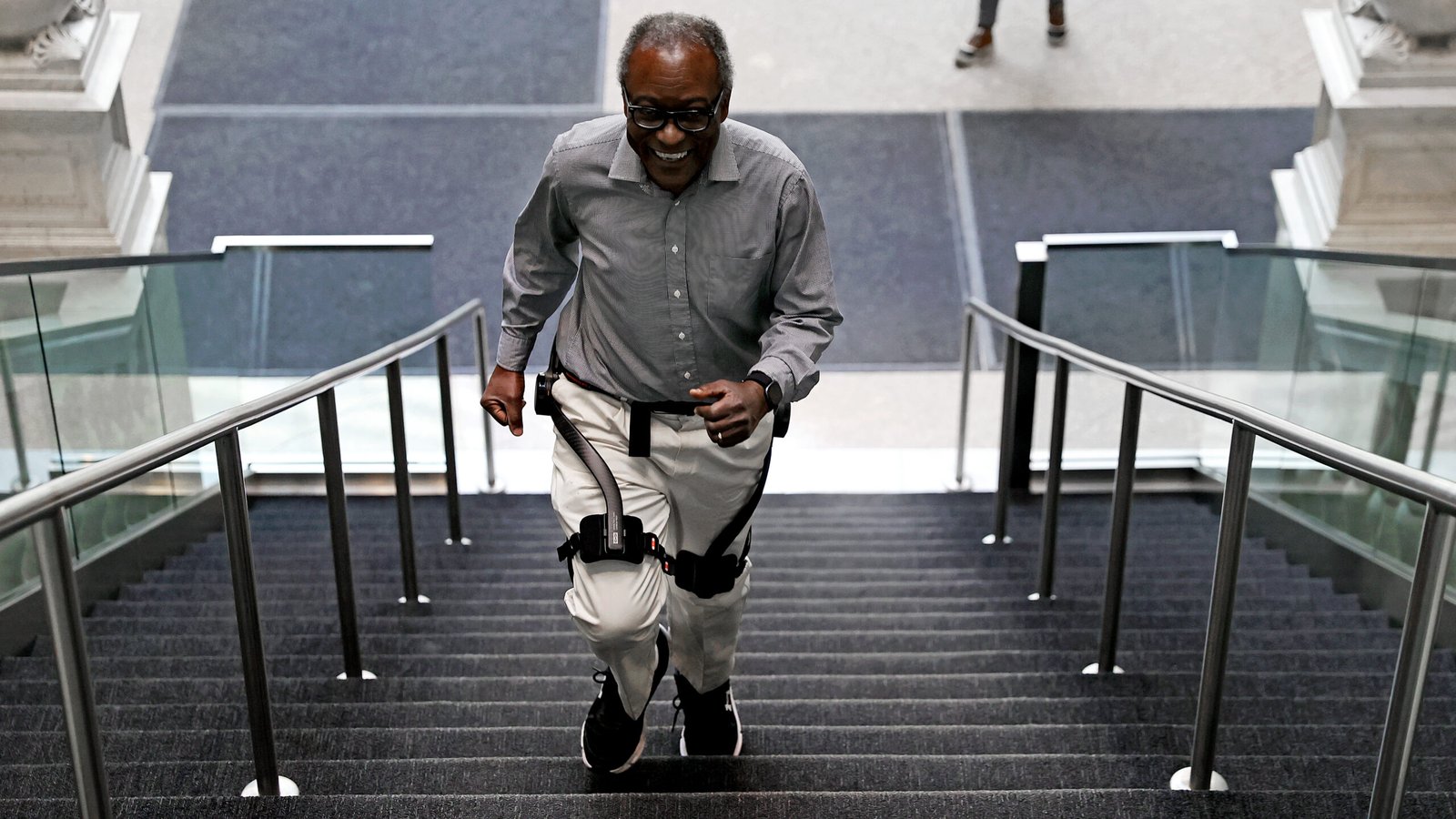
    Control units are normally pre-programmed for specific tasks, though modern exoskeletons are increasingly becoming more adaptive. Some are equipped with algorithms that learn from users’ actual working behaviors to better support their actions.

    However, assistance exoskeletons provide generally falls into three categories.

    Power augmentation increases the force capabilities of the user. This is commonly seen in assistive exoskeletons, like those being used by IKEA and in Ukraine.

    Assist-as-needed or resist-as-needed settings provide support to the body only when necessary. This setting is often used in rehabilitation devices, to help users train their bodies to recover lost capabilities.

    Finally there’s full robotic control, where the exoskeleton assumes complete control over part of the body. This tends to be for users who have lost certain motor functions. For example, a lower-body exoskeleton might use full robotic control to allow someone with spinal cord injury to walk.

    These ways of working can be combined and adapted according to the specific task, environment, and needs of the user.

    What’s next?

    For now, most exoskeletons rely on feedback from sensors to define how they exoskeletons behave; they’re wholly mechanical. But in the future exoskeletons could be operated with signals from the wearer’s muscles or brain. Research is exploring this, but it remains a challenge. Harnessing these signals might require an invasive interface and extensive user-specific calibration and adaptation.

    Power is another current challenge. Batteries have to be integrated into exoskeletons and regularly recharged. This introduces weight and size constraints that affect practicality. The energy density of batteries is steadily improving, however.

    New materials are also pushing the boundaries of what’s possible. Exoskeletons are being developed that are made from soft textile or rubber-like materials that can be integrated into clothing, footwear, or protective equipment.

    Research into walking exoskeletons during the 1960s and 1970s contributed to the development of the first humanoid bipedal robots. This has come full circle. Interest in humanoid robotics is now accelerating the development of actuators and batteries. These will advance the wearable robotic technologies of tomorrow.

    Ildar Farkhatdinov, Senior Lecturer in Healthcare Engineering (Robotics and Mechatronics), King’s College London. This article is republished from The Conversation under a Creative Commons license. Read the original article.

    Age dawn Exoskeleton
    Share. Facebook Twitter Pinterest LinkedIn Tumblr Email
    Previous ArticleHow to Use a PINN for a Navier-Stokes Inverse Problem
    Next Article Measuring the Creativity Potential of LLM Agents
    • Website

    Related Posts

    AI News

    Spotify billionaire’s body scan startup has come to America

    AI News

    Laytr’s new app lets you save anything you find online, not just articles to read

    AI News

    Relay.app AI Is Gone: How to Rebuild Its Human-in-the-Loop Workflows Step by Step

    Add A Comment
    Leave A Reply Cancel Reply

    Top Posts

    Spotify billionaire’s body scan startup has come to America

    0 Views

    Measuring the Creativity Potential of LLM Agents

    0 Views

    The dawn of the age of the exoskeleton

    0 Views
    Stay In Touch
    • Facebook
    • YouTube
    • TikTok
    • WhatsApp
    • Twitter
    • Instagram
    Latest Reviews
    AI Tutorials

    Quantization from the ground up

    AI Tools

    David Sacks is done as AI czar — here’s what he’s doing instead

    AI Reviews

    Judge sides with Anthropic to temporarily block the Pentagon’s ban

    Subscribe to Updates

    Get the latest tech news from FooBar about tech, design and biz.

    Most Popular

    Spotify billionaire’s body scan startup has come to America

    0 Views

    Measuring the Creativity Potential of LLM Agents

    0 Views

    The dawn of the age of the exoskeleton

    0 Views
    Our Picks

    Quantization from the ground up

    David Sacks is done as AI czar — here’s what he’s doing instead

    Judge sides with Anthropic to temporarily block the Pentagon’s ban

    Subscribe to Updates

    Get the latest creative news from FooBar about art, design and business.

    Facebook X (Twitter) Instagram Pinterest
    • About Us
    • Contact Us
    • Terms & Conditions
    • Privacy Policy
    • Disclaimer

    © 2026 ainewstoday.co. All rights reserved. Designed by DD.

    Type above and press Enter to search. Press Esc to cancel.